Chinese scientists find a way to boost rice yields while shortening growth cycle
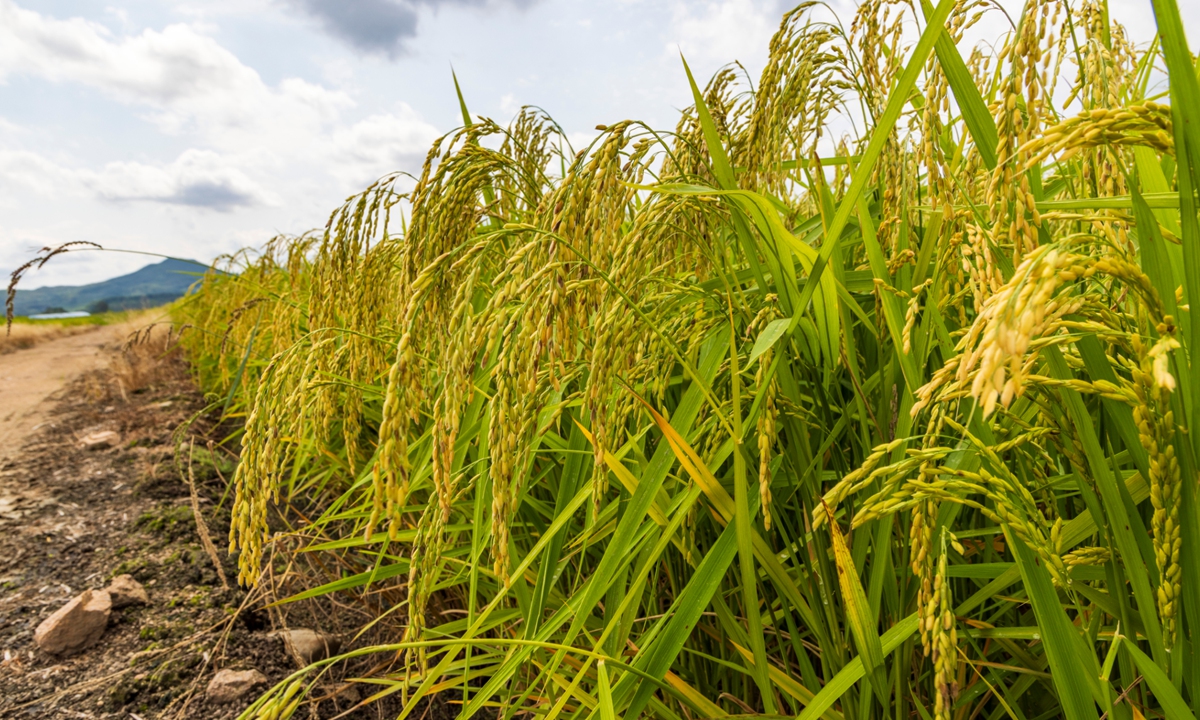
Rice Photo: VCG
A study published online in the journal Science on Friday showed the long-standing challenge in rice breeding - the difficulty of combining early maturity with high yields - could be addressed.
A research team led by Zhang Jian at the China National Rice Research Institute identified and cloned a rare allele, namely TGW1aJZ, that can simultaneously shorten rice's growth duration and increase grain yield. The study found that the gene encodes a florigen-like protein that not only promotes flowering but also responds to nitrogen signals and enhances nitrogen uptake and use.
The finding is particularly relevant to southern China, where farmers often use multiple-cropping systems involving early rice, late rice and oilseed crops.
In parts of southern China, farmers can grow two rice crops in the same year, leaving only a short window to harvest one crop and plant the next. Cutting several days from the rice growth cycle could therefore help farmers fit more crops into the same growing season.
The researchers said the gene could be used in different types of rice, including conventional early-season varieties and hybrid varieties planted later in the year, potentially providing a genetic resource for developing varieties that mature earlier while maintaining or increasing yields.
"We identified the key gene for early maturity and high yield, and developed a series of improved varieties that mature three to eight days earlier while delivering 4 to 11 percent higher yields," Zhang said.
China produced 56.58 billion jin (28.29 million tons) of early rice this year, according to data released by the National Bureau of Statistics (NBS). The output remained above 28 million tons for the sixth consecutive year, although it declined 0.8 percent from 2025.
The country's early rice planting area increased slightly to 71.164 million mu, or about 4.74 million hectares, up 22,000 mu from a year earlier. Average yield stood at 397.6 kilograms per mu, down 0.8 percent year on year.
Wei Fenghua, director of the NBS Rural Department, attributed the decline in yield partly to unfavorable weather during key stages of production. Persistent heavy rainfall in parts of southern China during the heading and flowering period affected pollination and grain setting, while several typhoons during the harvesting period caused waterlogging and lodging in some low-lying fields, affecting grain filling and harvesting.
"The government has continued to support rice growers through policies including subsidies for farmland fertility protection and crop rotation, as well as measures to stabilize expectations for farmers planting early indica rice," Wei was quoted as saying by Beijing-based Science and Technology Daily.
RELATED ARTICLES