China achieves 1st two-way laser communication ‘highway’ between Earth and the moon
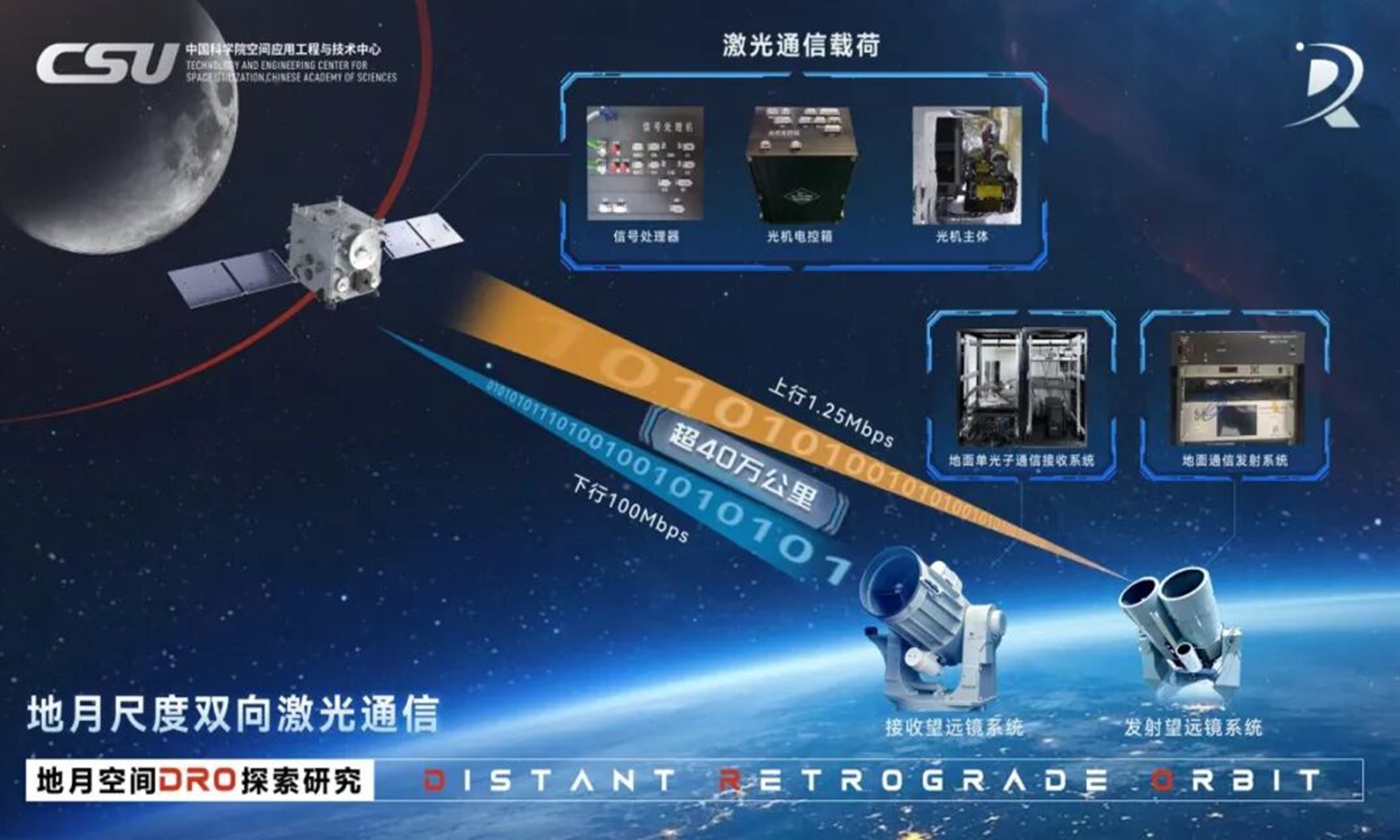
Illustration of Earth-moon scale two-way laser communication Photo: Screenshot from the Science and Technology Daily
China has successfully established a two-way laser link over a distance of more than 400,000 kilometers between Earth and the moon, achieving the country's first two-way high-speed laser communication in cislunar space, facilitating China's crewed lunar landings, the construction of lunar research stations, and deep-space exploration, the Science and Technology Daily reported on Wednesday.
This also marks the advance of China's space laser communication technology from near-Earth orbit into the Earth-moon region, said the report.
The mission, led by the Technology and Engineering Center for Space Utilization of the Chinese Academy of Sciences, was carried out using a satellite operating in a distant retrograde orbit.
Space laser communication transmits information using laser beams with advantages including high bandwidth, high speed, precise direction, and strong security. However, the greater the distance, the greater the technical challenges.
Communicating between Earth and the moon is comparable to precisely directing an extremely fine beam of light through a rapidly moving "pinhole" from 400,000 kilometers away. Even a tiny deviation of angle at the transmitting end can result in an error of several kilometers near the target, the report said.
After accounting for factors such as the satellite's orbit, telescope installation errors, atmospheric refraction, and laser flight time, the research team enabled the orbiting satellite and the ground-based telescope to remain continuously aligned while both were in motion, ensuring the laser beam accurately reached its intended target, according to the report.
Even so, after traveling 400,000 kilometers, the laser signal arriving at the ground is so weak that only a few photons remain. The signals received by the ground telescope are extremely faint, while moonlight, starlight, and city lights introduce significant interference. To overcome this, the team employed ultra-sensitive single-photon detectors and developed a sophisticated signal-recognition algorithm that successfully extracted the valid signals from massive amounts of noise.
As for transmission speed, through technical breakthroughs, the team significantly enhanced data-processing efficiency. The experiment achieved an uplink rate of 1.25 megabits per second (Mbps) and a downlink rate of 100 Mbps, according to the report.
Taking an 8K high-definition image of the lunar surface as an example, a researcher of the center Yang Lei said that downloading it via a traditional 5 Mbps microwave link would take about 4 to 5 minutes. With 100 Mbps laser communication, it takes only about 12 seconds.
"The 'information highway' between Earth and the moon has now been opened. In the future, we will be able to obtain more scientific data of original value," Yang said in the report. The related technologies will also provide new high-speed information transmission capabilities for China's crewed lunar landings, lunar research station construction, and deep-space exploration, according to the researcher.
Global Times
RELATED ARTICLES