ARTS / CULTURE & LEISURE
165-million-year-old katydids provide first evidence of ancient ultrasonic communication
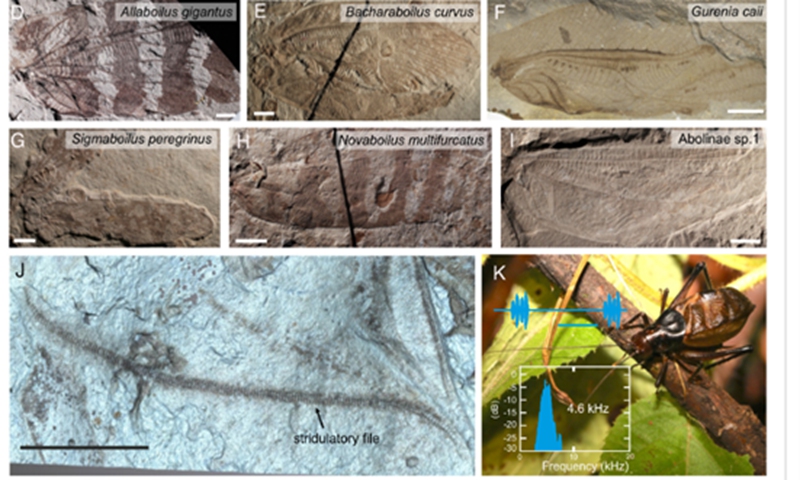
A screenshot of the paper published on the Proceedings of the National Academy of Sciences of the US
Research on Jurassic-era fossil katydids from Ningcheng county, North China's Inner Mongolia Autonomous Region, has provided the first evidence that insects capable of ultrasonic communication existed 165 million years ago, during the Middle Jurassic, a researcher at the Beijing-based Capital Normal University (CNU) told the Global Times on Thursday.
The 12-year-long study not only enriches the understanding of the diversity of sound frequencies produced by ancient katydids and the broader acoustic landscape of the time, but also provides the first evidence that ultrasonic communication in insects had already emerged by the Middle Jurassic, nearly 100 million years before the advent of bat echolocation, offering direct evidence for the co-evolution of acoustic communication among animals, Ren Dong, a professor at CNU's College of Life Sciences, told the Global Times.
The academic community had long believed that ultrasonic communication in insects evolved as an adaptation to predation by bats.
The findings were published online on Wednesday in the US journal Proceedings of the National Academy of Sciences. The research was conducted by the CNU in collaboration with multiple research teams in China and abroad.
"The study allows us to hear insect calls from the Jurassic period across 165 million years, proposes a new theory of two-way acoustic selection between insects and mammals in the Mesozoic Era, and provides a more complete picture of the co-evolution of hearing and sound production in terrestrial animals," said Ren, co-author of the paper.
Researchers selected 20 forewing specimens from nine species of male katydids in the Yanliao Biota of the Daohugou area in Ningcheng county and compared them with a relict katydid group, which is now found only in Southwest China's Sichuan Province. They developed a paleoauditory reconstruction process involving fossil wing morphology, wing resonance simulation, syllable reconstruction and calling-song temporal prediction to reconstruct the full acoustic characteristics of the calls produced by these ancient insects, according to Ren.
The calling frequencies of the nine fossil katydid species ranged from 5 to 20.5 kilohertz (kHz). Five species produced low-frequency pure tones in the 5-7 kHz range, while the remaining four occupied the medium- to high-frequency range of 8-20.5 kHz. The carrier frequency of one fossil species reached as high as 20.5 kHz, confirming that insects capable of true ultrasonic communication already existed during the Middle Jurassic, Ren noted.
Experts also found that the frequency spectra of the calls produced by the nine fossil katydid species were unusually narrow, meaning they were pure tones. Pure tones make it more difficult for predators to locate the source of a sound. Although early Jurassic mammals had already developed some ability to hear high-frequency sounds, the structure of their middle ears made it difficult for them to accurately determine the direction of pure tones.
Therefore, the evolution of pure-tone calling in Jurassic katydids was an anti-predator strategy in response to the pressure of eavesdropping by early mammalian predators, rather than a product of selection driven by ultrasonic sounds produced by bats, according to the new findings.
In 2012, Ren's research team, in collaboration with the University of Bristol, reconstructed for the first time the call of a Middle Jurassic katydid species, Archaboilus musicus, from Daohugou in Inner Mongolia.
RELATED ARTICLES