China-Kyrgyzstan trade hits $11.7b in Jan-July as ‘new three’ exports, e-commerce expand

The Ministry of Commerce of China File photo: VCG
China and Kyrgyzstan have maintained steadily growing economic and trade ties in recent years, with bilateral trade reaching $11.7 billion in the first seven months of this year, according to China's Ministry of Commerce (MOFCOM).
Under the strategic guidance of the two heads of state, China and Kyrgyzstan have maintained a steadily advancing economic and trade partnership in recent years, with bilateral cooperation delivering positive results across trade, investment and infrastructure, Huang Ling, a MOFCOM spokesperson said at a regular press conference on Thursday.
China-Kyrgyzstan economic and trade ties are part of a broader network of bilateral cooperation between China and its neighboring countries, said a Chinese analyst.
China has long been Kyrgyzstan's largest trading partner, Huang said. Exports of China's "new three" products — electric vehicles, lithium-ion batteries and photovoltaic (PV) products — as well as mechanical and electrical goods, rose rapidly during the January-July period. Cooperation in services trade and cross-border e-commerce also continued to expand, according to the spokesperson.
On investment and economic-technical cooperation, Huang said that China has become Kyrgyzstan's largest source of foreign investment. As of the end of July, Chinese direct investment in Kyrgyzstan across all sectors had exceeded $2 billion. Major projects in infrastructure, energy, mining, agriculture and green development are progressing smoothly, she noted.
Huang noted that talks on a China-Kyrgyzstan agreement on services trade and investment have made important progress. The two sides are also actively discussing and promoting trade and investment liberalization and facilitation within the framework of China-Central Asia cooperation and the Shanghai Cooperation Organization (SCO), she said.
"China and Kyrgyzstan have always upheld mutual benefit and win-win cooperation," said the MOFCOM spokesperson, adding that Chinese investment and engineering projects have brought tangible benefits to Kyrgyzstan's economy and public welfare.
She pointed to the Chinese-built oil refinery project in Kyrgyzstan as an important contributor to the country's energy supply security. Projects such as PV power stations, waste-to-energy plants and sewage treatment facilities have also supported Kyrgyzstan's green industrial transformation.
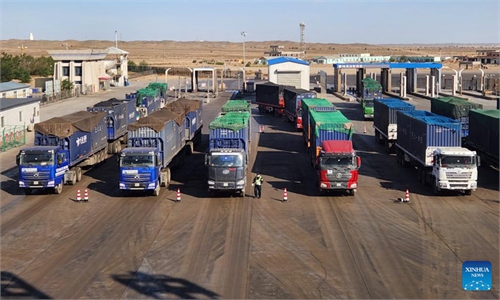
China has built or upgraded more than 10 road projects in Kyrgyzstan, significantly improving local transport infrastructure, travel convenience and cargo transportation, Huang said.
According to the spokesperson, various sectors in Kyrgyzstan have spoken highly of the outcomes of bilateral cooperation, particularly its role in improving livelihoods, creating jobs and increasing tax revenues.
The MOFCOM said that China is willing to work with the Kyrgyzstan side to jointly implement the important consensus reached by the two heads of state and continuously promote the high-quality development of China-Kyrgyzstan economic and trade cooperation.
The SCO Summit 2026 will be held in Bishkek, the capital city of Kyrgyzstan, from August 31 to September 1, 2026. The SCO plays an important role in enhancing good-neighborliness, friendship, unity and mutual trust among regional countries, safeguarding regional security and stability, and promoting regional prosperity and development, according to the Xinhua News Agency.
From a regional perspective, China-Kyrgyzstan cooperation offers key lessons for other SCO member states: first, the value of complementary cooperation; second, the importance of connectivity as a priority; and third, the effectiveness of multilateral cooperation mechanisms, Hu Qimu, a professor at the Maritime Silk Road Institute of Huaqiao University, told the Global Times on Thursday.
Hu noted that China-Kyrgyzstan cooperation offers a model for wider regional collaboration in areas such as connectivity, green development, digital trade and industrial coordination.
"China has advantages in technology, industrial capacity, and market access, while Kyrgyzstan and other SCO member states can offer geographic connectivity and resource advantages. Together, both sides could strengthen cooperation in industrial supply chains, green development, digital economy, and agricultural processing," Hu noted.
According to the expert, stronger connectivity has led to expanded economic ties. For instance, China, Kyrgyzstan, and Uzbekistan are working on the construction of a major cross-border project — the China-Kyrgyzstan-Uzbekistan railway — which will expedite shipments, reduce transportation costs, and make trade flows among the three countries more efficient and convenient.
In 2025, merchandise trade between China and Kyrgyzstan reached $27.2 billion, up 20 percent year-on-year, according to Xinhua.
The future of bilateral economic ties lies not only in expanding trade volume but also in upgrading the trade structure and strengthening industrial collaboration, Hu said.
Over the next three to five years, under the SCO framework, the two sides are expected to see sustained trade growth with a more optimized structure, major breakthroughs in cross-border infrastructure and customs clearance, and stronger regional industrial projects in areas such as new energy, the digital economy, agricultural processing, and regional logistics hubs.
RELATED ARTICLES