Construction of second China-Mongolia cross-border railway passes 50% mark, on track for 2027 completion
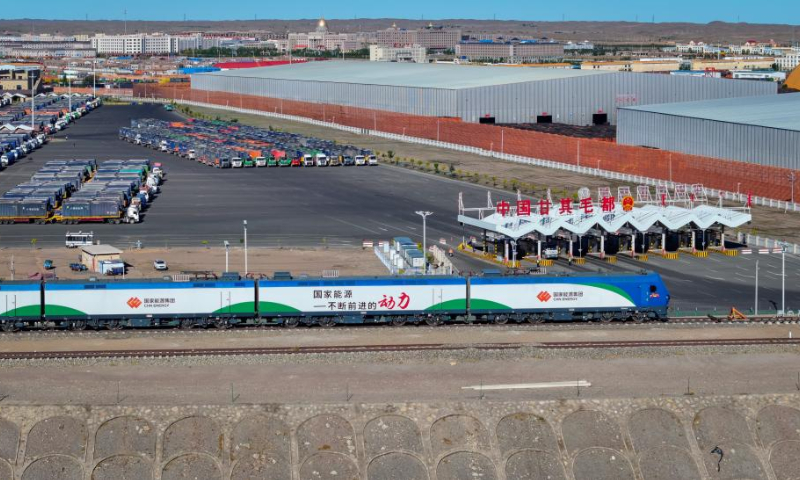
An opening ceremony is held for the second cross-border railway linking Ganqimaodu port in North China's Inner Mongolia Autonomous Region and Mongolia's Gashuunsukhait in Ganqimaodu on May 14, 2025. Photo: Xinhua
The construction of the second cross-border railway between China and Mongolia - the Ganqimaodu-Gashuunsukhait railway - has passed the halfway mark, with all 321 bridge piers completed on Friday. The railway is scheduled to complete and start operations in 2027, and is expected to handle 30 million tons of cargo transportation annually, according to media reports.
On Friday, 701 of the 760 precast T‑beams required for the entire line have been prefabricated, and 390 have already been installed. The remaining girders are expected to be fully placed by October 2026, keeping the overall timeline firmly on track for a 2027 completion, according to a report by CCTV News.
The railway runs from Ganqimaodu Port in Bayannur, North China's Inner Mongolia Autonomous Region, crosses the border via Mongolia's Gashuunsukhait Port, and connects to Gashuunsukhait Station in Mongolia's South Gobi Province. The line officially started construction in May 2025.
It is the second cross-border rail link between China and Mongolia, following the Erenhot-Zamyn-Uud railway that opened in 1956 - a gap of nearly 70 years, according to official statistics.
The total length of the Ganqimaodu-Gashuunsukhait railway is 9.91 kilometers, of which the cross-border bridge section accounts for 6.08 kilometers. The entire line features 321 piers and requires the installation of 760 precast T-beams. It is expected that all beam erection work will be completed by October, with the line planned to open to traffic in 2027.
Once completed, the project is expected to handle 30 million tons of cargo transportation annually, effectively connecting China's Ganquan Railway - linking the railway's start point Ganqimaodu and Baotou, the city to its south - with Mongolia's southward rail network. The transportation infrastructure is expected to further expand trade scale between the two countries in related fields and promote infrastructure connectivity and economic and trade exchanges along the route.
Global Times
RELATED ARTICLES