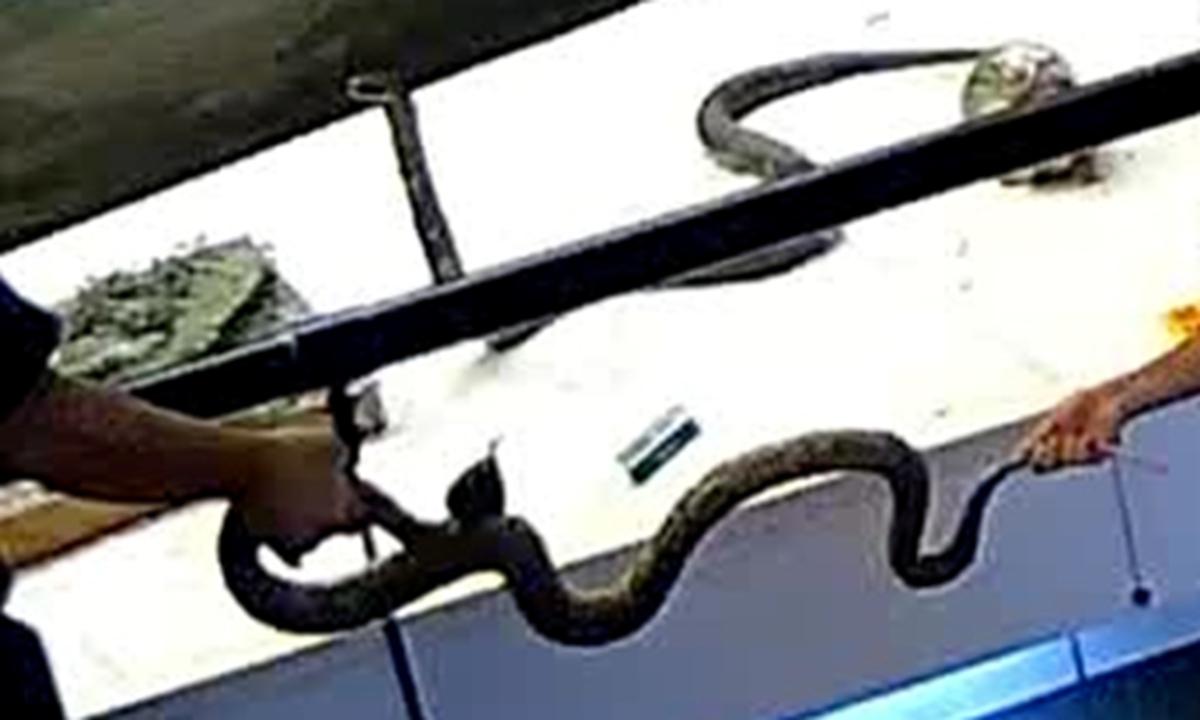
Surveillance footage shows a parent picking up a Mangshan pit viper specimen and handing it to a child. (Identifying information has been removed to protect the minor's privacy; only the hands, feet and specimen are visible.) Photo: Courtesy of the National Zoological Museum of China
Surveillance images from the National Zoological Museum of China have sparked online outrage after two children were seen grabbing and kicking endangered animal specimens, while their father picked up the specimens and handed them to the children to play with. The museum said on Saturday that one specimen was damaged, with the incident later trending on Chinese social media and garnering more than 10 million views as of press time.
When the incident occurred, museum staff monitoring the security footage immediately alerted security personnel, who approached the family. The parent initially denied touching the specimens. Only after a security guard reminded the parent to "wash your hands immediately if you touched the specimens" did the parent go to the restroom and wash their hands for two minutes.
In surveillance footage released by the museum, one of the children can be seen taking off a shoe and hitting a specimen.
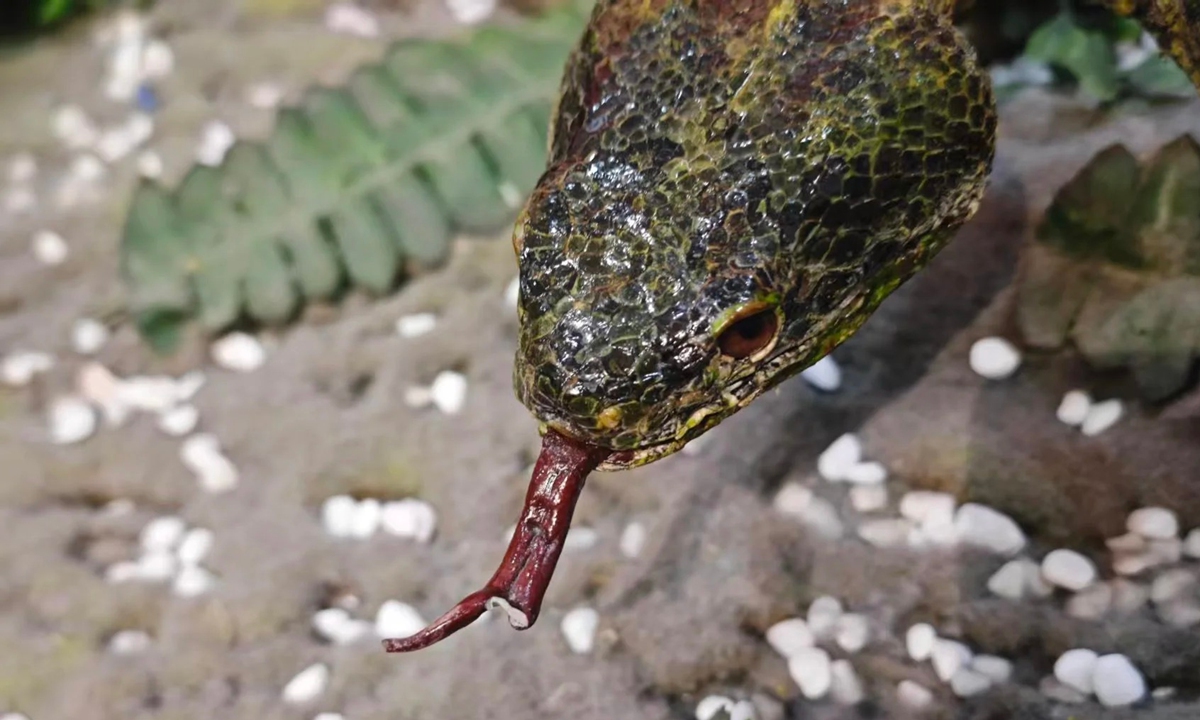
The damaged specimen was a Mangshan pit viper (Protobothrops mangshanensis), also known as the Mangshan iron-head snake. Photo: Courtesy of the National Zoological Museum of China
The damaged specimen was a Mangshan pit viper (Protobothrops mangshanensis), also known as the Mangshan iron-head snake. Endemic to China, the species is a national first-class protected wild animal, and its wild population is considered critically endangered.
The Mangshan pit viper specimen was severely damaged after the parent picked it up to play with the child, causing part of the specimen's tongue to break off and its abdomen to split open.
According to the museum, the specimen was donated by Chen Yuanhui, who was bitten by snakes nine times while researching and protecting the endangered species, leaving his middle finger permanently disabled.

The specimen was donated by Chen Yuanhui, who was bitten by snakes nine times while researching and protecting the endangered species, leaving his middle finger permanently disabled. Photo: Courtesy of the National Zoological Museum of China
The damaged specimen has since been repaired by professionals. The museum said its monitoring center had preserved the complete, uninterrupted surveillance footage of the incident and reserved the right to pursue legal action against those involved.
The National Zoological Museum of China strongly condemned the conduct, calling it a "typical and egregious case of uncivilized behavior at a museum." The museum stressed that adults should guide children to respect and protect exhibits, rather than joining in or allowing them to damage them.
The museum also emphasized its "do not touch" rule is intended not only to protect exhibits but also to ensure the safety of visitors. Animal specimens are not ordinary models or toys, but professional materials with scientific research, collection and educational value. The incident has also prompted public discussion about parents' responsibility to educate and set an example for children in public places.
Many netizens criticized the father for failing to stop the children and even joining in the behavior, saying that a child's young age should not excuse touching or kicking exhibits and that adults should intervene when children behave inappropriately.
The public criticism echoes the museum's call for parents to teach children to respect exhibits and nature. The National Zoological Museum of China called for "respect for life and awe of nature" to be an important lesson for children visiting museums.
Similar incidents have repeatedly occurred in museums in recent years, including visitors climbing over barriers, touching exhibits, littering, and running or playing inside exhibition spaces. Such behavior by "problem children" is often enabled by parents who fail to discipline or supervise them. This raises a question: beyond simply asking visitors to stop such conduct, what more can be done to curb it?
China's Museum Regulation stipulates that members of the public should take care of museum exhibits, facilities, and the surrounding environment and must not damage them. In practice, many museums state in their visitor guidelines that they have the right to warn against and stop behavior that threatens historic buildings, cultural relics, visitor safety, or the order of the venue. Suspected violations of the law may be referred to the police. A growing number of museums have also introduced lists of "uncivilized visitors," with those placed on such lists barred from visiting for a specified period, according to The Paper.
At the legal level, touching or damaging specimens in a way that causes harm to exhibits may also carry legal consequences. For example, seriously disrupting order in public places such as museums may violate China's Law on Penalties for Administration of Public Security, potentially resulting in a warning or a fine of up to 500 yuan (about $69). In more serious cases, offenders may face five to 10 days of detention and a fine of up to 1,000 yuan.
If a specimen is identified as a cultural relic or is of sufficiently high value, the act could also constitute the crime of intentionally damaging cultural relics under China's criminal law. In serious cases, offenders may face three to 10 years in prison as well as a fine, according to The Paper.
Under China's laws and regulations, when a person with no or limited capacity for civil conduct causes harm to another person or to property, the guardian is generally responsible for the resulting civil liability. In other words, the fact that the person who damages an exhibit is a minor does not mean there are no consequences. Museums may seek compensation from the child's guardian for related costs, including expenses incurred in restoring or repairing damaged exhibits.