‘In Europe, For Europe’ strategy highlighted as more Chinese companies report strong half-year sales in Europe
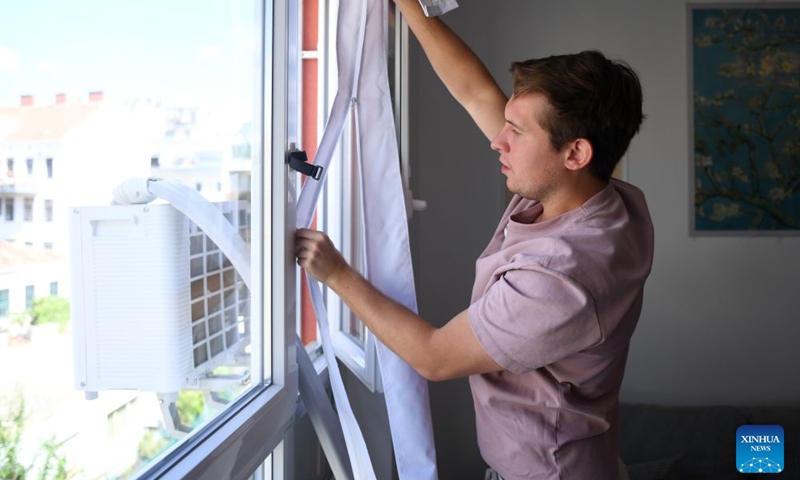
Denis Yurchak shows how to install a Midea Portasplit mobile split air conditioner at his apartment in Vienna, Austria, July 4, 2026. For Austrian resident Denis Yurchak, the search for an air conditioner to survive this year's scorching summer felt like embarking on an adventure.
Chinese electric appliance manufacturer Midea achieved impressive growth in both revenue and profit in the first half of this year, according to its newly released fiscal report, with its air conditioners witnessing outstanding sales in Europe.
Separately, a Chinese construction machinery manufacturer reported a robust overseas performance, with an increasing footprint across Europe.
As more Chinese companies post rising sales and forge closer ties with local partners in Europe, the trend highlights the growing strength of Chinese enterprises and their strong commitment to the "In Europe, For Europe" strategy, a Chinese expert said.
Midea reported operating revenue of 261.05 billion yuan ($38.81 billion) in the first half of this year, a year‑on‑year increase of 3.5 percent, and net profit attributable to shareholders of 26.45 billion yuan, up 1.7 percent, according to the fiscal report it sent to the Global Times on Sunday.
Midea Group's revenue growth was mainly driven by growth in overseas markets. Its overseas markets contributed 113.13 billion yuan, a year on year increase of 5.5 percent, compared with an increase of 1.9 percent for the Chinese mainland market.
Sales and revenue of the PortaSplit portable split air conditioner, a customized product meticulously developed to meet the specific needs of the European market, surged by more than 200 percent year‑on‑year in the first half of 2026, becoming a phenomenal hit in Europe and successfully breaking through to the broader consumer market.
On Thursday, Zoomlion reported first-half operating revenue of 27.14 billion yuan, up 9.17 percent year-on-year, with both domestic and overseas businesses posting gains. Overseas revenue surged 12.45 percent to 15.54 billion yuan.
The company said that as of end-June, it had nearly 7,000 local employees overseas. Its smart manufacturing facility in Hungary was completed and put into operation, while its German plant was expanded and upgraded.
Chinese companies have become more competitive globally after years of deep-rooted presence overseas. In Europe, as long as they pinpoint market needs and stay localized, they can perform well even when the business environment gets challenging, Cui Hongjian, a professor at the Academy of Regional and Global Governance at Beijing Foreign Studies University, told the Global Times on Sunday.
With the strategy of "In Europe and For Europe," Chinese enterprises in Europe are creating jobs and generating tax revenue for local communities, facts that speak for themselves, Cui said.
"Rejecting Chinese investment would come at a high cost: not just the capital, but the welfare, jobs, and social stability that come with it," Cui added.
Midea also said that the success of the PortaSplit, co-developed by Chinese and European teams, reflects Midea's "local for local" strategy.
By deeply understanding regional climates, building codes, infrastructure, and living habits, Midea has built a closed-loop system for research and development (R&D), design, and sales in target markets, delivering tailored products that truly resonate with local users, the company said.
A report jointly released by the China Chamber of Commerce to the EU, China Economic Information Service Shanghai headquarters and the Xinhua News Agency Europe regional bureau in March showed that despite challenges such as tightening EU policies and an increasingly complex business environment, Chinese companies in Europe's emerging industries generally remained optimistic about the European market and planned to continue scaling up their investments.
The report noted that in recent years, Chinese companies in Europe have been accelerating the implementation of their "In Europe, For Europe" localization strategy, becoming increasingly integrated into local industrial and supply chains through job creation, the introduction of advanced technologies, and deeper industrial collaboration.
China and the EU are each other's second-largest trading partners, with bilateral trade reaching $828.1 billion in 2025, up 5.4 percent year-on-year. As of the end of 2025, the stock of two-way investment between China and the EU had exceeded $280 billion.
On April 10, Sany Crane and Putzmeister signed a local manufacturing co-operation agreement to make all-terrain cranes in Aichtal, Germany. The two parties will integrate local manufacturing resources and supply chain advantages in Europe to upgrade Putzmeister's existing crane assembly line in Eichstätt.
Local production began in May this year, and in the longer term, Sany Crane also plans to build a new crane plant in Europe with an annual capacity of 200 units, which will bring its local supply capabilities to a new level, Sany told the Global Times.
Europe is one of Sany's most important overseas markets. Sany will establish localized R&D, production, and service teams to support the region's electrification and intelligentization efforts, Zhou Hequn, who is responsible for Sany's Germany business, told the Global Times on Sunday.
RELATED ARTICLES