ARTS / CULTURE & LEISURE
Rare 2,000-year-old four-horse chariot carving found in China’s Helan Mountains, first of its kind
By Published: Aug 30, 2026 11:00 PM

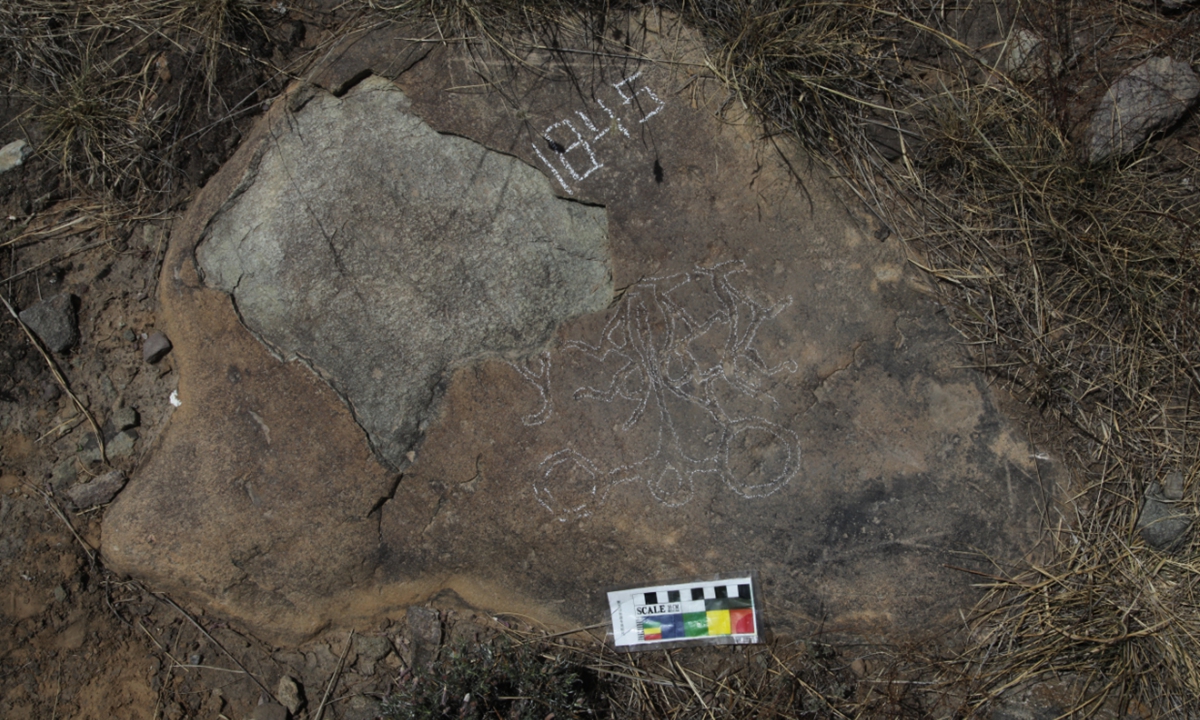
Photo: Helan Mountains rock art management office
A rare four-horse chariot rock carving has been discovered in the Helan Mountains of Northwest China's Ningxia Hui Autonomous Region, marking the first finding of its kind in the local area and filling a long-standing archaeological gap, according to a press release that the local rock art management office sent to the Global Times on Sunday."Extremely uncommon across national rock art relics, the discovery offers new evidence for studying ancient nomadic civilizations and cross-regional cultural exchanges along northern China's grassland routes," Zhang Jianguo, deputy director of the Helan Mountains rock art management office, told the Global Times on Sunday.
The carving, measuring 24 by 20 centimeters with lines about 1.5 millimeters deep, was found on a partially buried boulder in an alluvial fan area. Surrounded by thick grass, only about 15 centimeters of the rock was exposed above ground, making it extremely difficult to spot, the management office noted.
Fewer than 20 chariot-themed petroglyphs have been recorded across the Helan Mountains, and all previously discovered examples were of two-horse chariots. Previously, four-horse chariot images had only been found in Central Asia, Mongolia, southern Siberia, and China's Xinjiang and Inner Mongolia regions.
Zhang noted that, based on the carving technique and composition used, the petroglyph likely dates to around the Western Zhou Dynasty (1046BC-771BC).
"The use of a pecking method with marks suggesting a bronze tool indicates a relatively late date," Zhang said. "The four-horse chariot form was common starting from the early Western Zhou and flourished during the Spring and Autumn period."
Zhang noted that while Helan Mountains rock art has traditionally been dated from 3,000 to 10,000 years ago, the new find suggests some carvings may have been produced as late as 2,000 years ago.
The discovery provides important clues about transport and cultural exchanges along the northern steppe corridor, Zhang added. Similar chariot motifs appear in Xinjiang, Inner Mongolia, and across Central Asia, pointing to possible links with ancient population movements.
Zhang also drew attention to the Yaoheyuan site in today's Pengyang county in Ningxia, identified as the westernmost vassal state of the Western Zhou Dynasty, about 300 kilometers from the Helan Mountains.
"The chariot image could help explore connections between the two," he said, adding that the two sites might jointly testify to the westward spread of Western Zhou ritual culture across Northwest China.
On protection, Zhang said the discovery was part of a broader re-survey of the Helankou rock art area, the first in nearly 20 years, which has so far identified about 400 new petroglyphs.
"We have built a digital archive and will include this new find in the protection system," he noted.
The Helan Mountains rock art protection zone, located in the middle section of the eastern Helan Mountains, contains nearly 6,000 petroglyphs, including more than 700 human face images. The carvings record scenes of hunting, herding, and ritual, offering a window into the lives of ancient peoples.
The management office has cooperated with institutions including the Nanjing Museum, Lanzhou University, and Fudan University on preservation research and digital documentation, assigning each petroglyph a digital "identity card." The newly discovered four-horse chariot image will now join that system, providing solid evidence for studying the cultural connotations of Helan rock art and the broader history of human development, according to the press release.
RELATED ARTICLES