Construction of China-Kyrgyzstan-Uzbekistan railway advances steadily; flagship project set to bring new development opportunities
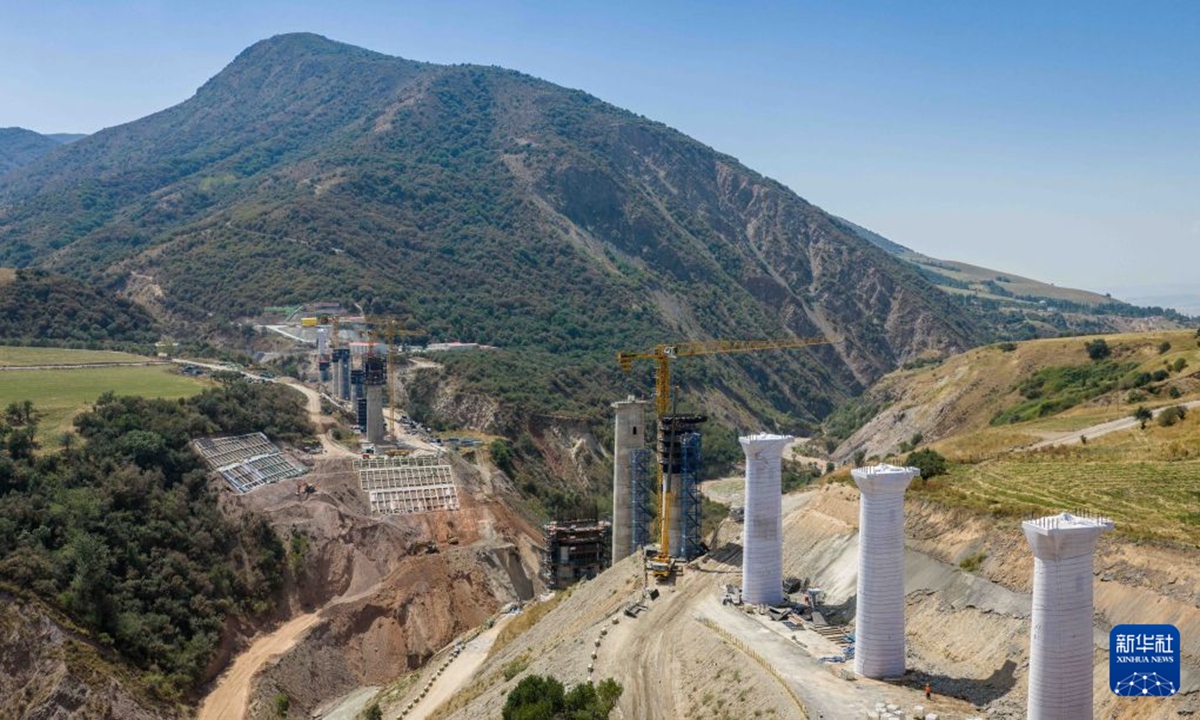
An aerial drone photo taken on August 15, 2026 shows a construction site of a grand bridge above the Kec-Alat River along the China-Kyrgyzstan-Uzbekistan railway in Jalalabad, Kyrgyzstan. Photo: Xinhua
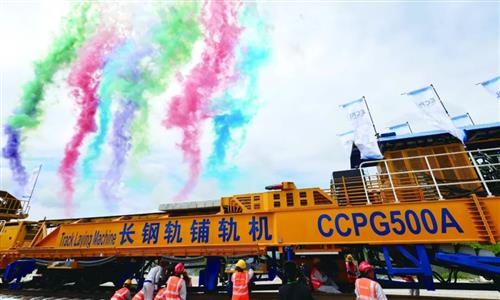
As a flagship project of cooperation within the Belt and Road Initiative (BRI) and a strategic connectivity initiative between China and Central Asia, the China-Kyrgyzstan-Uzbekistan (CKU) railway has advanced steadily since full-scale construction began on the Kyrgyz section in June 2025, according to China Railway International Co Ltd, a subsidiary of China State Railway Group.
To date, all temporary access roads and power supply facilities along the Kyrgyz section have been completed and put into operation; of the 29 new tunnels, 26 are underway with one already holed through; of the 50 bridges, 40 have broken ground; and of the 107 subgrade sections, 83 have commenced work, it said.
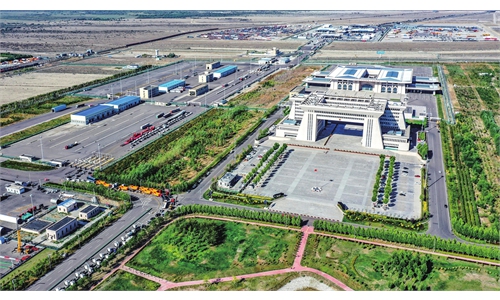
The route begins in Kashgar, in Northwest China's Xinjiang Uygur Autonomous Region, and passes through the mountainous terrain of Kyrgyzstan to reach Uzbekistan.
China is responsible for the construction of the section within China, Uzbekistan is responsible for the upgrading and reconstruction of the section within its territory, while the China-Kyrgyzstan-Uzbekistan Railway Company, a joint venture established by enterprises authorized by the three governments, is responsible for the financing, construction and operation of the section within Kyrgyzstan. On the Chinese side, China Railway International Co Ltd is taking the lead in executing the project.
The Kyrgyzstan section of the CKU railway runs 304.84 kilometers (km). It's a single-track line using diesel locomotives (with provisions for future electrification), designed for a speed of 120 km/h. There will be 20 stations along the line, including Torugart station, Markmal transshipment station and Jalalabad station. In general, the terrain slopes downwards from east to west and is characterized by significant elevation changes. The construction area is characterized by extremely harsh natural and climatic conditions, including high altitudes and low temperatures, strong winds, aridity, and challenging meteorological conditions, as well as complex engineering and geological conditions and hazardous geological processes, such as high seismicity, high geostress, and permafrost soils.
"Despite various difficulties, the project is still moving forward smoothly. As an old Chinese saying goes, 'When people are determined, they can overcome anything,'" Arslanbek Kasymaliev, a deputy general manager of China-Kyrgyzstan-Uzbekistan Railway Company, told the Global Times.
"This is, first and foremost, thanks to the political will of the leaders of the three countries - their initiative and strong support - and it would not be possible without the tremendous efforts of a wide range of professionals. Today, we are here as a strong international team advancing this project, with engineers, designers, lawyers, financial experts and professionals from various fields from China, Kyrgyzstan and Uzbekistan," Kasymaliev said.
Central Asia is home to towering mountains, fertile valleys, azure lakes and winding rivers - but has no access to the sea. As a vital corridor of the ancient Silk Road, the region's development has long been constrained by its geography, Zhang Hong, a research fellow at the Institute of Russian, Eastern European and Central Asian Studies at the Chinese Academy of Social Sciences, told the Global Times.
However, with rising Chinese investment in Kyrgyzstan, flagship BRI projects like the CKU railway are bringing real gains to Bishkek: strengthening regional connectivity, creating jobs and driving infrastructure and industrial upgrading once the project enters service, Zhang said.
According to China State Railway Group Co Ltd, as construction accelerates across the board, the CKU railway project has effectively driven the vigorous growth of Kyrgyzstan's upstream and downstream industrial chains in building materials, engineering machinery and transport services, continuously unlocking local dividends in employment, income growth and industrial upgrading. To date, the project has procured supplies and leased equipment locally for a cumulative value of about 770 million yuan ($114.47 million).
In addition, while expanding local hiring, the project has also prioritized skills empowerment. Relying on three specialized railway vocational training bases, it runs regular hands-on teaching and technical drills, having trained more than 1,800 local employees in total. Currently, over 2,000 Kyrgyz citizens are working on the project and in supporting service roles, achieving nearby employment and stable income growth.
"For Kyrgyzstan, this is a vital opportunity to further consolidate its transport and logistics position and open up new prospects for economic development," Kasymaliev said.
"As for us personally, although we cannot yet see the full picture of this railway today, our children and grandchildren will enjoy everything we are building now. When my family and friends ask me what I am doing, I tell them: I am building a railway - a railway that not only connects three countries, but connects an entire generation to new development opportunities," he said.
RELATED ARTICLES