Baidu dual-primary listing draws attention, expected to expand investor base and funding access
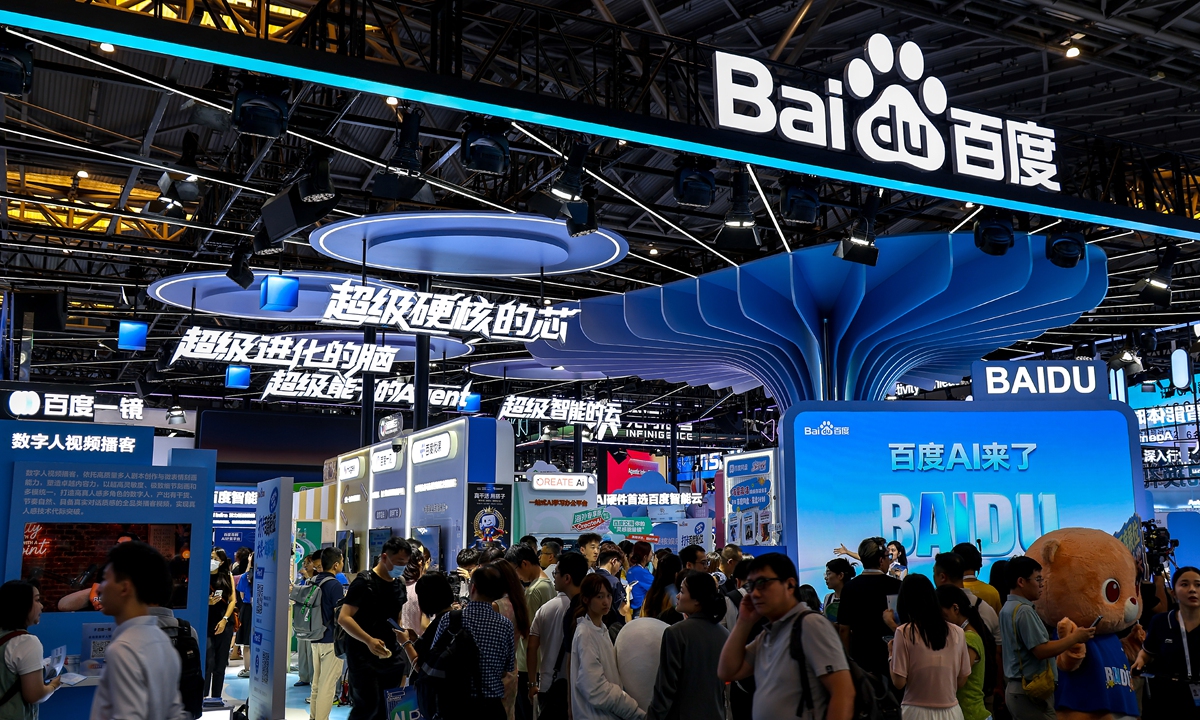
A corner of the Baidu booth at the 2026 World AI Conference held in Shanghai on July 29, 2026 Photo: VCG
Baidu's dual-primary listing in Hong Kong and on NASDAQ will take effect on Tuesday, a move that Chinese experts said could broaden its investor base and enhance capital-market flexibility, while extending the trend of major US-listed Chinese firms strengthening Hong Kong as a capital-market hub and creating more room for the market to reassess the value of Baidu's artificial intelligence (AI) assets.
The prospect of Baidu gaining greater access to Chinese mainland investors has drawn particular attention from industry observers. Dual-primary status makes the company eligible for Stock Connect, which would allow mainland investors to trade its Hong Kong shares in yuan and potentially bring fresh southbound capital.
Baidu previously announced that its voluntary conversion of its secondary listing status to primary listing on the Main Board of the Hong Kong Stock Exchange (HKEX) will become effective on Tuesday. Upon the effective date, Baidu will become a dual-primary listed company on the HKEX and the NASDAQ Global Select Market.
Baidu Chief Financial Officer He Haijian said that the dual-primary listing will broaden the company's investor base and improve its share liquidity, while marking an important milestone as Baidu's AI strategy enters a period of returns, according to the Xinhua News Agency. The company is also preparing to seek inclusion in the Stock Connect program as soon as possible after the conversion is completed, He Haijian said.
Baidu listed on NASDAQ in 2005 and returned to Hong Kong in March 2021 through a secondary listing.
Hong Kong is becoming an increasingly important platform for the return of US-listed Chinese companies, with its transparent institutional framework, deep international investor base and access to mainland capital giving it a distinct advantage, Liang Haiming, dean of the Hainan University Belt and Road Research Institute, told the Global Times.
Liang said that Hong Kong connects Chinese companies with capital across the Asia-Pacific and global markets while offering greater financing flexibility between Hong Kong and the US. Stock Connect further broadens access to mainland investors, who are more familiar with China's technology ecosystem and may be better-placed to assess the long-term value of businesses such as Baidu's AI cloud, homegrown chips and autonomous-driving operations, Liang said.
Baidu's move follows a similar conversion by NetEase, which became dual-primary listed on the HKEX on June 30.
Hong Kong's capital market is adjusting its listing framework to accommodate a broader pool of returning Chinese companies.
According to the Securities Times, the HKEX recently implemented new listing rules that lower market-capitalization thresholds, broaden the use of accounting standards and streamline listing procedures, reducing the cost and time for high-quality overseas-listed companies to seek a Hong Kong listing and facilitating the return of US-listed Chinese firms.
The new rules have significantly lowered the financial thresholds for overseas issuers seeking a secondary listing in Hong Kong, the report said.
The lower threshold for secondary listings by US-listed Chinese and other overseas companies should not be seen as simply easing standards, but as extending a channel once geared toward large unicorns to mid-sized growth companies, which could draw more Chinese firms back to Hong Kong, Chinese experts said.
Hong Kong's close integration with the Chinese mainland also gives it access to a deep capital pool, strong technology investment demand and a more supportive growth outlook, further strengthening its appeal to returning Chinese companies, Liang said.
RELATED ARTICLES