ARTS / FILM
China’s summer movie season closes with $1.85 billion at box office, record screenings

Photo: Promotion poster for Niu Lai
China's 2026 summer movie season closed with box office revenue of 12.498 billion yuan ($1.85 billion), up 4.45 percent year-on-year, while cinema attendance reached 340 million, an increase of 5.86 percent. The season, which ran from June 1 to August 31, saw 38.51 million screenings, a record high, according to the China Film Administration.Against this backdrop, the official account of the Chinese animated film Niu Lai said on Tuesday that the film's domestic screening authorization has been extended until October 4 and that overseas release plans have been confirmed.
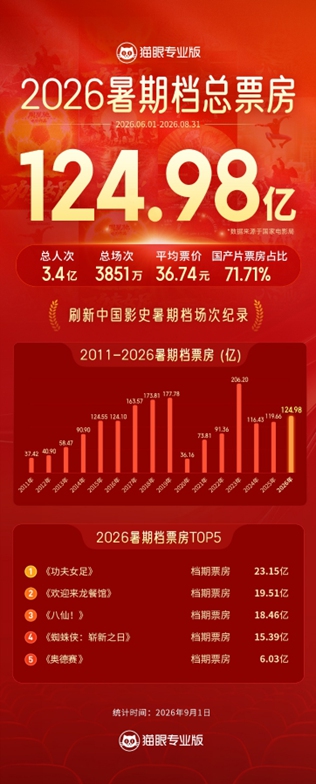
China's 2026 summer movie season closed with box office revenue of 12.498 billion yuan ($1.75 billion) Photo: Courtesy of the Maoyan Research Institute
China's domestic production continued to dominate the market, accounting for 71.71 percent of the total summer box office. According to CCTV News, the top three films were all Chinese productions: Kung Fu Soccer with 2.315 billion yuan, Once Upon a Time in the Middle East with 1.951 billion yuan, and All Wishes Come True! with 1.846 billion yuan. Hollywood releases Spider-Man: Brand New Day and The Odyssey ranked fourth and fifth, respectively.
Beyond the headline figures, the audience itself is changing. This year, male viewers accounted for 43.8 percent of the audience, up 3.6 percentage points from 40.2 percent last year. Industry insiders attributed the increase to the popularity of action and war films, saying the overall gender split among moviegoers has become more balanced. Viewers aged 35 and above accounted for 26.2 percent, up 3.5 percentage points year-on-year, while the core 25-34 age group remained in the largest segment at 41.9 percent. The figures suggest that films are attracting more mature and family audiences, according to China News Service.
At the same time, moviegoers' choices are becoming increasingly diverse. The Maoyan Research Institute told the Global Times on Tuesday that factors such as IP recognition, word of mouth, buzz and curiosity can all influence ticket purchases, with "strong word of mouth but limited reach" emerging as a new feature of the market.
This year's top-grossing film during the summer movie season was the first box-office leader in five years to fall short of 3 billion yuan, while the share of solo moviegoers rose for a fourth consecutive year, suggesting that audience preferences are becoming increasingly segmented, according to the Maoyan Research Institute.
Another notable trend was the continued importance of IP. Maoyan found that all of the top 10 new releases during the summer season had some form of established IP or audience recognition, ranging from established film franchises and literary or cultural properties to recognizable directors, actors and emerging online IPs.
Yet having an established IP is not enough to guarantee box-office success. Maoyan Entertainment market analyst Lai Li told the Global Times that as China's film market continues to evolve, industry players and audiences need to better align their expectations and pace.
"During the first half of this year's summer movie season, overall momentum was relatively weak, but the market gained strength in the second half, with both box office revenue and cinema attendance steadily recovering. Films across a diverse range of genres attracted audiences back to theaters with distinctive selling points," Lai said.
"These positive developments further demonstrate that the stable development of the market ultimately depends on quality content. This is both a source of confidence in the continued growth of China's film market and a reflection of its resilience," he said.
Chen Jin, a data analyst at Beacon Professional Edition, told the Global Times on Tuesday that IMAX box office revenue during this year's summer movie season reached 745 million yuan, up 40 percent year-on-year.
"Among them, The Odyssey alone generated 328 million yuan in IMAX box office revenue, while Spider-Man earned nearly 200 million yuan in the format," he said. "The figures show that audiences are increasingly willing to pay for premium audiovisual experiences."
"When the content is strong enough and the technology is advanced enough, audiences are willing to pay higher ticket prices and choose better-equipped theaters. This is also why box office revenue from premium formats has surged even as average ticket prices overall have declined this year," Chen said.
According to Chen, overall, this year's summer movie season achieved growth in both box office revenue and cinema attendance. The audience profile continued to improve, market distribution became more balanced, and film content saw multiple breakthroughs, providing stronger confidence for the future development of China's film market.
As of August 31, China's total box office for 2026 had reached 28.21 billion yuan, with 717 million cinema visits, according to CCTV News.
RELATED ARTICLES