‘Robot kindergarten’ opens in Beijing, exploring self-learning beyond human-led training
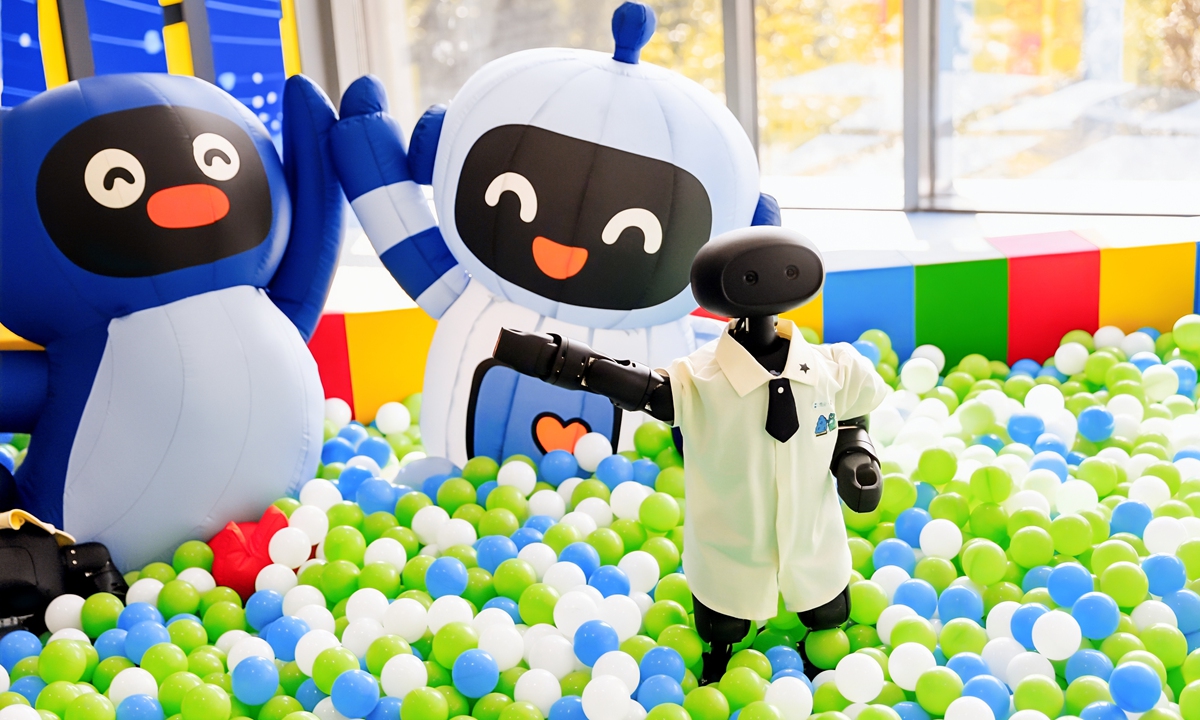
A "robot kindergarten," jointly established by Tashan Technology and a team led by Turing Award winner Richard Sutton, opens in Beijing's Shijingshan district on September 1, 2026, focusing on tactile sensing and continuous robot learning. Photo: courtesy of Tashan Technology
A "robot kindergarten" opened in Beijing's Shijingshan district on Tuesday, exploring a different approach to robot training: instead of having humans demonstrate every task, researchers want robots to learn through touch, trial and error, and their own experience.
The facility, jointly established by Chinese tactile-sensing company Tashan Technology and a team led by Turing Award winner and reinforcement learning pioneer Richard Sutton, focuses on tactile sensing and continuous learning.
The Global Times observed robots at the facility repeatedly trying movements, receiving feedback from physical interaction and adjusting their behavior. For example, if a robot runs into a wall while learning to walk, the collision becomes part of its experience. It records what happened, tries again and adjusts its movement to avoid the same mistake. Here, failure itself becomes data for learning.
Speaking at the opening, Sutton said the project aims to provide a safe environment where robots can learn about their own bodies and interact with the physical world through experience. He noted that this will require not only new algorithms, but also robots and environments specifically designed for learning. Failures will be part of the process, he said, adding that researchers, like the robots themselves, will need to learn, adjust and keep experimenting.
Tashan Technology CEO Ma Yang said the facility allows robots to learn through touch and trial and error in a controlled environment, adjusting their behavior based on real-world feedback.
China has been expanding humanoid robot training facilities as the industry pushes toward real-world deployment. Training bases in Beijing's Yizhuang and Shijingshan districts, for example, have recreated real-world settings where robots practice tasks ranging from precision operations to household work.
Much of this training relies on data collected through human demonstrations, teleoperation or motion capture. The "robot kindergarten," however, is exploring a different question: whether robots can continue learning and adapting through their own experience in the physical world.
Kris De Asis, a senior researcher in the Openmind Global Research, a research institute originating in Canada, told the Global Times that many robots today are trained through human demonstrations, teleoperation data or simulation, after which their learned behavior is largely fixed. Continuous learning, by contrast, aims to let robots keep adapting after deployment, including to objects and situations that were never covered in their original training.
The approach is slower than learning by imitation, but Kris said that the difference is largely one of "long-term versus near-term benefits." He also pointed to hardware as an immediate bottleneck: robots must be robust enough to withstand the mistakes required for learning. "If it can't make a mistake, then it can't learn," he said.
Wang Peng, an associate research fellow at the Beijing Academy of Social Sciences, told the Global Times that autonomous exploration could help robots break out of the limits of task-specific training and build a more fundamental understanding of the physical world. Instead of relying heavily on large amounts of human-labeled or teleoperation data, robots could generate valuable data through real-world interaction, forming a continuous cycle of exploration, feedback and improvement.
Wang said that in the longer term, experience accumulated by individual robots could potentially be fed back into shared models and transferred across machines, allowing robots to improve as they work. Such a model could be particularly valuable in complex environments where it is impossible to collect demonstrations for every possible situation in advance.
The approach, however, remains at an early stage. Kris said that a small spider-like robot at the facility learned to move forward in about 40 minutes without prior knowledge, but that was a narrowly defined task. For complex humanoid robots, learning involves far more variables, from balance and energy use to temperature control and self-defense.
For now, such autonomous learning is more likely to complement rather than replace teleoperation, imitation learning and simulation. But as robots move from demonstrations into factories, commercial services and eventually homes, Wang said that the approach could become an important direction for robotics, allowing machines to keep learning and adapting to new situations after deployment.
RELATED ARTICLES