Chinese AI firm opens online store to sell coding subscriptions, a key step in commercialization
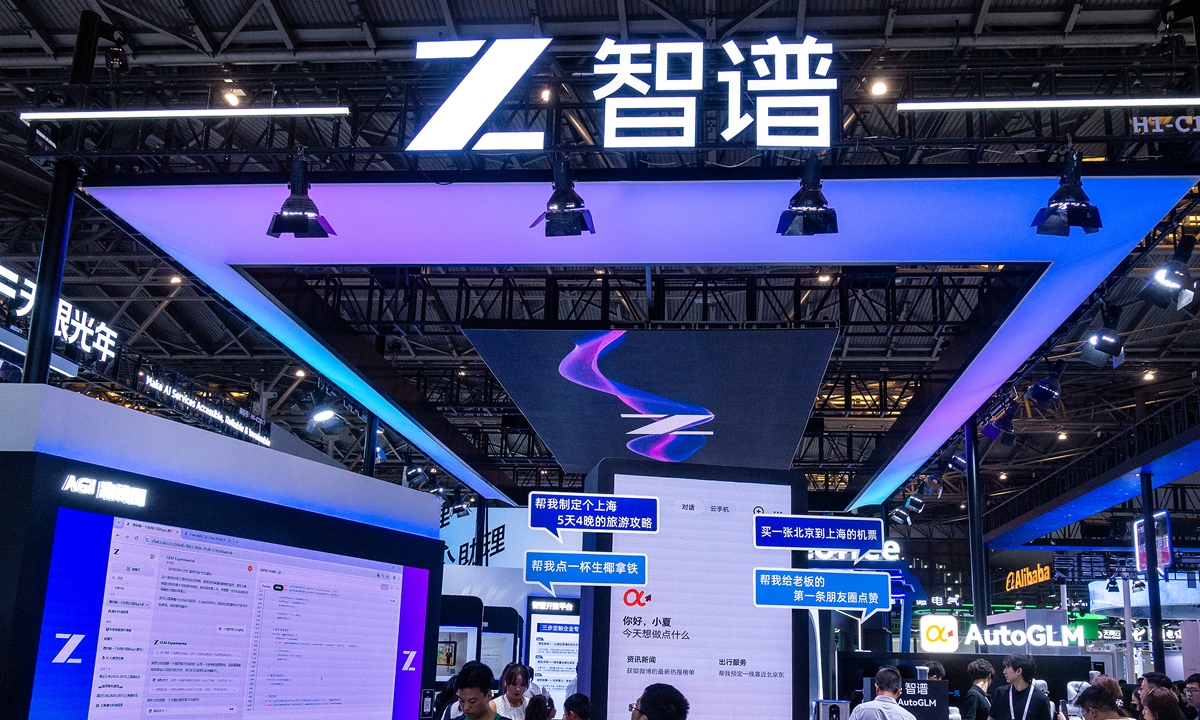
Booth of Zhipu at the exhibition hall of the 2025 World Artificial Intelligence Conference on July 28, 2025 Photo: VCG
Chinese artificial intelligence company (AI) Zhipu AI opened an official flagship store on Tmall on Wednesday to sell its GLM Coding Plan subscriptions, marking a fresh effort to bring AI model services beyond developer platforms and into China's mainstream consumer marketplace, as AI adoption continues to accelerate across the country.
Industry analysts said that the move highlights a broader shift in China's large-language model sector, where technological advances are increasingly being matched by efforts to broaden the paying user base and develop more scalable sources of recurring revenue.
The flagship store is selling individual GLM Coding Plan subscriptions in the Lite, Pro and Max tiers, alongside a standard team plan, according to product information displayed on the store.
Powered by Zhipu's flagship GLM-5.3 model, the plans support more than 20 mainstream coding tools, including ZCode, Claude Code and OpenCode, and cover the full development workflow, from understanding requirements and generating code to debugging, codebase question-and-answer functions and automated task execution.
Industry analysts said that the subscription model works much like a mobile phone plan, offering better value for high-frequency users than standard pay-as-you-go application programming interface (API) pricing.
Zhipu's latest Coding Plan is priced notably higher than the previous version, with the Pro tier rising from 149 yuan ($22) to 538 yuan per month, more than 3.6 times its previous price. The higher pricing comes with a new token-based credit system and an upgrade from GLM-5 to GLM-5.3, according to media reports.
The Coding Plan itself is not new, having already been available through Zhipu's own platform, but moving it onto Tmall marks a shift in distribution, bringing AI subscriptions that were previously sold mainly through developers' own websites and platforms into a mainstream consumer marketplace with broader traffic, payment and marketing reach, said Liu Dingding, a veteran technology industry analyst.
"The development is notable precisely because token has traditionally been a professional term more closely associated with developers and To-B use, while Tmall is fundamentally a To-C platform," Liu told the Global Times on Wednesday.
Putting such services on a consumer e-commerce platform can expand their reach, while also showing that concepts and products once seen as highly technical are gradually moving closer to a broader group of users, Liu added.
The move comes as Chinese large-language model developers are broadening their monetization channels, from enterprise APIs and developer subscriptions to more consumer-facing paid services.
The shift is already visible in Zhipu's revenue mix. The company posted first-half revenue of 953.9 million yuan, up about 400 percent year-on-year. Its open-platform and API business generated about 825 million yuan, accounting for 86.5 percent of total revenue, according to company results cited in media reports on Monday.
Liu said that the broader industry is moving beyond a phase dominated by heavy upfront investment, with companies increasingly being tested on their ability to turn model capabilities into sustainable commercial returns. "The shift is giving the sector a stronger commercial footing as paid use expands across both enterprise and consumer markets," he said.
That commercial push is being supported by a sharp rise in actual AI use. Daily token calls in China surged from about 100 billion at the beginning of 2024 to more than 140 trillion in March 2026, an increase of more than 1,000 times, according to the National Data Administration. China recorded about 21.1 quadrillion token calls in 2025, while data used for AI inference exceeded that used for training for the first time.
RELATED ARTICLES