India seeks 10 trillion yen in investment with Japan. Why are Japanese companies hesitant?
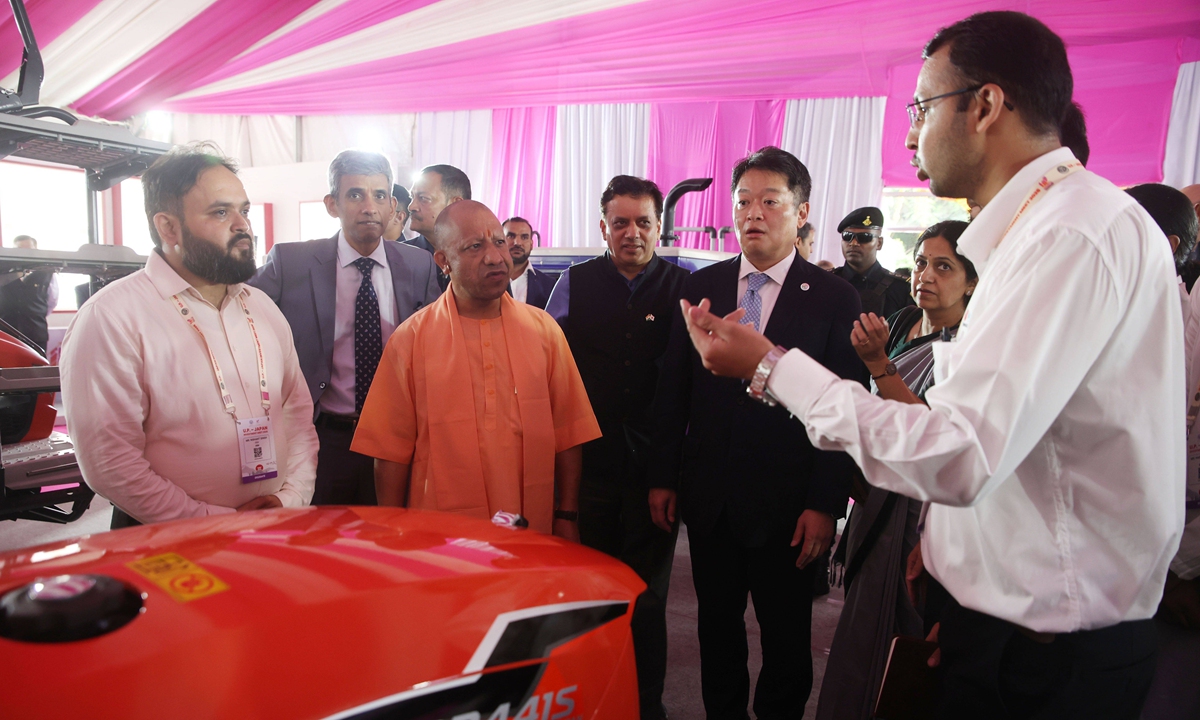
Representatives from India and Japan visit an exhibition area on August 21, 2026 during the Uttar Pradesh-Japan Investment Meet 2026 in Lucknow, India. Photo: VCG
India's Commerce Minister Piyush Goyal recently led a roughly 200-member delegation to Japan, making investment pitches in Tokyo, Nagoya and Osaka. But the trip — described by India as its "largest-ever" business delegation — has yet to yield any statement with explicit investment commitments of the two sides.
Japanese companies, while expressing interest in the Indian market, remain hesitant about significantly scaling up their investments. A Chinese expert told the Global Times that although India has made some adjustments in certain areas, deep-seated issues such as exchange rate management and capital repatriation are unlikely to see fundamental changes in the short term. India has shown attraction for Japanese companies, and the hard part is proving that the potential can turn into real, predictable returns, the expert noted.
According to the official information, the India's largest-ever business delegation spans sectors ranging from manufacturing, semiconductors, clean energy and steel to automotive, financial services, healthcare and start-ups. The visit aimed to advance efforts toward the target of 10 trillion yen ($62.96 billion) in Japanese private investment in India over the next decade, agreed upon during Prime Minister Shri Narendra Modi's visit to Japan in 2025.
During the visit, Goyal engaged with Japanese financial institutions including MUFG, Mizuho and Nomura. He also highlighted India's ambition to build a globally competitive semiconductor ecosystem, with semiconductor demand projected to reach $150 billion by 2032.
Japan does have expectations for India. A 2025 survey by the Japan Bank for International Cooperation found that India ranked first for the fourth consecutive year as a promising destination for Japanese manufacturers to expand their businesses in the medium term. In addition, Japan established the Japan-India Economic Affairs Division in April to promote companies' expansion of business and investment from Japan to India.
However, there is a notable gap between optimism and large-scale entry. Data from the Japan External Trade Organization showed that as of October 2024, 1,434 Japanese companies were operating in India. Over the same period, Thailand hosted 6,083 Japanese firms, Vietnam 2,543, and Malaysia 1,643.
During the meeting with Goyal, Japanese institutions flagged the need to simplify profit repatriation, improve access to Indian capital markets and provide greater regulatory predictability. Share buybacks, capital reductions, and secondary equity sales also frequently run into extended regulatory delays, according to India media outlets.
The Indian government is clearly aware of these concerns and has begun signaling its willingness to address them through policy adjustments.
Goyal, during the visit, committed that his ministry would develop a framework to ease compliance and regulatory norms, including the Bureau of Indian Standards certification requirement, the Business Standard reported. Recently, the government also eased FDI norms for inventory-based e-commerce firms. Simultaneously, India has initiated work towards a more predictable FDI policy and is likely to introduce an updated model bilateral investment treaty soon, according to the report.
Wan Zhe, professor at the Belt and Road School of Beijing Normal University, told the Global Times that India has indeed begun making adjustments in some areas including streamlining certification and approval procedures for high-tech companies, which could help reduce entry costs for businesses. However, on more fundamental institutional issues such as exchange rate management, capital repatriation and judicial efficiency, substantive change is unlikely in the short term, the expert said.
Wan believes that capital ultimately seeks returns, and geopolitical slogans cannot replace commercial performance. "India has successfully convinced Japanese companies that 'opportunities exist here.' The next step is to prove that 'those opportunities can be realized in a stable and predictable way.' And that may well determine whether the 10 trillion yen investment target ultimately moves from an ambitious plan to real money.
More important than whether the target is achieved is how many Japanese companies can truly enter the Indian market and stay for the long haul, the expert noted.
RELATED ARTICLES