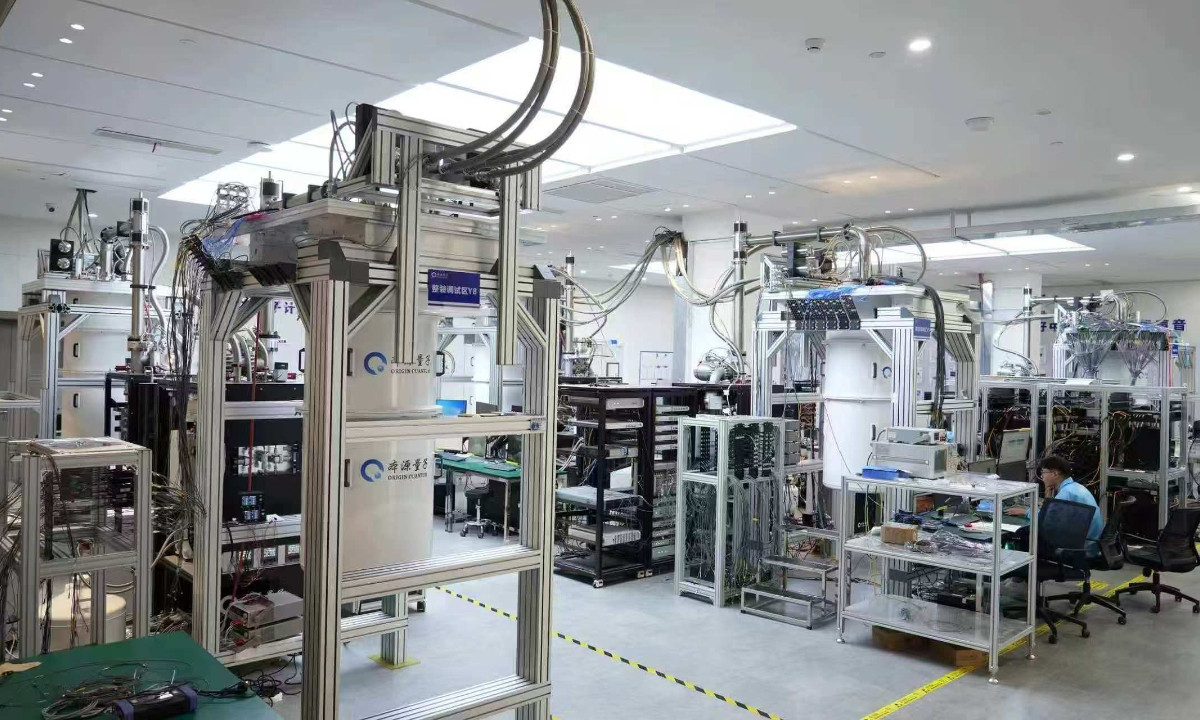
Origin Wukong superconducting quantum computer cluster Photo: Courtesy of the Anhui Quantum Computing Engineering Research Center
Chinese research teams have achieved a breakthrough on an independently developed superconducting quantum computer, with tests showing information transmission efficiency of up to 98 percent for a single quantum router, Origin Quantum Computing Technology Co, one of the project's participators, told the Global Times in a press release on Thursday.Tian Feng, former dean of SenseTime's Intelligence Industry Research Institute, said the significance of the breakthrough lies not simply in the 98 percent transmission efficiency, but in offering a new way to reduce operational complexity and accumulated errors in quantum computing.
The achievement was jointly made by several Chinese research teams.
The teams developed a coherent quantum routing system for bucket-brigade quantum random access memory (QRAM) for the Origin Wukong superconducting quantum computer. The system acts like a "fast lane" for data transmission, helping address a key challenge in scaling up QRAM.
QRAM is a key functional component for algorithms such as quantum search and quantum machine learning. At its core is a "quantum router," which directs data to the correct destination according to address instructions.
In conventional designs, however, as the routing network expands, each additional node requires a large number of standard quantum gates to decompose and execute the instructions layer by layer, sharply increasing circuit depth and accumulated errors and thereby limiting the scalability of QRAM, according to the release.
Researchers built three independent quantum routers and a two-layer quantum routing network directly onto China's third-generation independent superconducting quantum computer Origin Wukong for testing. The results showed that a single quantum router achieved an information transmission efficiency of up to 98 percent, while the two-layer network reached an overall transmission efficiency of 93 percent. In random-access tests, the average fidelity reached 94.8 percent for the single quantum router and 82.4 percent for the two-layer network.
The breakthrough offers a new way to integrate scalable QRAM into existing superconducting hardware, researchers said. It also shows that China's quantum computing research is moving beyond improving individual performance metrics toward testing more complex quantum functions on real machines, according to a report from the Science and Technology Daily on Wednesday. The approach could also help cut computing costs and improve efficiency, while offering a new way to better integrate quantum chips with circuit design.
As quantum memory networks grow, more sequential operations are required, increasing the risk that errors will affect final results, according to Tian. By shortening critical operation paths and improving the efficiency of individual routing nodes, the new approach could allow existing hardware to support more complex quantum storage and data-access tasks.
Tian said the result also suggests that the development of quantum chips should not be judged only by the number of quantum bits, or qubits, but also by how efficiently they are used. The approach taps additional energy levels of superconducting qubits without simply adding more physical qubits, potentially easing some control and calibration burdens.
However, Tian cautioned that a 98 percent routing efficiency does not mean large-scale QRAM is ready for commercialization. Error control, hardware stability, and system costs will remain major challenges as networks scale up.
RELATED ARTICLES