ARTS / CULTURE & LEISURE
From restored mangroves to re-cleaned lake, decades of ecological protection take shape in Xiamen
Tides of renewal
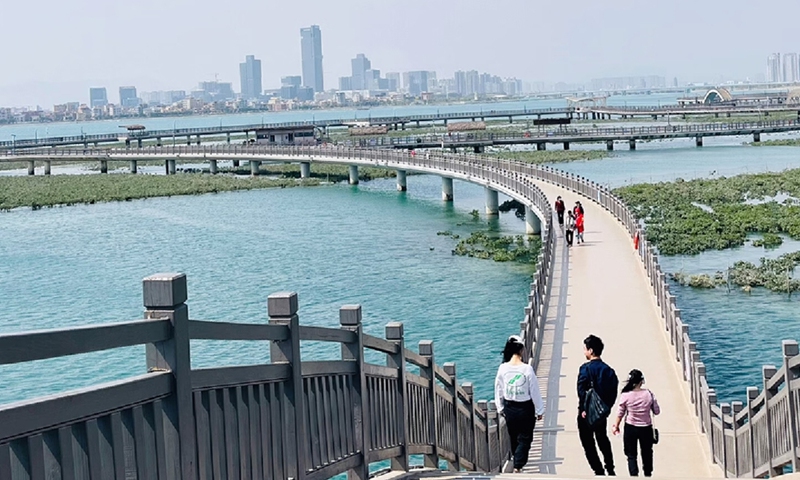
Tourists walk on a pathway in Xiatanwei Mangrove Park. Photo: Sun Langchen/GT
From the air, the Xiatanwei Mangrove Park in Xiamen, East China's Fujian Province, looks almost like a giant piece of land art.
Across several islands of different shapes and sizes, dense green mangrove forests form striking patterns. On one small island, the trees spell out the letter "I." On another, they take the shape of a heart, while a larger island is covered with a five-pointed star. Together, they convey a simple message: "I love China."
The spectacular aerial view, set against the expansive mangrove wetlands, left a deep impression on Guillermo Ortuno Crespo, co-lead of the IUCN World Commission on Protected Areas High Seas Specialist Group.
"It is difficult to describe this place with any other words," Crespo told the Global Times. Having first visited the city more than a decade ago, he said he was struck by how dramatically it had changed.
For many foreigners, Xiamen may still conjure up images of Gulangyu Island, the Xiamen Marathon, its status as a special economic zone, or of local delicacies such as oyster omelets.
"It is now a model of ecological development that can serve as a reference for the rest of the world," he said.
Decades of effort
Located at the northeast corner of the Huan Dong coastal area, on both sides of the Huojue Bridge at the head of Tong'an Bay, Xiatanwei covers a planned area of 404 hectares, including 85 hectares of artificially cultivated mangroves.
This is Xiamen's first wetland park centered on mangroves and the largest artificially reconstructed mangrove wetland in Fujian Province. It has served as a carbon-neutral forest demonstration site for the BRICS summit.
For Lu Changyi, one of the designers in the team of mangrove restoration project led by top Academician Lin Peng of Xiamen University, the motivation came from a worry that under increasing pressure from human activity, the forests could eventually disappear altogether.
"We were not simply carrying out a mangrove planting project. We also needed to create distinctive landscapes," Lu said.
Different mangrove species have different requirements for growth, he explained, while a diverse landscape also needs to follow the ecological principle of habitat heterogeneity. The team selected species of different heights and used satellite positioning and surveying to determine where each tree should be planted.
Low-growing mangroves were planted alongside taller species, and the differences in height were deliberately used to create a layered landscape that is both visually striking and ecologically diverse.
Behind the seemingly simple design was meticulous planning. "Every detail on the blueprint had to be checked and rechecked. I don't know how many times the drawings were revised," Lu said.
The specifications went down to the exact location of individual seedlings, with a spacing of 0.8 meters between them. Even seemingly minor details, such as how to keep newly planted seedlings upright, were carefully explained to workers.
The mudflats that look calm from a distance can be hazardous up close. Broken glass, shells, nails and other debris were mixed into the tidal flats, creating additional challenges for the workers, and after years of adjustment on design, the whole program took seven years of construction.
The area, once dominated by disorderly aquaculture operations, was transformed into a sprawling mangrove ecosystem. The restored wetlands absorb pollutants, increase biodiversity and form a natural green barrier against typhoons and storm surges.
The project was later included in an international casebook jointly released by China's Ministry of Natural Resources and the IUCN. It has promoted the restoration along the city's coastline, with about 14.5 kilometers of beaches restored over the past two decades, covering 1.65 million square meters, according to local media reports.
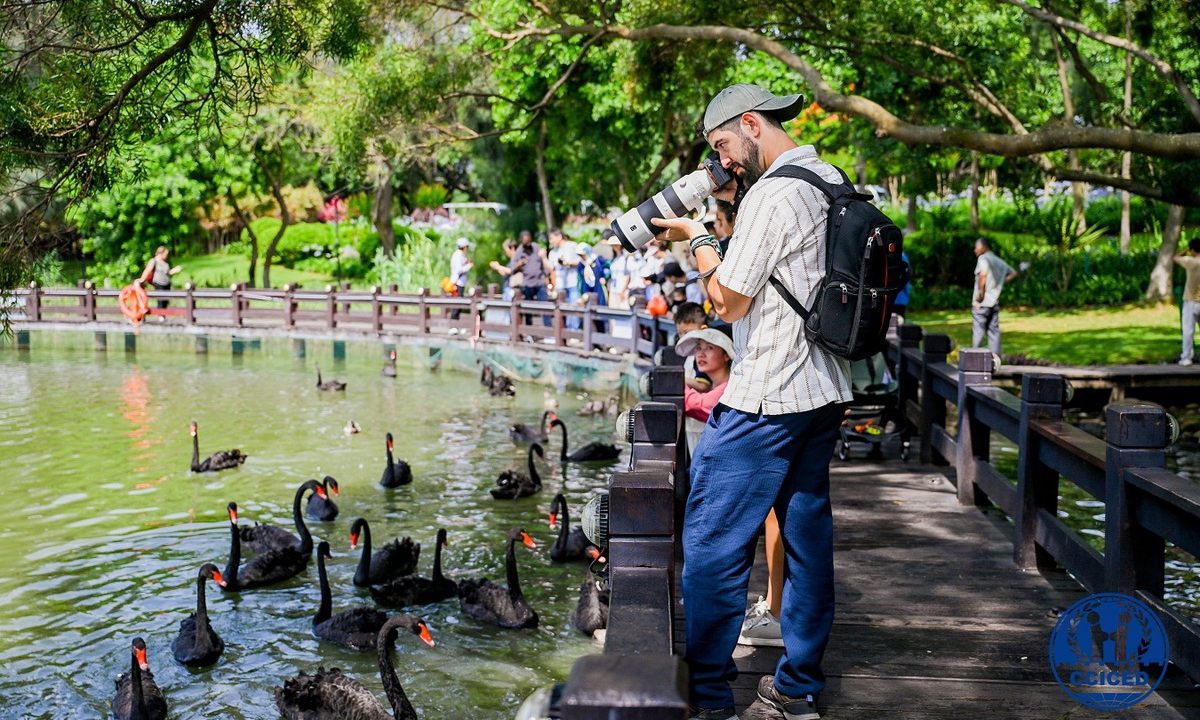
Guillermo Ortuno Crespo, co-lead of the IUCN World Commission on Protected Areas High Seas Specialist Group, tours Xiatanwei. Photo: Courtesy of CCICED
Ecological living room
Much of Xiamen's broader ecological transformation is embedded in the city's long-term urban planning. Across the water from Xiatanwei lies Yundang Lake, another emblematic example.
The lake was once notorious as a heavily polluted "stinking lake" after land reclamation and the discharge of wastewater. Its restoration was arguably even more complicated than the mangrove project at Xiatanwei.
In 1988, Xiamen launched a comprehensive campaign to restore it, putting forward a 20-character approach centered on managing the lake according to law, intercepting and treating pollution, dredging and reinforcing its banks, improving water circulation and beautifying the surrounding environment, urban planning representative Liu Haishan noted.
Today, Yundang Lake has become what locals describe as an "ecological living room" for Xiamen. According to Liu, the first priority was to tackle the source of the pollution.
More than 100 industrial enterprises around the lake were relocated, while waste water treating facilities were constructed and upgraded, gradually improving water quality.
Engineers developed a solution tailored to the lake's unique geography, using tidal flows to replenish water. Through the construction of a western embankment gate and diversion structures, the restoration team harnessed the natural difference between high and low tides to introduce seawater from the western sea area into the lake, helping accelerate the natural purification of the water.
Large-scale dredging was carried out at the same time, removing approximately 3.2 million cubic meters of sediment from the lakebed. Rather than simply disposing of the dredged material, the city used it to reclaim land and has provided a habitat for birds and other wildlife.
All these restoration projects have continued to influence the city's environmental governance. In 2021, environmental protection regulations were implemented, requiring discharge outlets entering rivers and the sea to have clearly defined management responsibilities. The regulations call for comprehensive inspections of sewage discharges and collection along streams and lakes, with the goal of achieving full collection and treatment of waste water.
Its approach has been integrated into coastal management and has been shared with other Chinese cities, including Zhuhai, Zhanjiang, and Meizhou.
In 2006, the secretariat of the Partnerships in Environmental Management for the Seas of East Asia (PNLG) was permanently established in the city, helping connect 53 member cities in 10 countries to promote and implement integrated coastal zone management.
"Xiamen is a highly suitable choice, given China's strong commitment to environmental protection," Crespo said. "This will also be a monumental milestone for Xiamen's internationalization."
RELATED ARTICLES