BRASIL 247 / MORE
Brazil and Mozambique enter a new phase of cooperation to build productive capacity beyond traditional trade ties
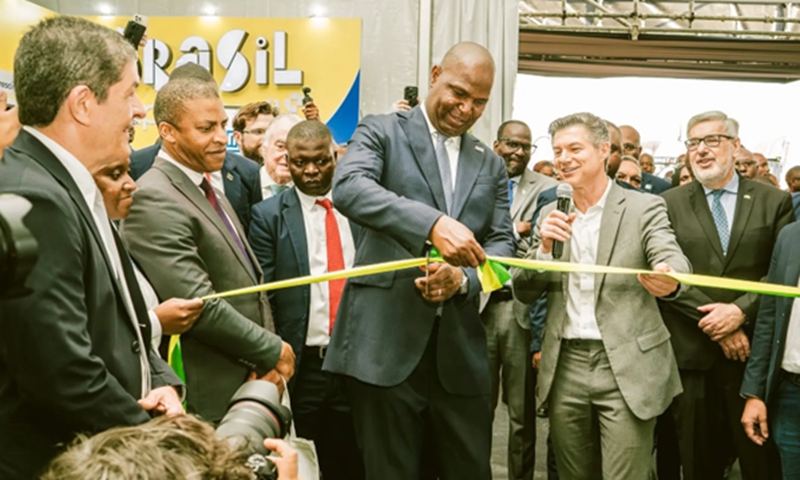
Credit: FACIM Moçambique
Brazil is the country of honor at the Maputo International Trade Fair (FACIM), Mozambique's largest multisectoral business fair, which opened on August 31 with the presence of Mozambican President Daniel Chapo. The head of state visited the Brazilian pavilion of ApexBrasil and officially inaugurated the space, according to Brasil 247.
The Brazilian pavilion brought together 70 people representing companies, cooperatives and organizations from Brazil, marking the largest Brazilian participation in FACIM's history. During the event, meetings were held between 30 Brazilian companies and 100 Mozambican companies, generating an intensive business agenda between the two countries.
The Maputo event marked the final stage of ApexBrasil's mission to Southern Africa, which also visited Angola, South Africa and Zambia. Brazilian companies participating in the Mozambique leg are seeking business opportunities and new partnerships in the country, in a movement that complements the alignment between ApexBrasil and Mozambique's APIEX. During the event, ApexBrasil President Laudemir Müller held two meetings with President Chapo to align areas of cooperation between the two governments.
The event also highlighted the presence of the United Arab Emirates, represented by the country's Minister of State for Foreign Affairs, Sheikh Shakboot Nahayan Mabarak Al-Nahyan.
"We want to be a priority country for Mozambique"
For Laudemir Müller, president of ApexBrasil, relations between the two countries need to move beyond traditional trade. "Instead of a relationship based exclusively on the export of products, we want to build local production capacity, develop suppliers and integrate technology and technical knowledge into the Mozambican business sector," he said during the Brazil-Mozambique Business Meeting. The event was promoted by ApexBrasil.
Müller said that 64 Brazilian companies already export to Mozambique and emphasized Brazil's ambition in the region: "Of course, it is not the only one, but we want to be a priority country for Mozambique".
According to him, Mozambique has a natural vocation as a gateway to the regional market: "Mozambique is the ideal logistics platform and natural gateway for Brazilian products and investments to access the member countries of the Southern African Development Community (SADC)".
The ApexBrasil president also revealed plans to create a direct air route connecting Brazil and Maputo, with the aim of increasing passenger flows, business and commercial cargo logistics between the two nations. He described the journey as a "historic day" for bilateral relations.
Mozambique as a platform for expansion into Africa
Álvaro Massingue, president of the Confederation of Economic Associations of Mozambique (CDA), highlighted the country's potential as an operational base for Brazilian companies across the continent.
"We want Brazilian capital to find in Mozambique not only a market, but a platform for production and expansion into Africa".
According to him, the CDA is prepared to help bring companies closer together: "it is prepared to play its role, to bring companies together, facilitate governments, promote B2Bs, identify opportunities and follow the transformation of intentions into business".
Massingue also cited the institutional foundation supporting this cooperation through the Mozambique-Brazil Cooperation and Facilitation Agreement for Investments and the partnership between ApexBrasil and APIEX.
On the Brazilian government's side, Carlos Moscardo, director of Trade Promotion, Investments and Agriculture at the Ministry of Foreign Affairs, reaffirmed the willingness to give concrete form to the projects discussed.
"Everyone here is willing to collaborate with this project to resume relations with Africa, and in this specific case with Mozambique, with new energy and new momentum, and make these projects much more concrete".
A new phase in bilateral relations
Brazilian Ambassador to Mozambique Ademar Seabra highlighted the significance of the partnership. He welcomed participants while emphasizing the importance of technical training: "We welcome everyone who is here, precisely in the implementation of this support for technical and vocational training, and human capital is indispensable, without a doubt, because without it, none of this would stand".
Seabra described the diplomatic work in the region in almost missionary terms: "We are deeply moved by the profession of believing, exploring and having not only a bilateral partnership, but also becoming missionaries, anticipating a major frontier of economic development, which is Africa in general and Mozambique in particular". According to him, relations between the two countries are renewed every day.
"For us, from the Brazilian Embassy, every day is a different FACIM. Every day Brazil is a country honored by Mozambique, and every day Mozambique is a country honored by us. Every day is a daily effort for this project to be carried out and for these tasks to become concrete".
The ambassador said the commitment would not end when the fair closes: "Even after FACIM closes, we want to be together with each of these entrepreneurs. We want to follow up on the direct dialogue with the Mozambican government, we want to operate and work to open markets, provide trade defense, improve investments, which is a fundamental issue, in building business partnerships with Mozambican companies, and build Mozambican capacity for entrepreneurship".
Seabra also linked Brazil's development to that of Mozambique: "We imagine that, for us, the Brazilian development project that we want for our country will always be incomplete as long as Mozambique is not also a great nation, one that also offers and distributes wealth and allows equal opportunities for all and its entire population as well".
He recalled that President Luiz Inácio Lula da Silva's visit to Mozambique last year was the starting point for this new phase: "There is a great perspective that was opened throughout bilateral relations, which have always been exemplary and edifying, and which, following President Lula's visit last year, when he announced a series of processes, some underway a little more slowly, some a little more quickly and some that we already have. The visit triggered a series of processes".
According to the ambassador, progress is already visible: "We have already made a lot of progress in just a few months during this period, there has already been an evolution in a series of processes, in agricultural development. There has been major progress, and beyond that there is also the issue of Brazil's participation in projects in the hydrocarbons market, renewable energy, infrastructure, health, the aeronautical sector, services and everything involving the digitalization of the state. It is one of the densest and closest relationships between our countries so that we can carry out all these projects".
For Seabra, Brazil's leading role at this year's FACIM increases the country's responsibilities: "The deference shown to Brazil increases our responsibility and makes us want to expand our projection here in Mozambique, immensely expanding this new phase".
Sharing Brazil's development experience
The ambassador also reflected on Brazil's trajectory as an international partner: "Today Brazil is a country that, even with our difficulties and also our dreams and aspirations and hopes, but we are also a country that has a great history of development, a beautiful history that is realized through accumulated experiences, with great cooperation and presence in various countries and regions of the world, which have always believed in Brazil. Brazil is a synthesis of all these foreign interests, which helped us offer our population, coming from all continents and in all forms".
He detailed the different forms of cooperation Brazil has received throughout its history — "such as through investments, technical cooperation, project development, sectoral development, inclusion" — and said that this experience is now being shared with Mozambique.
"This accumulated experience makes Brazil great as well, as a synthesis of all this. And we have the pleasure, in the same way, of sharing this experience with Mozambique".
"Brazil is a partner of excellence, first order, interested in Mozambique being great and prosperous", the ambassador summarized, echoing a statement by President Daniel Chapo earlier at the event: "we do not want a partnership that is only commercial, technical and political, it is a true partnership between us".
A call for joint ventures
Concluding the round of speeches, APIEX Director-General Luís José Machava placed the partnership in a historical perspective: "Cooperation between Mozambique and Brazil ignites deep historical and cultural ties and sincere friendship. However, today we are called upon to translate this heritage into a structured flow of direct investment, bilateral trade that is vibrant and innovative partnerships that drive industrialization and the sustainable development of both countries".
Machava pointed to specific areas where Brazilian experience could directly contribute to Mozambique's development: "Brazil's vast experience in decarbonizing its energy matrix, in the development of biology and in its productive and industrial experiences represent valuable missions that can be integrated into Mozambique's properties".
He also highlighted the country's institutional environment for investors: "Our legislation for investment provides for a wide range of tax and customs benefits" and "our processes have been innovated to radically encourage the establishment of companies, the licensing of projects and investments, the facilitation of visas and an assistance regime focused on business growth".
Finally, the APIEX director-general issued a direct invitation to entrepreneurs from both countries: "I would like to actively encourage all Mozambican and Brazilian entrepreneurs to make the most of this space, identifying commercial synergies, establishing joint ventures for the transfer of technologies and structuring lasting commercial alliances that transform territorial borders at FACIM".
(Reported by Brasil 247 on September 2, 2026)
