Foreign guests take on robots in tug-of-war, won over by tech charm in South China
By , Ding Yazhi and Li Jiayu Published: Sep 04, 2026 07:25 PM

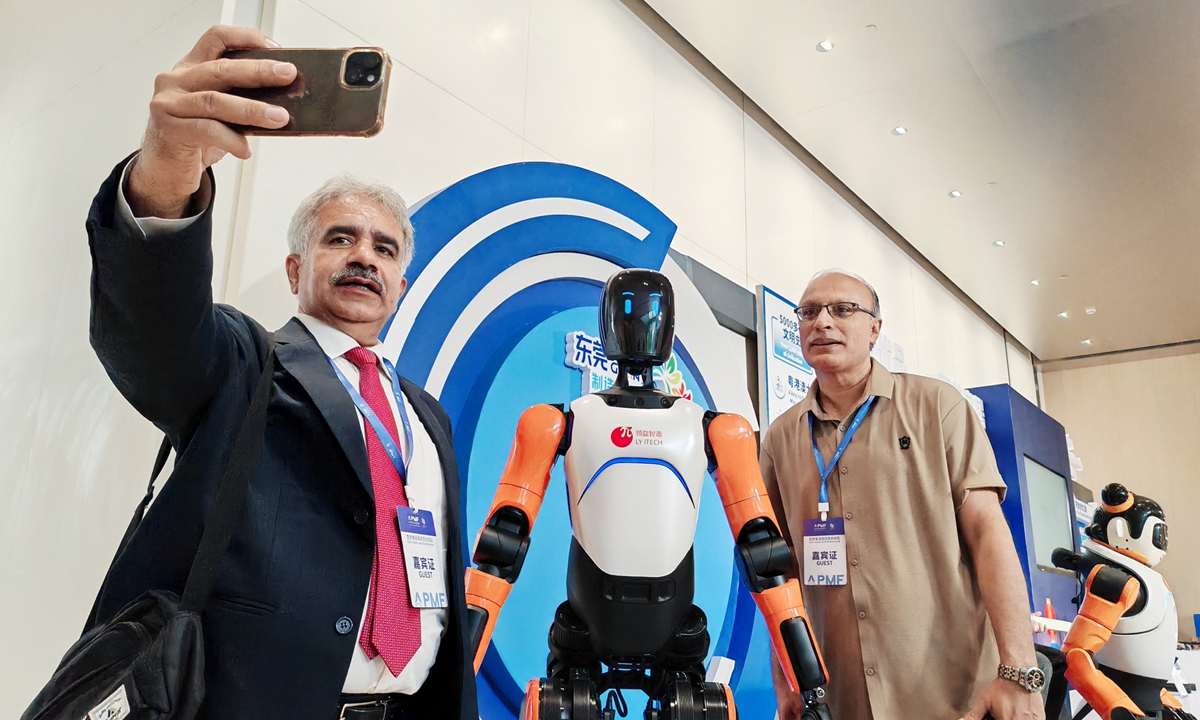
International guests take selfies with robots in Dongguan, South China's Guangdong Province, on September 3, 2026. Photo: Guan Kejiang/GT
Three foreign journalists lean back with all their strength on one end of a rope while a four-legged robot dog stands unmoved on the other; a Myanmar delegate and a robot raise their "hands" toward each other to form a heart for the camera; an international visitor carefully packs a Dongguan-made AI pet doll, planning to take it home for his child; and crowds gather around a robotic-arm coffee machine, phones held high for photos.These were just some of the scenes on Thursday as Chinese and foreign media representatives visited tech companies across South China's Guangdong Province.
On September 5, the high-level Asia-Pacific Media Forum will open in Shenzhen. In the days leading up to the event, groups of overseas media representatives fanned out to experience Chinese technological innovation firsthand at local enterprises.
"Come on! Come on!" Cheers and laughter filled a park in Zhuhai. On one side of the tug-of-war rope were three foreign journalists; on the other stood the quadruped robot dog named Qinbao. The journalists pulled with everything they had, with bodies angled backward. Qinbao stayed planted, its four mechanical legs firmly fixed to the ground. After several rounds of three-against-one contests, the robot dog won every time.
Weighing about 75 kilograms, Qinbao can carry a 200-kilogram load and even pull a 2.55-ton vehicle. For many of the foreign reporters, this was their first close encounter with a quadruped robot. The playful challenge offered a direct, memorable feel for the strength of Chinese robotics technology.
"I didn't expect it to be so powerful," said Chanthamaitry Thepsimeuang, a reporter from Laos' mainstream media outlet Pasaxon. "China has developed many advanced robots that can do things humans cannot."
In Dongguan, global media representatives visited OPPO's headquarters and were quickly drawn to the smart robots on site. One journalist stepped forward to shake hands; the robot smoothly lifted its "palm" in response, triggering a burst of camera flashes.
They also experienced a DeRUCCI smart mattress. What looks like an ordinary mattress contains layers of sensors and large data models. It can monitor heart rate, breathing, body movements, and sleep stages in real time, then adjust firmness and support to better align the spine and improve rest.
Sitt Min Thar San, an editor at the Myanmar Herald, told the Global Times this was his first visit to China. He had long heard about China's advanced technology, yet the real-world experience went beyond his expectations.
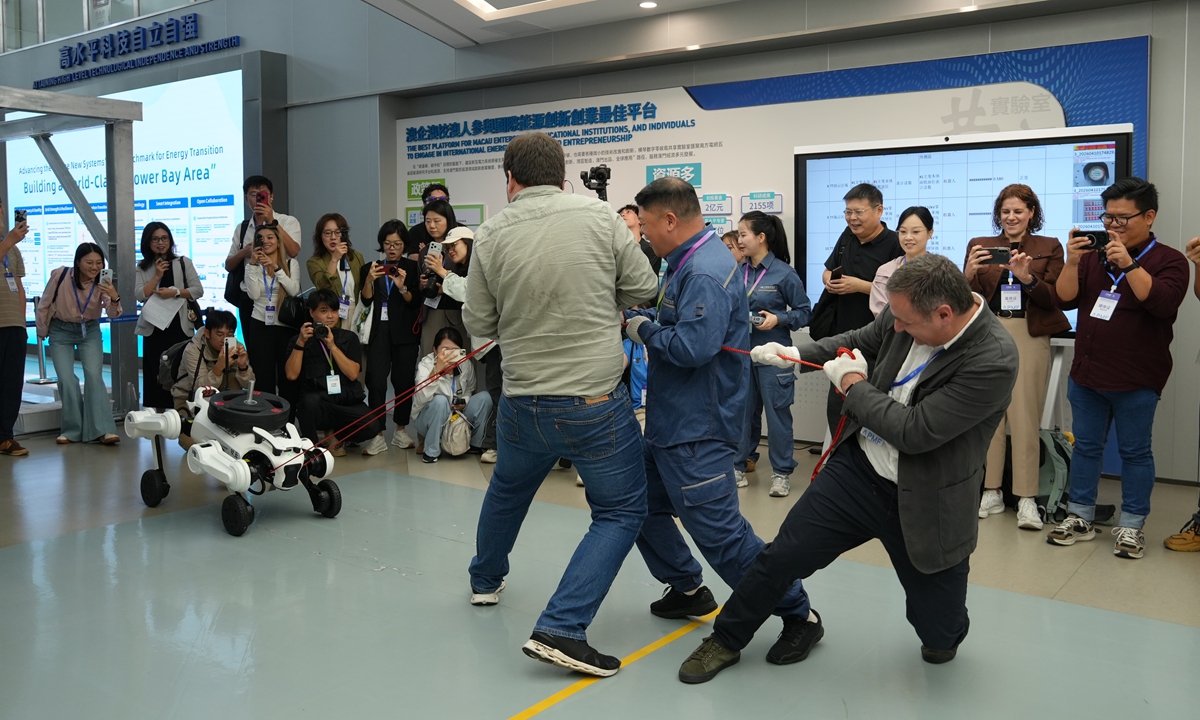
Three foreign journalists play a game of tug-of-war with a robot in Dongguan, South China's Guangdong Province, on September 3, 2026. Photo: Li Jiayu/GT
Cutting-edge tools are woven into everyday life. One striking example was the AI-powered mattress that tracks human health. Beyond the innovations themselves, he was impressed by China's ability to balance industrial growth with ecosystem protection.Dahlan Dahi, CEO of Indonesia's Tribun Network, said Chinese companies' steady investment in research and development left a strong impression. "R&D is essential. Only through continuous research can a company master leading-edge technology, keep iterating, and stay competitive."
The visiting route ran from Guangzhou's deep historical roots and Foshan's manufacturing base to Zhuhai's youthful energy, Zhongshan's cultural heritage, Dongguan's smart manufacturing, and Shenzhen's innovation-driven growth. It linked cities across the Greater Bay Area and showcased concrete progress in industrial upgrading, green development, renewable energy and cultural creativity.
Along the way, the visits also reflected the practical, mutual benefits that connect Asia-Pacific economies.
RELATED ARTICLES