PHOTO / CHINA
Land section of Jintang undersea tunnel achieves full breakthrough in E China's Zhejiang
Published: Sep 05, 2026 11:35 AM
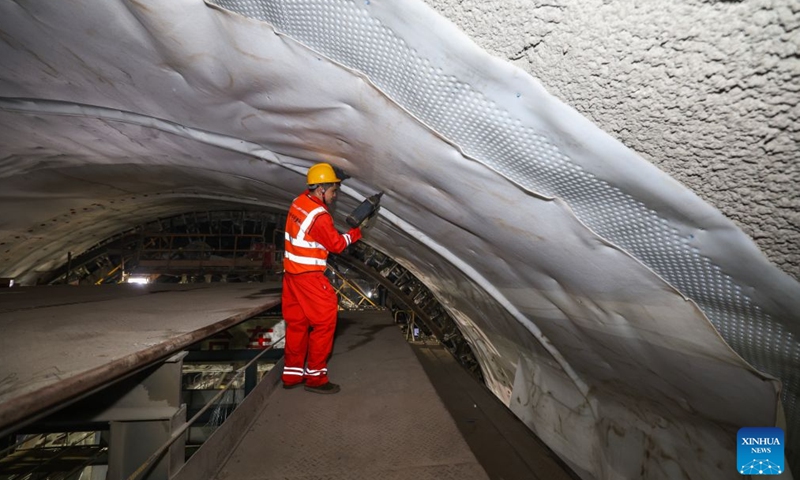
A construction worker works at the entrance of the Jintang undersea tunnel, east China's Zhejiang Province, Sept. 4, 2026. The 7.83-km land section of the 16.18-km Jintang undersea tunnel achieved full breakthrough on Friday. The tunnel is an important facility for the Yongzhou (Ningbo-Zhoushan) high-speed railway, and is designed as a single-bore, double-track tunnel for speeds of up to 250 km per hour. (Xinhua/Xu Yu)
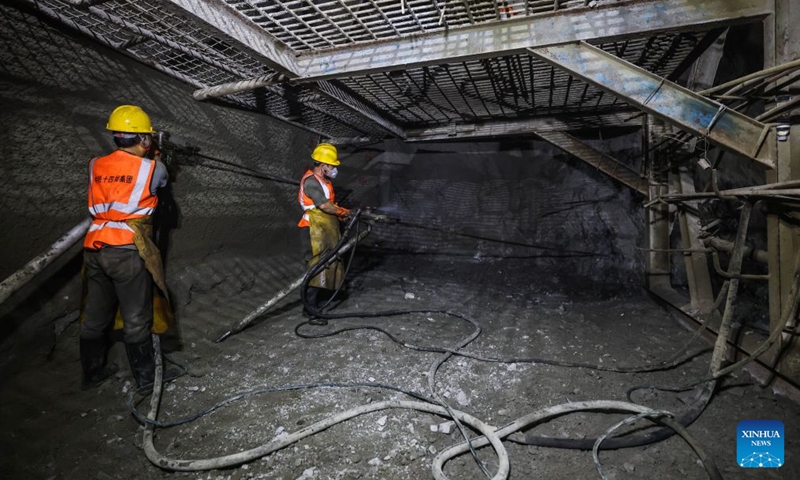
A construction worker works at the entrance of the Jintang undersea tunnel, east China's Zhejiang Province, Sept. 4, 2026. The 7.83-km land section of the 16.18-km Jintang undersea tunnel achieved full breakthrough on Friday. The tunnel is an important facility for the Yongzhou (Ningbo-Zhoushan) high-speed railway, and is designed as a single-bore, double-track tunnel for speeds of up to 250 km per hour. (Xinhua/Xu Yu)
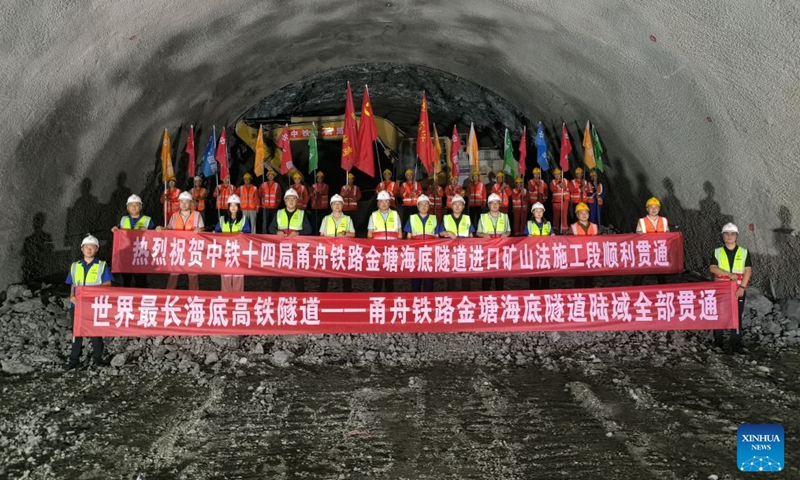

Construction workers work at the entrance of the Jintang undersea tunnel, east China's Zhejiang Province, Sept. 4, 2026. The 7.83-km land section of the 16.18-km Jintang undersea tunnel achieved full breakthrough on Friday. The tunnel is an important facility for the Yongzhou (Ningbo-Zhoushan) high-speed railway, and is designed as a single-bore, double-track tunnel for speeds of up to 250 km per hour. (Xinhua/Xu Yu)
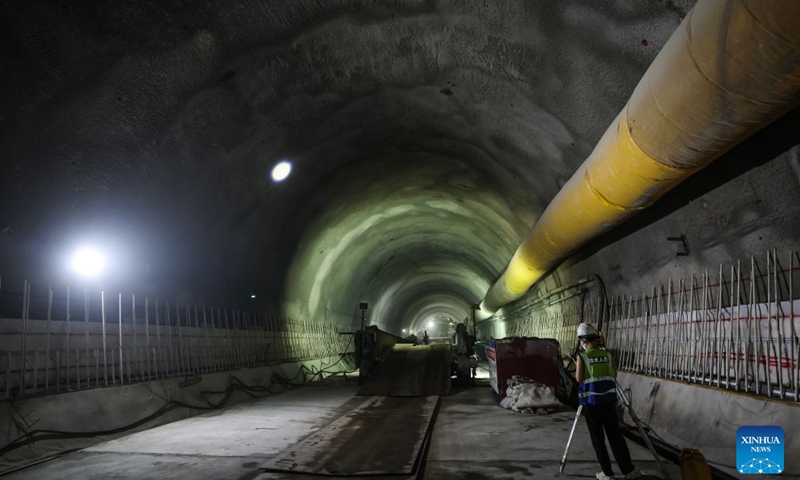
Construction workers work at the entrance of the Jintang undersea tunnel, east China's Zhejiang Province, Sept. 4, 2026. The 7.83-km land section of the 16.18-km Jintang undersea tunnel achieved full breakthrough on Friday. The tunnel is an important facility for the Yongzhou (Ningbo-Zhoushan) high-speed railway, and is designed as a single-bore, double-track tunnel for speeds of up to 250 km per hour. (Xinhua/Xu Yu)


Construction workers pose for a group photo in celebration of the full breakthrough of the land section of the Jintang undersea tunnel, in east China's Zhejiang Province, Sept. 4, 2026. The 7.83-km land section of the 16.18-km Jintang undersea tunnel achieved full breakthrough on Friday. The tunnel is an important facility for the Yongzhou (Ningbo-Zhoushan) high-speed railway, and is designed as a single-bore, double-track tunnel for speeds of up to 250 km per hour. (Xinhua/Xu Yu)

Construction workers pose for a group photo in celebration of the full breakthrough of the land section of the Jintang undersea tunnel, in east China's Zhejiang Province, Sept. 4, 2026. The 7.83-km land section of the 16.18-km Jintang undersea tunnel achieved full breakthrough on Friday. The tunnel is an important facility for the Yongzhou (Ningbo-Zhoushan) high-speed railway, and is designed as a single-bore, double-track tunnel for speeds of up to 250 km per hour. (Xinhua/Xu Yu)


Construction workers inspect the condition of the entrance of the Jintang undersea tunnel, east China's Zhejiang Province, Sept. 4, 2026. The 7.83-km land section of the 16.18-km Jintang undersea tunnel achieved full breakthrough on Friday. The tunnel is an important facility for the Yongzhou (Ningbo-Zhoushan) high-speed railway, and is designed as a single-bore, double-track tunnel for speeds of up to 250 km per hour. (Xinhua/Xu Yu)

Construction workers inspect the condition of the entrance of the Jintang undersea tunnel, east China's Zhejiang Province, Sept. 4, 2026. The 7.83-km land section of the 16.18-km Jintang undersea tunnel achieved full breakthrough on Friday. The tunnel is an important facility for the Yongzhou (Ningbo-Zhoushan) high-speed railway, and is designed as a single-bore, double-track tunnel for speeds of up to 250 km per hour. (Xinhua/Xu Yu)