8 state-owned central financial firms get 360b yuan capital boost to strengthen risk resilience
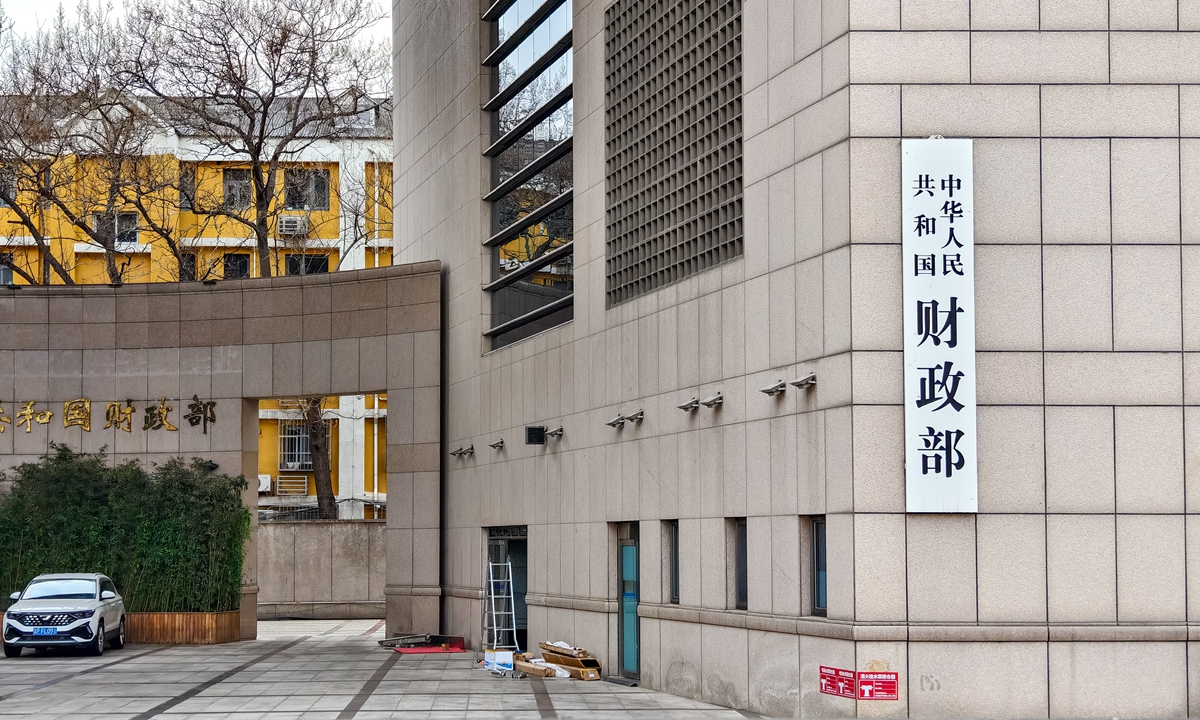
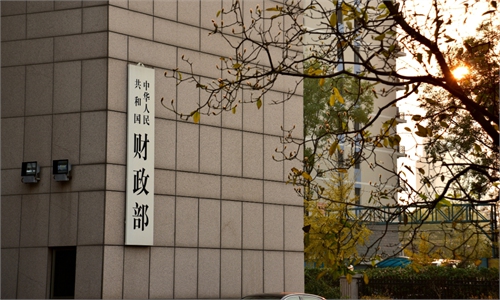
China's Ministry of Finance Photo: VCG
Eight Chinese central financial enterprises, including Industrial and Commercial Bank of China (ICBC), unveiled capital increase plans on Sunday to replenish their core Tier-1 capital. The plans total 360 billion yuan ($53.6 billion), which will help further strengthen their steady operating capacity, risk resistance capacity and ability to serve the real economy, the Xinhua News Agency reported.
The replenishment will give banks and financial institutions more resources to channel into credit for the real economy, while strengthening their ability to withstand external shocks at a time of global financial uncertainty, experts told the Global Times on Sunday.
According to the announcements, ICBC and Agricultural Bank of China (ABC), two large state-owned commercial banks, plan to issue A shares to specific investors - the Ministry of Finance (MOF), China National Tobacco Corp and related subsidiaries - aiming to raise no more than 100 billion yuan and 160 billion yuan, respectively.
In addition, the MOF will inject 30 billion yuan into the Export-Import Bank of China and 10 billion yuan into China Export & Credit Insurance Corp, two policy financial institutions.
Four state-owned commercial insurers also announced capital increase plans on the same day. People's Insurance Company (Group) of China (PICC) plans to issue A-shares to the MOF as a specific investor, aiming to raise no more than 15 billion yuan. The MOF will inject 35 billion yuan into China Life Group and 7 billion yuan into China Taiping. China Reinsurance plans to have the MOF subscribe in cash for its domestic shares, raising 3 billion yuan.
China Life Group said that the injection will further strengthen its steady operations and risk resistance capacity, and provide momentum for the company to focus on its core business, improve corporate governance and pursue differentiated development, according to a statement on the group's website.
China Taiping said in a statement that the injection will further enhance its ability to withstand risks, help keep key indicators such as solvency ratios balanced and stable, consolidate the foundation for long-term sustainable development, and improve its capacity to serve national strategies and support the high-quality development of the real economy.
For PICC, the shares would be subscribed for in cash by the MOF, and the proceeds will be used entirely to replenish the company's capital after deducting related issuance costs. The capital replenishment will help PICC further consolidate its capital base, enhance its steady operating capacity and risk resistance capacity, and better fulfill the insurance industry's role as an economic shock absorber and social stabilizer, the insurer's statement said.
Banks play a leading role in China's financial system, and credit support is urgently needed for companies, particularly private enterprises, Bian Yongzu, the executive deputy editor-in-chief of Modernization of Management magazine, told the Global Times on Sunday, adding that only by raising their capital adequacy ratios can financial institutions free up more credit resources for the real economy.
Bian added that emerging sectors such as big data and artificial intelligence include many start-ups that need low-interest credit while their operations are still weak. Stronger bank capital, therefore, gives a significant push to the economy's transformation and upgrading.
Capital replenishment follows a certain cycle, Dong Shaopeng, a senior research fellow at the Chongyang Institute for Financial Studies at Renmin University of China, told the Global Times on Sunday.
Banks incur some bad debts as they do business and need fresh capital to expand into new business, while regulatory rules on indicators such as bad-debt and reserve ratios mean core Tier-1 capital has to be topped up at a certain stage, Dong said.
Dong said that 360 billion yuan is not a particularly large amount and represents a fairly routine plan to further expand capital, and that for listed companies such as ICBC, ABC and PICC, raising funds from existing major shareholders including the MOF and China National Tobacco Corp is a normal operation - as is a direct injection, which is the same thing without pricing through shares.
RELATED ARTICLES