Indonesian SMEs optimistic about Chinese market amid broader policy support
Tapping into booming market
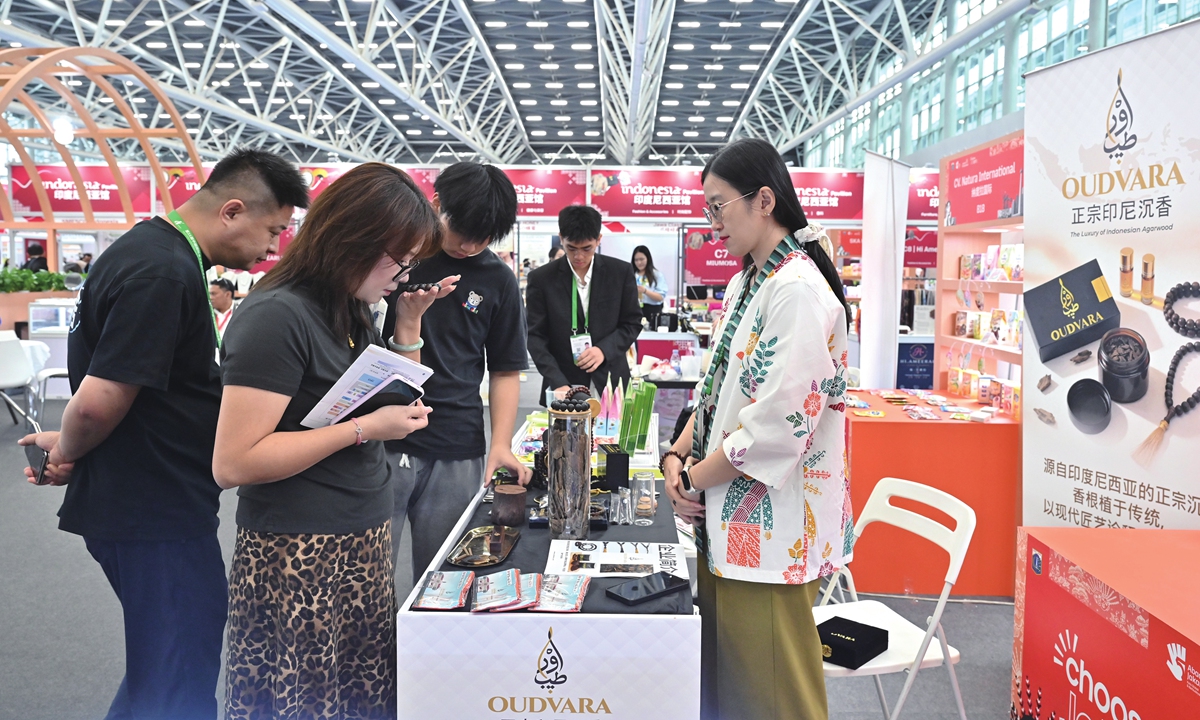
Visitors select agarwood at the Indonesia pavilion of the 21st China International Small and Medium Enterprises Fair held in Guangzhou, South China's Guangdong Province, on September 4, 2026. Photo: VCG
At her exhibition booth, neatly arranged trays display dried sea cucumbers of various sizes, alongside an assortment of other dried seafood products. Eldha Anggia, a seafood exporter from Indonesia, is attending the show for the very first time. Though her company is still a fledgling business - only two years old - she is brimming with confidence and eager to break into the Chinese market.
"We may be small, but we truly believe in the quality of what we offer," Anggia said with a warm smile. "We're very keen to explore opportunities in major Chinese cities, such as Shanghai, Beijing, and beyond. If there's any chance to work with Chinese partners, we would be absolutely thrilled."
The event that Anggia mentioned is the 21st China International Small and Medium Enterprises Fair in Guangzhou, South China's Guangdong Province, which opened on Thursday. A total of seventy-five Indonesian companies are showcasing their agricultural products, food, and medical supplies, hoping to enter China's massive market through this platform.
For many Indonesian small and medium-sized enterprises (SMEs), China is more than just an export destination - it represents a landscape of immense promise. With its vast population, growing demand for premium imported goods, and increasingly open trade policies, the Chinese market offers a rare opportunity for overseas businesses to scale up.
Vast opportunities
Anggia's optimism is shared by fellow Indonesian exhibitors.
Loh Jin Han, market development executive of CV. Manna Anugerah Sejahtera - an Indonesian company with just over 20 employees - is no exception. Now in his fourth year at the fair, Loh has brought a curated selection of his firm's premium offerings, including coconut products, sugar, chocolate, coconut oil, and coconut syrup.
For Loh, the fair is a fertile ground for networking and deal-making. Several Chinese buyers are already in active negotiations with his company over product imports. He is optimistic that a successful entry into the Chinese market would give his business a significant lift.
Maman Abdurrahman, Indonesia's minister of micro, small and medium enterprises, said China possesses abundant technological resources.
Introducing such technologies to Indonesia could bring tremendous benefits to the country. Through technological upgrading and digital transformation, Indonesian SMEs - particularly those in sectors like agriculture and food products - could gain greater opportunities to enter the Chinese market, according to Abdurrahman.
Broader vision
The fair coincided with the 32nd APEC Small and Medium Enterprises Ministerial Meeting, which took place in Guangzhou on Friday. During the one-day session, two significant initiatives were unveiled: the Asia-Pacific artificial intelligence empowerment cooperation center for SMEs in Guangzhou and a dedicated SME cooperation zone in Shenzhen, Guangdong.
Li Lecheng, China's minister of industry and information technology, said on Friday that these achievements fully demonstrate the high importance that APEC economies attach to supporting the development of SMEs, lay the foundation for deepening APEC cooperation in the SME sector in the future, and further contribute "Chinese solutions" and "Chinese strength" to promoting common prosperity in the Asia-Pacific region.
Abdurrahman spoke highly of the meeting's outcomes. He said it offers valuable opportunities for technology transfer, market opening, and stronger cooperation between Indonesia and China.
"If Indonesia is happy, China will be happy. And if China is happy, Indonesia will also be happy," he said, noting that the two countries already enjoy broad collaboration in many areas, and that the meeting has further expanded business opportunities for both sides.
Indonesia invites Chinese companies not only to invest in the country, but also to build together with Indonesia - creating stronger supply chains, developing talent, advancing technology, and serving regional and global markets from there, the Xinhua News Agency reported in July, citing Indonesia's Minister of Investment and Downstream Industry Rosan Roeslani.
China is one of Indonesia's primary strategic drivers as the Southeast Asian country accelerates industrialization and pursues its economic growth aspirations, said Roeslani, adding that China has been Indonesia's largest trading partner for 13 consecutive years and remains consistently among its top three sources of foreign direct investment.
Against this backdrop of growing cooperation, the upcoming 23rd China-ASEAN Expo in Nanning, capital of South China's Guangxi Zhuang Autonomous Region, from September 17 to 21 is poised to take bilateral ties to the next level, offering more neighboring countries an even bigger platform to showcase their products and forge new partnerships.
The expo will feature over 2,200 Chinese enterprises and nearly 1,000 Association of Southeast Asian Nations (ASEAN) companies. For the first time, a dedicated exhibition area will showcase the technological and application needs of ASEAN countries, enabling Chinese enterprises to engage in targeted business matching based on these displayed demands.
China's trade with the ASEAN exceeded $1 trillion for the first time in 2025, with bilateral trade reaching $1.05 trillion, up 7.4 percent year on year, China's Vice Minister of Commerce Yan Dong said on Tuesday.
China has remained ASEAN's largest trading partner for 17 consecutive years, while ASEAN has been China's biggest trading partner for six successive years.
Looking ahead, China will actively promote the early entry into force and implementation of the China-ASEAN Free Trade Area 3.0 Upgrade Protocol, which was signed in October 2025, and facilitate cooperation in key areas such as the digital economy and green development, Wang Liping, an official with the Chinese Ministry of Commerce, told the conference.
China will also expand imports of quality ASEAN goods to boost bilateral trade volumes and explore new space for cooperation in emerging fields, with a strong push for trade in services, digital trade, and green trade, said Wang.
RELATED ARTICLES