Smart breeding robot unveils embodied AI version capable of pollination, collecting data
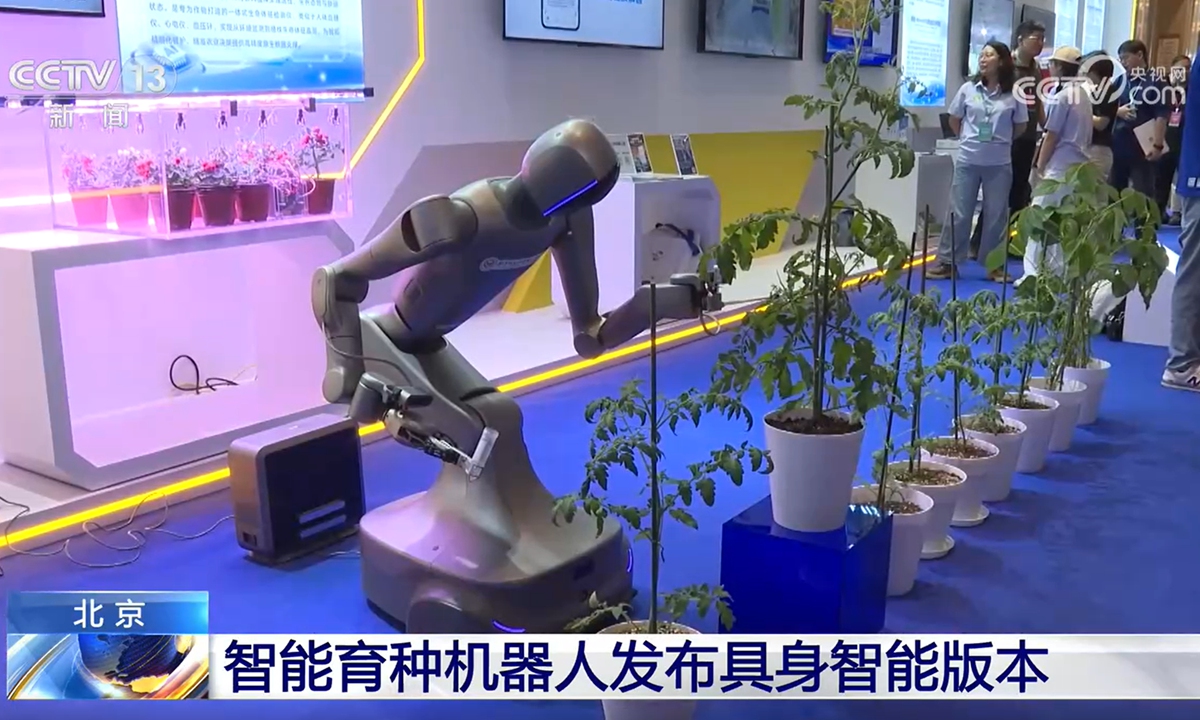
Photo: Screenshot from CCTV News
An embodied artificial intelligence (AI) version of China's robot GEAIR, capable of autonomous navigation and flower breeding, was recently unveiled in Beijing. The upgraded robot can now perform complex tasks including flower-part identification, positioning, pollination, and phenotypic data collection, according to Chinese state media CCTV News.At the launch event, GEAIR demonstrated the pollination of tomato flowers. Holding a pollen tube in its right hand and a pollination brush in its left, it worked with both "hands" in coordination: First dipping the brush into the pollen, then carefully sweeping it across the stigma of the tomato flower. A single pollination takes less than 10 seconds, and the amount of pollen picked up in one dip is enough for about 50 pollinations.
To begin with, agricultural experts used biotechnology to modify the crop's morphology, exposing the previously enclosed stigma and eliminating the need for manual petal-opening in search of it - thereby creating the physical space the robot requires for pollination. At the same time, the robot must navigate obstacles such as branches and leaves while accurately locating the needle-tip-sized stigma among crops to complete the pollination.
"Cross-pollination is repetitive labor," said Xu Cao, a research fellow at the Institute of Genetics and Developmental Biology of the Chinese Academy of Sciences. "It has to be done bent over within a very short time window, and it is exhausting. But this robot can work as soon as it is charged, and its operating window is much longer. What's more, it can operate autonomously in heat or cold, day or night. This way, farmers can get the job done better by managing the robot."
The advent of embodied AI breeding robots is empowering agricultural production through the integration of biotechnology and AI - driving a shift from "leaving crops to the mercy of the weather" toward "farming with scientific insight," while cutting costs, raising yields, and improving efficiency.
AI-driven technologies are invigorating China's smart breeding sector, propelling the digital and intelligent transformation of the agricultural industry and contributing to the country's food security.
In 2025, China's grain output hit a record 715 million tons. The outline of the 15th Five-Year Plan (2026-30) calls for raising comprehensive grain production capacity to about 725 million tons by 2030. It stresses stabilizing rice and wheat production while boosting corn and soybean capacity. Achieving this goal will require technology to play a central role in safeguarding the country's food security.
RELATED ARTICLES