ARTS / CULTURE & LEISURE
Cost, complexity, and fairness drive modern pentathlon to drop equestrian for obstacle racing: UIPM president
Obstacle racing reshapes modern pentathlon on road to LA Olympics
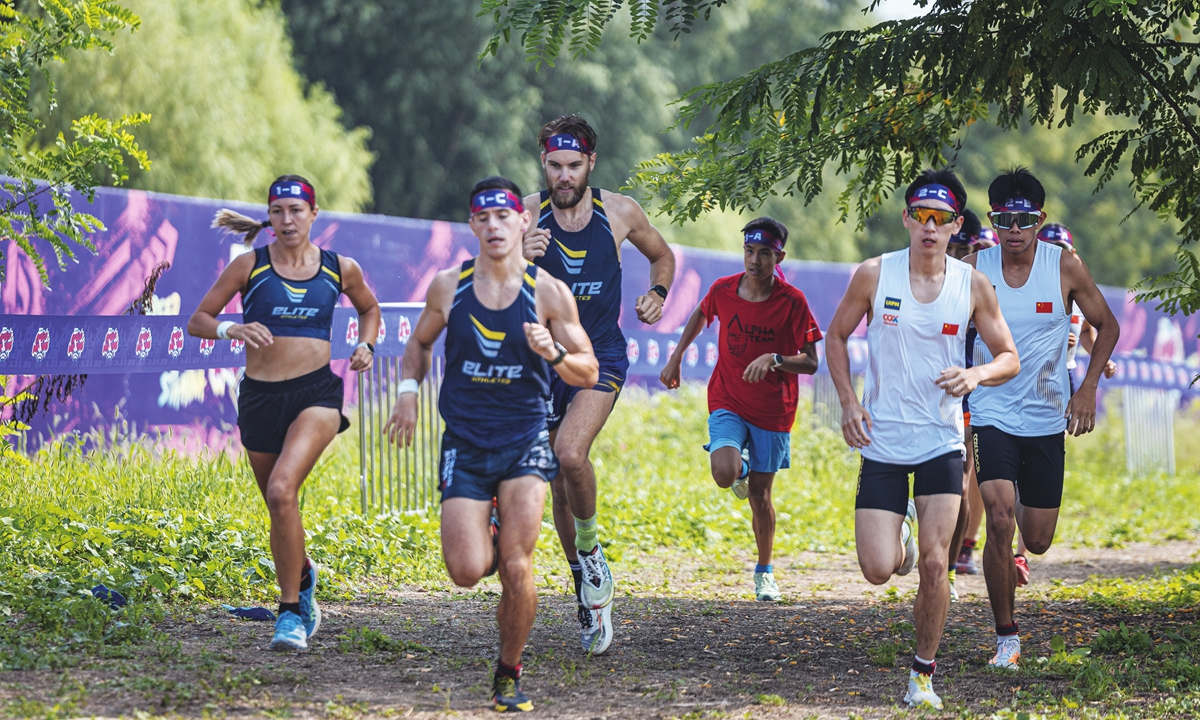
Athletes compete in the 3?km team event on September 6, 2026 at the UIPM 2026 Obstacle World Championships in Beijing. The Championships concluded that day, bringing the emerging Olympic sport closer to the public. Photo: Li Hao/GT
As athletes raced over walls and through a series of obstacles in Beijing on Sunday, the UIPM 2026 Obstacle World Championships came to a close, with cheers ringing out from around the course.The event came as obstacle racing prepares to make its Olympic debut at the 2028 Los Angeles Games, replacing equestrian as the fifth discipline of modern pentathlon, a sport that has included horse riding for more than a century.

Rob Stull, president of the Union Internationale de Pentathlon Moderne Photo: Jiang Li/GT
In an exclusive interview with the Global Times, Rob Stull, president of the Union Internationale de Pentathlon Moderne (UIPM), explained why the sport decided to leave equestrian behind, how obstacle racing was selected from dozens of alternatives, and what the change means for the future of the Olympic discipline."Cost, complexity, and fairness" were the three factors that drove the decision, Stull said. He also detailed how the UIPM reviewed 62 sports and projects against 14 criteria before choosing obstacle racing, and how the federation managed the transition for athletes who had spent years training and competing with horses.
Changing landscape
For decades, equestrian had been part of modern pentathlon. Keeping horses, maintaining facilities, and organizing training and transport could be costly, particularly for countries and regions with fewer resources. For some, that raised a question of how accessible the discipline could be as the sport sought to reach more people.
"For a sport to grow, your sport has to be accessible," Stull said. "Unlike football, which requires little more than a ball and two goals, equestrian requires horses, facilities, training, and transportation, making it difficult to develop in regions with fewer resources."
Cost was not the only concern. Fairness had also long been an issue. According to Stull, in modern pentathlon, athletes did not know in advance which horse they would ride, while the animal's condition could also affect performance.
"Horses are living beings. They're just like people. They have good days and bad days," Stull told the Global Times.
The change did not happen overnight. After the Tokyo Olympics in 2021, the UIPM first looked at whether the existing equestrian format could be adjusted to address concerns over fairness and accessibility. By late October, it had begun looking for an alternative. According to Stull, the federation set 14 criteria for a new discipline, covering factors such as cost, fairness, global reach, youth appeal, and broadcast potential. A 22-member working group then reviewed 62 sports and projects before narrowing the field to three. Obstacle racing eventually emerged as the choice.
For athletes who had spent years training and competing with horses, the change was harder to embrace.
"If you're an athlete and you're competing and you're a champion, you don't want to change," Stull said. "The UIPM introduced obstacle racing first at youth and junior competitions, while senior athletes continued with equestrian through Paris 2024."
According to Stull, obstacle racing is becoming a new entry point for modern pentathlon.
"Swimming had traditionally been the main route for athletes entering the sport, while obstacle racing is now attracting younger competitors," he said. "The average age is about 26.8 for modern pentathlon athletes, compared with about 22.6 for obstacle racers."
That younger generation can get started without much in the way of specialized equipment. Stull said even tables and chairs can be used for basic obstacle training. "In Guatemala, a wooden obstacle course was built for less than $2,000 and can last five to 10 years, while a 100-meter course in Cuba was made using scaffolding and other locally available materials," he said. That lower entry point is also changing how the sport can reach audiences beyond traditional pentathlon venues.
Setting a new stage
The change is already visible in the way major obstacle-racing events are being staged. Beijing hosted the inaugural standalone Obstacle World Championships in 2025 and brought the event back this year. The choice of Beijing is part of a broader relationship between China and the UIPM. In 2024, China hosted the Modern Pentathlon World Championships in Zhengzhou, Central China's Henan Province, before Beijing hosted the first standalone Obstacle World Championships the following year.
For Stull, the value of holding international competitions in China goes beyond the competition itself. "We trust the organizers here," he said, adding that international events like this also give athletes and spectators from different countries a chance to meet and experience China.
For US athlete Anthony Jacob, who competed at the Beijing championships, that experience extended beyond the competition. He told the Global Times that he enjoyed the food and atmosphere in Beijing and was especially glad to have a Chinese visa valid for 10 years, giving him the opportunity to return. Jacob said such experiences can make an international competition more than a short trip centered on results. Athletes arrive for the event, but their impressions of a country can also come from what happens between competitions, a meal, the atmosphere of a city, or the prospect of coming back.
For many Chinese athletes competing at the championships, exchanges were also taking place on the course. Beijing athlete Wang Yuanhao told the Global Times that some foreign competitors were curious about the host city, Beijing itself, asking about local food and places to visit after the competition.
"Conversations about the city often became a natural way for athletes from different countries to get to know each other, and that's how we make friends."
For Stull, these encounters are part of what international sports can offer beyond the results on the course.
"When you bring people together from different countries, they get to know each other, they get to know the culture, and they get to know the country," he said. "With obstacle racing, we can put a course in the middle of a city, bring the sport to the people, and let them see it up close."
RELATED ARTICLES