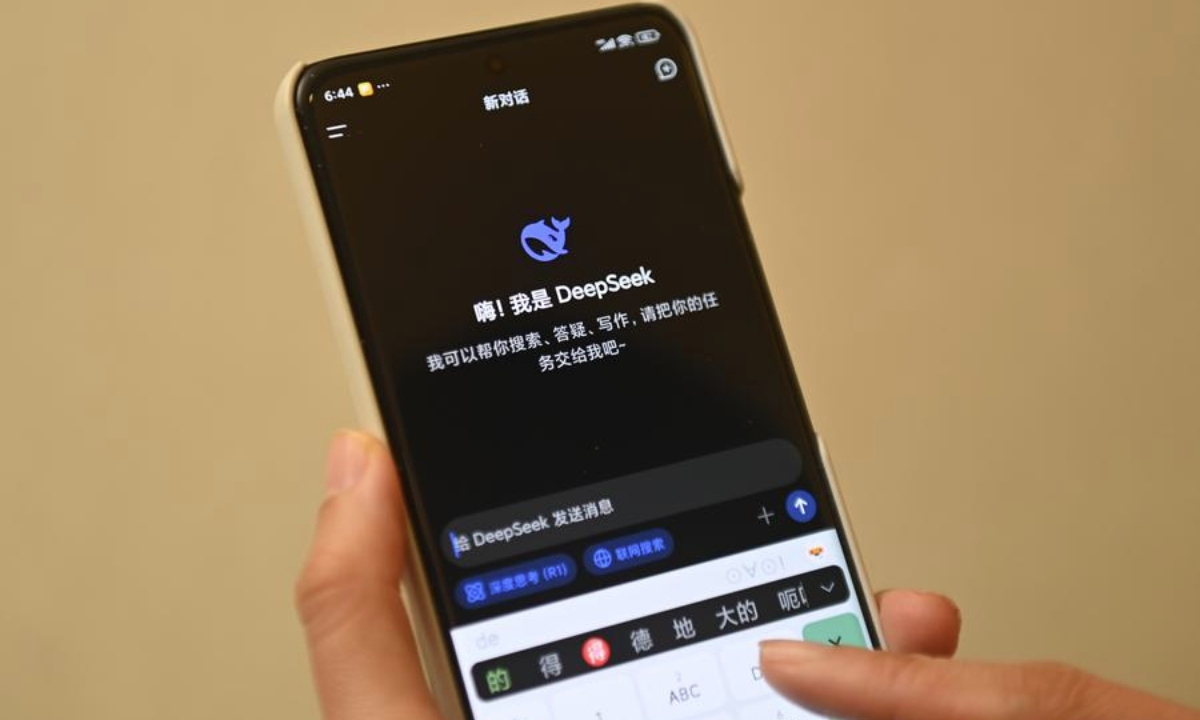
A person uses DeepSeek app on a mobile phone on Feb. 17, 2025. (Xinhua/Huang Zongzhi)
Chinese artificial intelligence (AI) developer DeepSeek on Tuesday opened about 150 new positions, targeting senior engineers with two to 10 years of experience. Unlike the company's broad recruitment drive in June, every one of the new roles sits on the engineering side, with not a single AI research position among them.
The pattern marks a clear turn in the industry, Chen Jing, a vice president of the Technology and Strategy Research Institute, told the Global Times on Tuesday. Competition among large-language model (LLM) developers is shifting from training models to building systems, he said. As the capability gaps among foundation models narrow, the moat is moving out of the laboratory and onto the ground where models are actually deployed.
The openings fall into two tracks. Server-side development engineers will work across the LLM research platform, agent framework components, research and development efficiency infrastructure, the DeepSeek API (Application Programming Interface), online services and data engineering.
Agent elastic computing engineers are split between platform development and underlying systems, according to a post by Cui Tianyi, head of DeepSeek's Harness team, on social media X.
Cui said in his post that anything in computing becomes vastly more complex once it grows large, listing volumes of data, machines and containers, training tasks, evaluation tasks, agent environments, users and requests, all rising sharply.
That shift has changed what counts. Model capabilities are converging fast, and leading Chinese and US models perform similarly on most tasks, Chen said. The question users and enterprises ask is no longer whether a model can do the job, but how well it does it: How fast it responds, how reliably it stays up and how much it costs.
Wang Peng, an associate research fellow at the Beijing Academy of Social Sciences, told the Global Times on Tuesday that hiring structures across leading Chinese AI firms are tilting toward engineering and deployment, marking the industry's move from a phase of technical breakthroughs into one of industrial application. DeepSeek is shifting from a small, research-focused organization into a scaled provider of industrial services, filling in engineering, operations and enterprise service capabilities that were previously thin, he said.
It is DeepSeek's second expansion this year. On June 25, the company said that it was working to at least double the size of every department, opening 33 job categories across seven areas, with positions in Beijing and Hangzhou, East China's Zhejiang Province. Its core team numbered only about 150 in early 2025, representing the team behind the R1 reasoning model.
By the time of the release of V4 in 2026, total headcount had passed 300, according to Chinese media outlet jiemian.com.
LLMs are no longer demonstrations but production tools, Chen said. Once agents are embedded in real business processes, a single outage or delay can translate into commercial losses, while inference costs climb exponentially with user numbers, making infrastructure efficiency a direct determinant of margins. As the technology gap narrows, the gap in experience becomes the gap in revenue, he said.
Raising inference speed and driving down the cost per call is what allows AI to move beyond high-end pilot projects at a handful of companies and become affordable across thousands of industries, Wang said. Engineering optimization also directly determines profit margins, he added, and is the main support for AI companies seeking to escape the model of burning cash for scale and move to generating positive cash flows.
After closing its first funding round of 50 billion yuan ($7.45 billion) in June, DeepSeek moved fast. It opened a large-scale recruitment drive to expand its team, then rolled out the full versions of DeepSeek-V4-Flash and DeepSeek V4 Pro in succession, along with a developer preview of DeepSeek Harness, Chinese media outlet 21st Century Business Herald reported.
DeepSeek also plans to deploy at least 160,000 of Huawei's next-generation Ascend 950DT accelerator chips at a data center under construction in Ulanqab, North China's Inner Mongolia Autonomous Region, to run its models. If the plan proceeds, it would become one of the largest known clusters of domestically developed AI chips, said the report.
Chinese AI commercialization is moving from chasing benchmark rankings to expanding systems, Chen said, strengthening infrastructure so agents can be embedded in real business flows at scale, while companies explore tiered API subscriptions, performance-based revenue sharing and ecosystem integration. The industry has passed proof of concept and reached the threshold of meaningful revenue, with leading firms including Zhipu, MiniMax, and Kimi listing or raising funds.
Several hurdles remain, Wang said. Adapting general-purpose models to specific industry scenarios still requires a large amount of engineering work, and there is a significant shortage of people who combine technical skills with an understanding of industry business logic. Self-reliance in computing infrastructure and extreme energy efficiency remain long-term challenges, and the industry is still working out how to move from technically usable products to ones that genuinely create commercial value, he said.
The room for growth is substantial, Chen said. Paid conversion among consumer users at Chinese model companies still trails leading overseas peers, and API pricing remains a fraction of premium overseas tiers, leaving considerable headroom for revenue as products mature and their value is recognized.
Surging user and agent task volumes have pushed system complexity to a new level, and the current wave of engineering recruitment is how companies are building the capacity to meet it. Getting that infrastructure right is what will carry the industry through the next stage of commercialization, Chen said.
RELATED ARTICLES