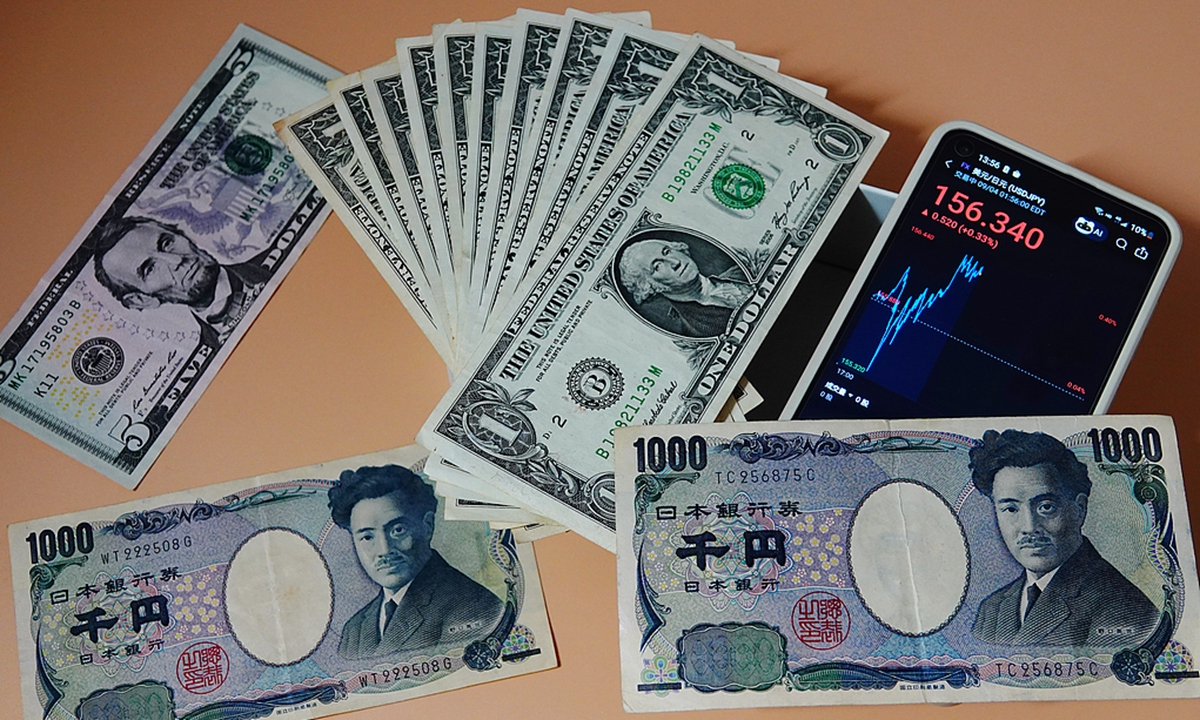
Japanese yen and US dollar Photo: VCG
Driven partly by expectations of faster Bank of Japan (BoJ) policy tightening, the yen has hovered around a seven-month high this week.
Meanwhile, US Treasury Secretary Scott Bessent on Tuesday touted his efforts to strengthen Japan's currency, saying that when he makes market calls these days, he's effectively doing so with inside information, Bloomberg reported.
His remarks, which drew widespread attention, came as the market expects the BoJ to raise its policy rate to 1.25 percent from the current 1.0 percent at its policy meeting scheduled for September 18.
Rising expectations of monetary tightening have not only fueled the yen's sharp rally, but also exposed rifts between the US and Japan behind their exchange-rate stabilization efforts.
In late July, the US Treasury bought yen to support the battered Japanese currency, the Financial Times reported, Washington's first yen-buying intervention with Tokyo in more than a decade. However, market observers generally believe that the US intervention actually centered on its own financial security, not Japan's economic stability. Japan is the largest foreign holder of US Treasury debt. If the BoJ were to stabilize the yen solely on its own, it would have to sell its holdings of US debt to obtain dollar liquidity and then buy yen in support of the currency.
According to data released on Monday by Japan's Ministry of Finance, Japan's foreign reserves stood at $1.208 trillion at the end of August, down by a record $79.6 billion from $1.287 trillion a month earlier. This is precisely the most sensitive point in US-Japan financial ties. Currently, US Treasury yields are facing intense upward pressure. A concentrated Japanese sell-off would deliver a direct blow to the US financial system.
Moreover, a weak yen has long been a thorn in America's side. The yen's low rate has significantly boosted the price competitiveness of Japanese automobiles, machinery, and other export products, drawing frequent complaints from US industries.
Sustained US diplomatic and financial pressure has left Japan with few policy alternatives, despite its full awareness of the severe economic costs of rate hikes. Japan's total government debt is estimated to reach 232 percent of its GDP by the end of 2026, far higher than in most other advanced economies.
The government's annual interest payments on its debt are sustained by an environment of ultra‑low interest rates. Raising rates against this backdrop would directly increase the fiscal burden, lifting financing costs for companies and households, and dealing a blow to already fragile market confidence. The Takaichi administration's recent fiscal expansion only adds fuel to the fire.
While rising interest rates threaten to strain Japan's already fragile economic and fiscal system, Washington shows no qualms about pressing for a hike, since its emphasis on yen stability seems always to be about serving US interests.
Last week, when Bessent met BoJ Governor Kazuo Ueda on the sidelines of the G20 finance ministers' meeting, he said that the yen is undervalued and that he supports Japan taking "decisive" action to address it.
Even if the rate hike materializes, the rifts between the US and Japan appear unlikely to heal. For a long time, the interest rate divergence between the US and Japan has fueled massive yen carry trades. Investors have borrowed yen and used the money to buy dollar assets such as Treasury debt and even equities.
The yen carry trade has been one of the major sources of funding behind the rally in US stocks in recent years, particularly in the artificial intelligence sector.
As Japanese long‑term rates rise, these leveraged carry positions will incur losses, potentially triggering a large‑scale unwinding, with global investors selling US bonds and stocks to repay their yen loans. Such a reversal would subject American financial markets to considerable adjustment pressures.
For this reason, it is hard to judge exactly how the exchange rate of yen will move after an interest rate hike.
If a Japanese government debt crisis breaks out, the yen will depreciate sharply; if the yen carry trade unwinds on a large scale, the yen will appreciate significantly. Both directions have the potential to send shock waves that affect the US.
But one thing is clear: As long as the US believes the yen-related risk remains unresolved, the rift in the US-Japan alliance will only deepen.
RELATED ARTICLES