ARTS / CULTURE & LEISURE
Shanghai sports bureau says Olympic champion Liu Xiang accepts 494,000-yuan buyout as athlete retirement deals draw attention
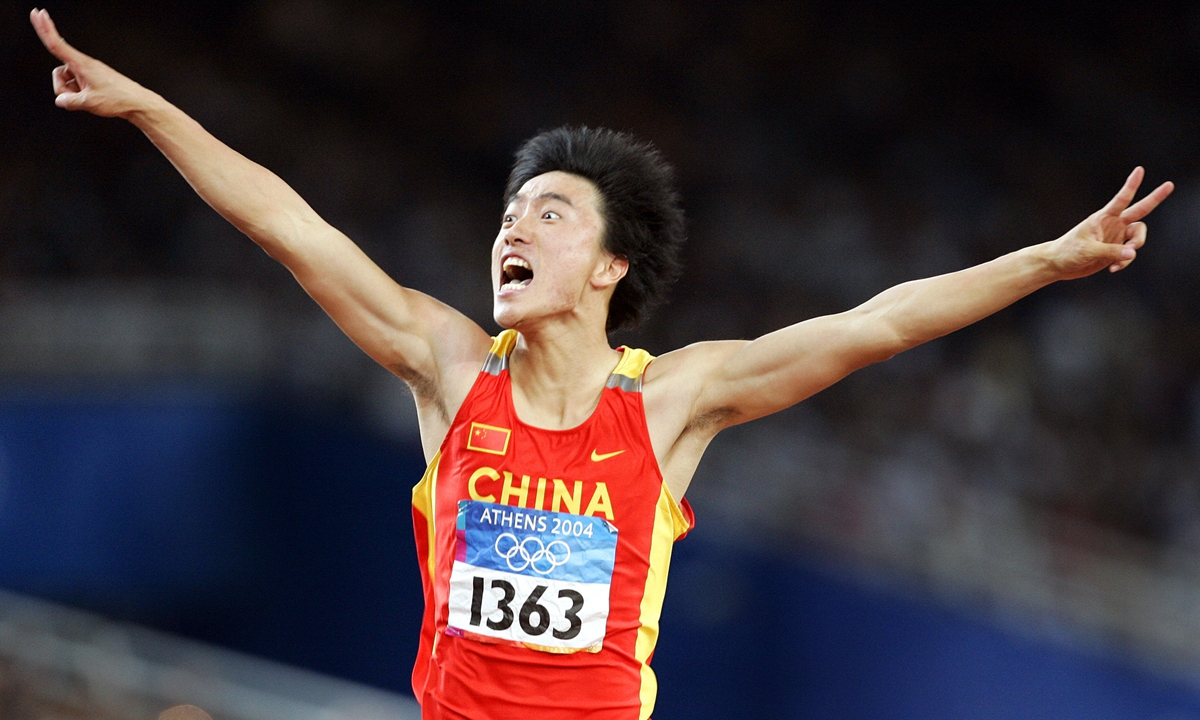
China's Liu Xiang celebrates as he crosses the finish line to win the men's 110 hurdles final at the 2004 Olympic Games on August 27, 2004 in Athens, Greece. Photo: VCG
Former Olympic champion Liu Xiang has chosen to leave the state sports system through a voluntary buyout, 11 years after retiring, the Shanghai Sports Bureau said Wednesday afternoon. The move comes as the hurdler's comments anpit his retirement arrangements have sparked public discussion.
Liu, one of China's most accomplished track and field athletes, had been offered several options for a post-retirement placement, including positions involving the head of an athletics center, a technical director and sports universities, the bureau said in a statement on its official Sina Weibo account on Wednesday. Liu ultimately chose to pursue a career independently, the bureau said, adding that it respected his decision.
According to the bureau, Liu submitted an application to voluntarily choose independent employment on September 1 and signed the relevant agreement. His personnel transfer procedures were largely completed by September 7, and he was given 494,000 yuan ($73,200) in economic compensation.
The arrangement followed a public discussion over what Liu described as being asked to choose between a buyout and working as a coach.
Liu, 43, said in a post on his personal Weibo account on Wednesday morning that he had completed the buyout process on September 1 and received 494,000 yuan.
He also said he had donated 982,935 yuan in wages and subsidies he had received since April 7, 2015, the date of his retirement, to the China Charity Federation for disaster relief following mudslides in Southwest China's Xizang Autonomous Region.
The Shanghai Sports Bureau said it expressed its respect for Liu's decision to donate his post-retirement income to relief efforts.
Liu also addressed the controversy surrounding his retirement arrangements, saying that he respected the regulations but objected to using them as an excuse for delays.
"I respect the regulations and accept the oversights, but regulations have never been an excuse," Liu wrote. "Just like becoming a coach or taking the buyout, it came 11 years late, and it was no longer a choice."
Liu said he did not want public pressure to force authorities to create a third option for him. Instead, he called for more flexible and diverse arrangements for retired athletes.
"I hope the organization will seriously consider the future of every retired athlete and treat them well, allowing retirement arrangements to be more flexible and giving them more suitable choices," he wrote.
Liu retired in 2015 after a career that made him one of the most recognizable athletes in Chinese and Asian track and field.
Born in Shanghai in 1983, Liu won the men's 110-meter hurdles at the 2004 Athens Olympics in 12.91 seconds, equaling the then-world record and setting an Olympic record. He broke the world record two years later, running 12.88 seconds at a meet in Lausanne, Switzerland, and went on to win the 110-meter hurdles at the 2007 World Championships in Osaka, Japan.
Liu's career was subsequently hampered by injuries. He withdrew from the 110-meter hurdles at both the 2008 Beijing Olympics and the 2012 London Olympics, and formally announced his retirement in April 2015.
Under China's system for retired athletes, post-retirement arrangements can include organizational placement within the sports system or self-employment placement, under which an athlete leaves the system and receives a one-time settlement, Fu Zhenghao, a sports commentator, told the Global Times.
According to Xinhua News Agency, more than 3,000 athletes retire each year in China, with the number typically rising in years that coincide with the Olympic Games or China's National Games.
Many accomplished athletes transition into coaching, drawing on their professional expertise and competition experience to pass on their knowledge to the next generation. Olympic table tennis champion Wang Hao, for example, became coach after retiring, helping train successive generations of Olympic and world champions.
Others have moved into sports administration. Former Olympic diving champion Xiong Ni, table tennis world champion Qiao Yunping, Olympic weightlifting champion Zhan Xugang and Olympic volleyball champion Li Shan are among those who have taken up leadership positions in sports departments.
An increasing number of retired athletes are also finding opportunities as physical education teachers. The expansion of school sports has created a new career path for athletes seeking to put their sporting experience to use beyond professional competition.
Some choose to return to school themselves, pursuing university degrees and further education after retirement. Athletes who have been awarded the title of International Master of Sports or achieved outstanding results in major competitions may be eligible for admission to universities through special programs.
Others have ventured into business and entrepreneurship. Li Ning, the Olympic gymnastics champion who founded the sportswear brand that bears his name, is perhaps the best-known example.
The rise of social media and short-video platforms has also opened another avenue for retired athletes. Chinese Olympic champion Zhang Jiaqi, for example, has turned to livestreaming e-commerce on Douyin after retiring.
RELATED ARTICLES