US President's claim that he would love to see Irish reunification highlights ‘delicate ties’ between US and UK
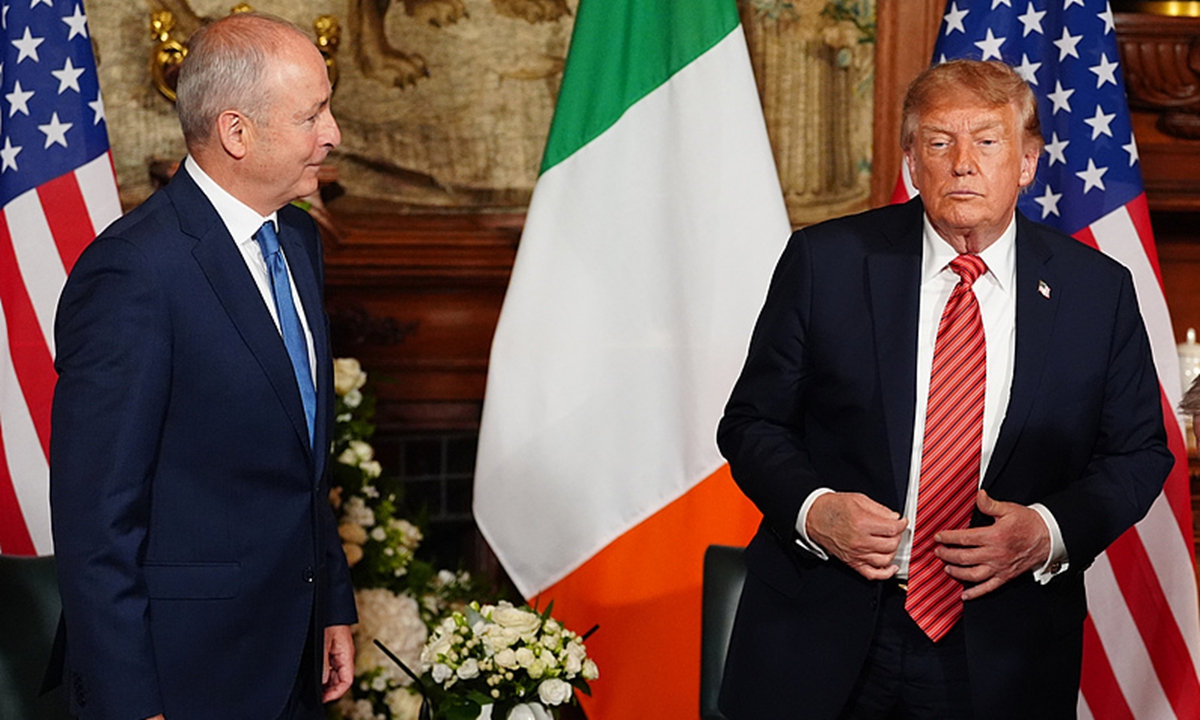
Ireland's Prime Minister Micheal Martin and US President Donald Trump during a meeting at Farmleigh House in Dublin on September 12, 2026. Photo: VCG
"Well, I don't want to cause any problems, but I will tell you, I'd love to see it unified," Trump told reporters sitting next to Irish Prime Minister Micheal Martin after the pair met in Dublin. "It's going to happen eventually ... I think it would be a fantastic thing," Reuters reported.
Trump later said that there "was no good answer" to the question on Irish unity but repeated that he thought it would be "a very cool thing," per the Reuters report.
The US President's comments come weeks after new British Prime Minister Andy Burnham said a referendum on Northern Ireland leaving the UK was "off the table", a position Downing Street on Saturday said remained unchanged.
Under the terms of the 1998 Good Friday Agreement, a referendum can be held only at the discretion of the British government, the Reuters report noted. The accord ended three decades of violence between Irish nationalists seeking a united Ireland and unionists who wanted Northern Ireland to remain part of the UK.
The unexpected intervention prompted a swift rebuttal from the UK government and Northern Ireland's unionist leaders, the Guardian reported on the same day. Gavin Robinson, the Democratic Unionist party (DUP) leader, said Northern Ireland's constitutional future would be decided by its people, not by commentary in London, Dublin or Washington.
The Conservative leader, Kemi Badenoch, citing what the US President "did with Greenland and Canada becoming the 51st state," noted that this sort of loose talk about the future of democratic countries is deeply unhelpful and creates unnecessary tension, according to the media outlet.
The Ulster Unionist Party (UUP) leader Jon Burrows said that while America is an "important ally," Northern Ireland's future will be decided by its people, the BBC reported.
A BBC article, however, questioned the real audience of Trump's speech as though it was billed as a 20-minute address to Irish and Irish American business leaders, but was about twice that and strayed largely into domestic US matters.
Li Guanjie, a research fellow with the Shanghai Academy of Global Governance and Area Studies under the Shanghai International Studies University, told the Global Times that UK-US relations are increasingly delicate.
Under the current administration, Washington has become more involved in the UK's domestic affairs, while Britain has also challenged US positions on issues such as Greenland. As US foreign policy shifts, differences between the two countries are becoming harder to ignore, Li said.
The New York Times noted that the comment breaks with decades of US neutrality on an issue rooted in a long history of violence.
This rhetoric on unification may also serve as a means for the US to pressure the UK to align with Washington's priorities, Li continued.
Trump repeated his criticisms once again of what he views as the UK's lack of support for his military operation in Iran, per BBC.
However, their different capabilities and priorities make a close alignment difficult. Washington's insistence that Britain follow its lead therefore reflects US interests without fully taking into account Britain's circumstances, the expert added.
RELATED ARTICLES