ARTS / CULTURE & LEISURE
Bai Yulu reclaims women’s snooker world No.1 with eyes on the Crucible
China’s female snooker player Bai Yulu hopes to inspire generations
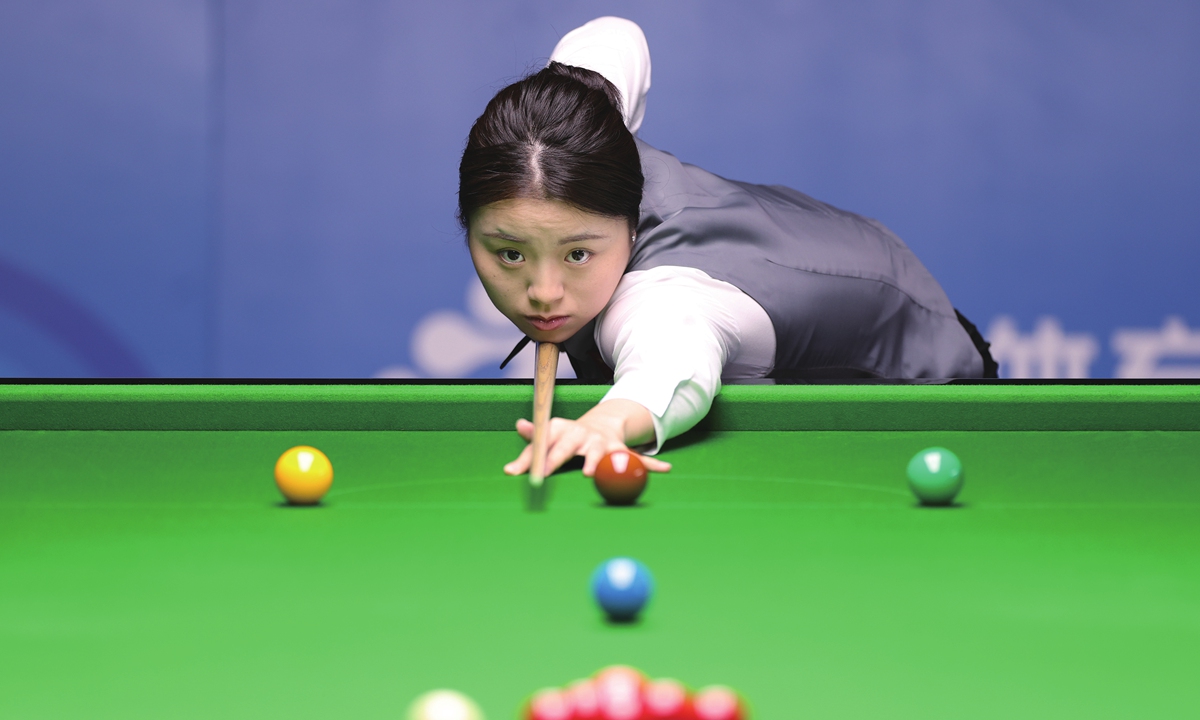
Chinese player Bai Yulu Photos on this page: VCG
For 23-year-old Chinese snooker player Bai Yulu, reclaiming the world No.1 ranking was not quite the celebration it might have been the first time around.The Chinese player defeated England's Reanne Evans 4-1 in Leeds on September 6 to win the UK Women's Snooker Championship for the third consecutive year and return to the top of the women's rankings.
But having already experienced what it feels like to reach No.1, and then lose the position, Bai said the latest achievement had left her with a stronger sense of urgency than excitement.
"I feel that the second time, the sense of urgency is actually stronger," Bai told the Global Times in an exclusive interview. "The first time I reached No.1, I was probably happier. Although I knew the points difference wasn't very big, I still felt that way."
Bai first rose to world No.1 in January 2026 after winning the WSF Women's Championship, but lost the top spot after she was knocked out in the quarterfinals of the World Women's Snooker Championship in May.
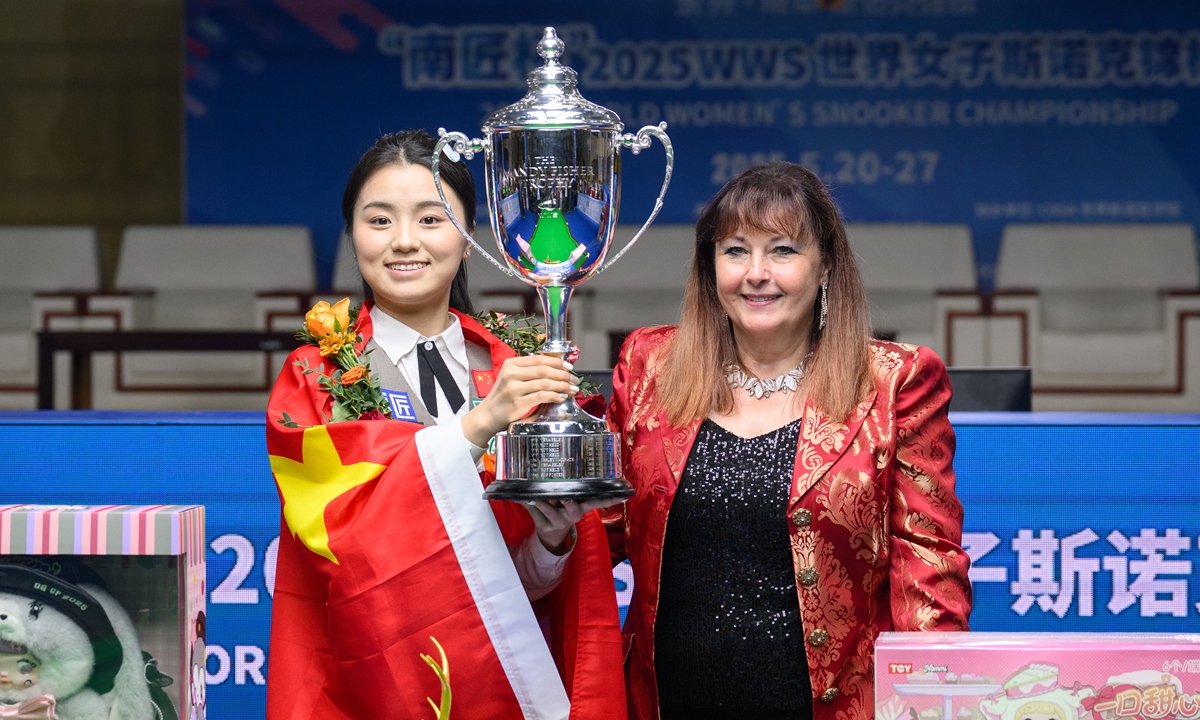
Bai Yulu (left) holds the trophy of 2025 World Women's Snooker Championship in Dongguan, Guangdong, on May 27, 2025. Photos on this page: VCG
That experience has changed how she looks at the ranking."I really feel that I can't relax," Bai said. "In every tournament, the environment is different, and you can't guarantee that you will perform particularly well every time. So I still need to maintain that sense of urgency and keep my form and results stable."
Target beyond No.1
If the world No.1 ranking is not Bai's ultimate destination, what is? Her answer is straightforward: the Crucible.
"I definitely want to qualify for the main draw stage [of the World Snooker Championship] at the Crucible," Bai said.
The Crucible Theatre in Sheffield is the traditional home of the World Snooker Championship, where the world's leading men's players compete for the sport's biggest title.
Bai has already tested herself in that environment. In the 2026 qualifying tournament, she defeated Daniel Womersley 10-7, becoming the first female player to win a match at the World Championship qualifier in nine years.
Yet Bai knows that winning one qualifying match and reaching the Crucible main draw are two very different challenges. "Every time I play in the qualifying tournament, it's a very long match," she said. "For me, every time I finish one of these matches, I feel a little exhausted."
She described the experience as one that requires her to give it her all, physically and mentally.
"It really feels like I'm using everything I have in that match," she said. "There is also the mental battle of facing the problems your opponents give you and trying to solve them."
Growing Chinese presence
Bai's ambition also reflects a broader change in the snooker landscape.
When she first began watching professional snooker, there were relatively few Chinese players competing overseas. Now, she said, more than 30 Chinese players are competing in the UK. "Chinese players are becoming more numerous, and the overall strength of the Chinese contingent is getting stronger and stronger," Bai said.
For players living and competing far from home, that growing presence matters.
"When we come to compete overseas, every player seems to feel more confident," she said. "The internal competition becomes more intense, and in that environment everyone seems to be able to improve together."
She has also noticed that the growing number of Chinese players has changed how they are perceived by audiences abroad.
"We feel that when we're abroad, we receive a lot of respect," she said.
The growth did not happen overnight. Bai remembers earlier generations of Chinese players as the figures who first brought the sport to her attention.
For her generation, those pioneers created a pathway. Now she sees another cycle taking place, as younger players are inspired by the achievements of today's Chinese professionals.
"When we were young, the standout figure of Chinese snooker was definitely Big Brother Hui," Bai said, using the familiar Chinese nickname for snooker trailblazer Ding Junhui. "He influenced generation after generation of players to get into the sport or take the professional path."
She also pointed to the success of younger Chinese players such as men's world champions Wu Yize and Zhao Xintong as another source of inspiration for children now picking up a cue. "Through the efforts of these players on the table, every performance can make more people pay attention to snooker and fall in love with it," she said.
Quiet evolution
For Bai, the development of Chinese snooker is not only about the men's game. She has seen more girls in China begin to take up snooker seriously, even as women's participation remains much smaller than men's. "Before, we felt that there weren't many female players either," she said. "Now, gradually, there are more, and many young girls are beginning to get involved and take the professional path."
She said the next stage of women's snooker will depend on the collective efforts of female players rather than any one individual. "It really depends on the collective strength of female players working together," Bai said.
At the same time, competing alongside men can provide valuable experience. "Through constantly playing against stronger male players, including competing with them on the same stage, we will definitely learn more and gradually grow," she said.
Bai has given herself a concrete target for the next five years: a place inside the world's top 64 men's players.
"I hope that in five years I can reach the top 64," she said. "Although that is only just the top 64, there will actually be a lot of challenges." The biggest of them, she noted, is experience.
"In that kind of high-intensity competition, I still need more experience, as well as more experience in tactics and technique," she said.
Bai is already looking beyond the ranking. "I think first of all, I need to be a good player. For me, no matter what happens, I want to always maintain that perseverance in competition," Bai said. "I hope to show everyone that kind of determination, and also inspire more young girls."
RELATED ARTICLES