‘Robots building robots’: World’s 1st 10,000-unit-scale industrial humanoid robot smart factory starts production
By Liu Yang and Published: Sep 14, 2026 10:57 PM

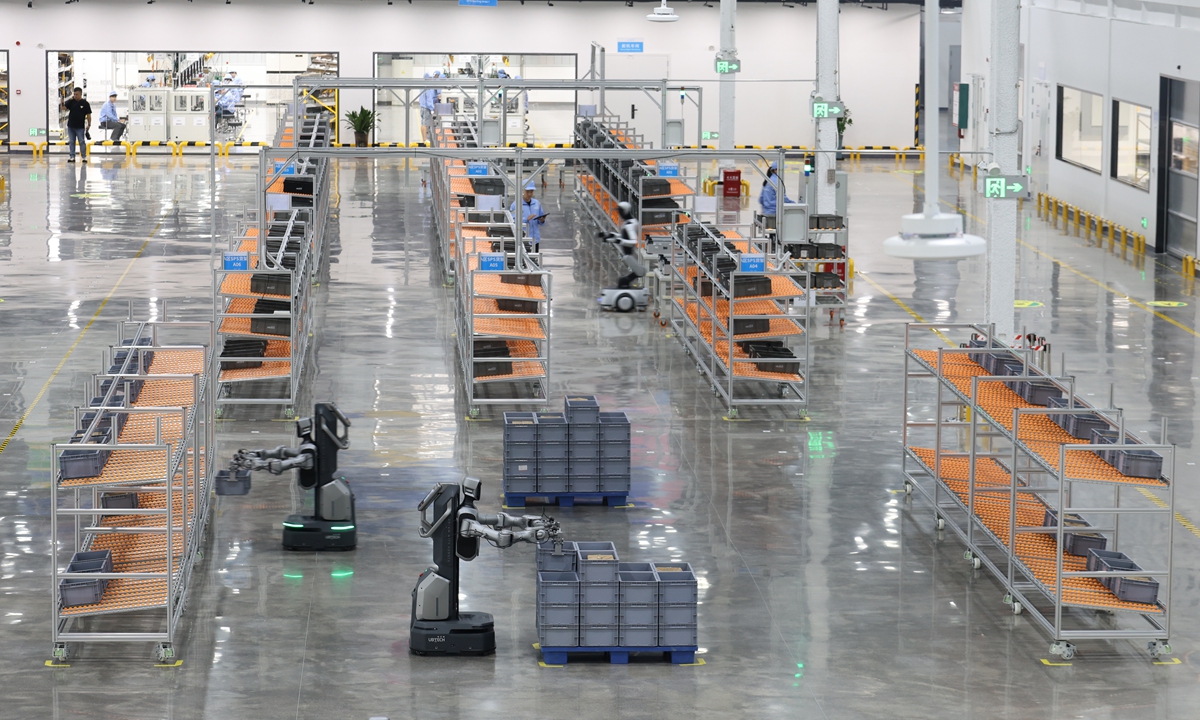
A view inside UBTECH Robotics' smart factory in Liuzhou, South China's Guangxi Zhuang Autonomous Region Photo: VCG
The world's first intelligent manufacturing facility for humanoid robots designed for 10,000-unit capacity has begun operating in Liuzhou, South China's Guangxi Zhuang Autonomous Region, UBTECH Robotics, China's humanoid robot developer, announced on Sunday, noting that the factory can roll out one industrial humanoid robot every 10 minutes.The project relies on intelligent planning through industrial simulation systems and scheduling by a digital "smart brain," truly realizing the manufacturing model of "robots building robots." This pulls Chinese humanoid robots from lab prototypes and small-batch trial production into a brand-new stage of large-scale intelligent manufacturing, said the company.
According to UBTECH, the plant covers 14,000 square meters and stands 13.8 meters high. It primarily produces the Walker S series and Cruzr series of embodied intelligent industrial humanoid robots.
Foreign enterprises also participated in the construction of the smart plant, as it was jointly built by UBTECH and Siemens Digital Industries Software. Powered by the jointly developed manufacturing operations management system that serves as the factory's "smart brain," it achieves full-process digital closed-loop management of work-order scheduling, material distribution, and quality monitoring. Full-process one-item-one-code traceability is enabled through each robot's unique serial number, said a statement on the company's WeChat account.
In this factory, robots serve both as products and as tools of new-quality productive forces, providing the entire industry with a replicable mass-production template.
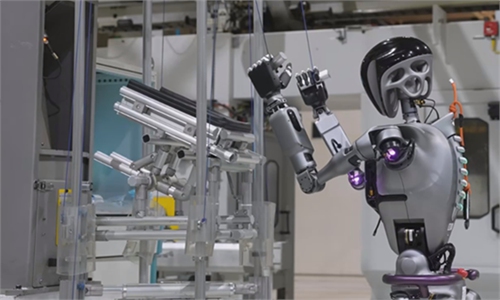
On the production front line, embodied intelligent industrial humanoid robots such as the Cruzr Y1 and Cruzr S2 participate in depalletizing, palletizing, loading, and material handling. Final assembly employs collaborative robots, power-assist manipulators, unmanned logistics vehicles, and 360-degree rotating worktables that enable multi-angle precision assembly in place, supporting flexible mixed-model production of multiple robot types.
For quality inspection, each complete robot undergoes more than four hours of whole-machine testing and passes through an automotive-grade lighting inspection tunnel for 360-degree dead-angle-free appearance screening.
In the warehousing and logistics segment, UBTECH has independently developed the industry's first fully automated stereoscopic warehouse for humanoid robots. Occupying only 65 square meters, it can store 112 robots and improves space utilization by more than 50 percent.
Moreover, a full-domain intelligent logistics matrix composed of automatic guided vehicles, unmanned forklifts, and logistics vehicles connects the entire chain of sub-assembly, final assembly, testing, and storage, efficiently matching the turnover demands of 10,000-unit-level capacity, according to the statement.
Pang Jianxin, vice president of UBTECH, said in an earlier interview with the Global Times that mass production is inseparable from the support of China's supply chain. "Without the Chinese supply chain, mass-producing complex components would be extremely difficult unless cost advantages were completely sacrificed," Pang noted.
"Chinese robots have already entered the global first tier. This foundation rests on the large number of engineers, scientists, and application scenarios accumulated in China over the past 10 to 20 years, which have formed a very strong supply-chain base, manufacturing capability, as well as research and development strength. In industrial applications, China is also at the forefront because it possesses the richest scenarios," Pang said.
In July, China's industrial robot output reached 98,677 units, representing a year-on-year increase of 30.2 percent. From January to July, production totaled 635,056 units, up 28.5 percent, data from the National Bureau of Statistics showed.
RELATED ARTICLES