ARTS / CULTURE & LEISURE
Interview with Chinese sci-fi writer: Can Chinese sci-fi find its next breakthrough after Three-Body?
AI works ‘too smooth’ as literature needs ‘friction’
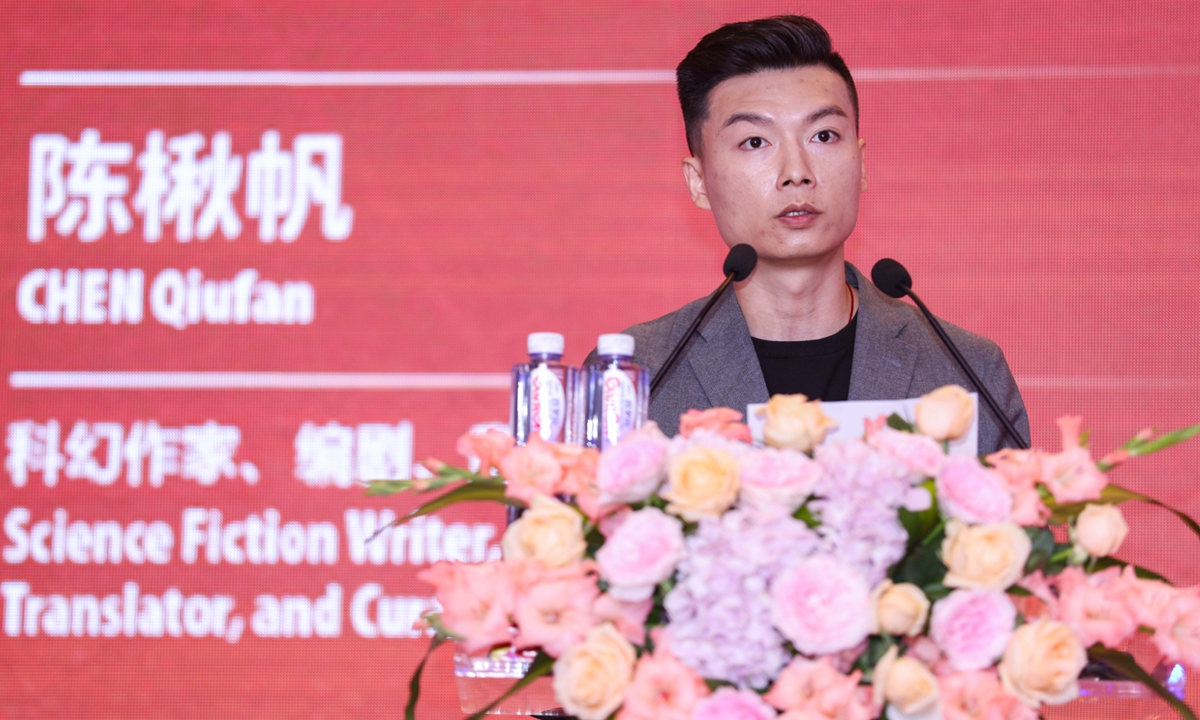
Chinese science fiction writer Chen Qiufan Photo: VCG
The 37th Galaxy Awards, which concluded on Friday, saw a 1990s-born writer sweep three major awards, a pop star's sci-fi book attract attention after making the shortlist, and the Best Long Novel Award left vacant.Chinese science fiction writer Chen Qiufan won his seventh Galaxy Award for his novel Ocean Break, which received the Best Original Book Award. Meanwhile, 1990s-born writer Hua Yanxin swept three honors - Best Short Story, Best Novelette and Best Newcomer - emerging as one of the most prominent new voices at this year's awards.
The shortlist for the Best Original Book Award also drew attention beyond the traditional sci-fi community, with Hong Kong singer G.E.M.'s The Path of Revelation making the final list, though it ultimately failed to win.
Science Fiction World, the organizer of the awards, said the winning works at this year's Galaxy Awards reflect both current trends and emerging themes in science fiction while reaffirming the magazine's commitment to the genre's core appeal. The winners include established writers, mid-career authors and emerging voices.
Chen noted the three awards won by Hua Yanxin and G.E.M.'s inclusion on the shortlist both reflect a more open science fiction community, where age and professional backgrounds are becoming less of a barrier. G.E.M.'s selection, he said, was also a recognition of her creative ability and helped introduce science fiction literature to a wider audience.
This year marks the 20th anniversary of the publication of The Three-Body Problem. Over the past decades since the novel was first published, Chinese science fiction has reached a much wider international audience.
In Chen's view, part of this trend "reflects China's growing strength in technology and innovation."
Chen told the Global Times that he was encouraged by the continued improvement of younger writers.
"I think Chinese science fiction is getting better and better. For one thing, the quality of works by the younger generation has improved tremendously. There are also more and more awards and writing competitions, particularly those aimed at young people," he said.
"In a sense, all of this is laying a stronger foundation for the development of Chinese science fiction, cultivating an environment and nurturing the soil for the genre to grow," added Chen.
"But the question is, how do we produce a work like The Three-Body Problem in the post-Three-Body era? How do we find a different path and break new ground?" Chen said.
A younger generation of science fiction writers has been experimenting with broader subjects and forms, including ecological writing, cross-media storytelling and content creation involving artificial intelligence (AI).
The growing use of AI has also introduced a new question for literary awards: How to define the role of human creativity in an era when machines can generate increasingly sophisticated text and images.
This year's Galaxy Awards guidelines specifically mentioned scrutiny of works generated by AI that were not properly labeled.
Chen has been thinking about AI and writing for years. He began experimenting with AI-assisted writing in 2017, well before generative AI became a mainstream consumer technology.
In his creative process, AI serves as a collaborative partner. He often assigns it different roles, such as philosopher, scientist or thinker, and engages it in extended conversations.
"AI-generated text is too smooth, like glass that leaves no fingerprints," Chen said. Human experience, by comparison, is rough and carries warmth and imperfections. "Good literature needs friction," he said.
Chen said the rapid development of technology also changed the way he thought about the relationship between science fiction and the future.
While he was writing Ocean Break, ChatGPT spread around the world within months, while brain-computer interfaces had already entered human clinical trials. Some of the technological details he had imagined in the novel were subsequently reached by real-world developments, he said.
"Many ideas that once existed only in science fiction are becoming a reality," Chen said. "Using AI is a natural development. But creators must continue to think independently."
Ultimately, he said, the value of a work is still determined by human creativity.
Chen also stressed the importance of allowing writers to express their own cultural identity. For him, successful cultural exchange is not about adapting Chinese stories to fit foreign expectations. As a genre, science fiction naturally transcends national boundaries. It explores humanity's relationship with technology, the future and our shared destiny - questions that can resonate across languages and cultures. By combining these universal themes with distinctive Chinese traditions and perspectives, writers can create stories that are both globally accessible and culturally rooted.
"Science fiction provides a common language," Chen said.
RELATED ARTICLES