Germany's planned China curbs risk externalizing competitiveness problems: expert
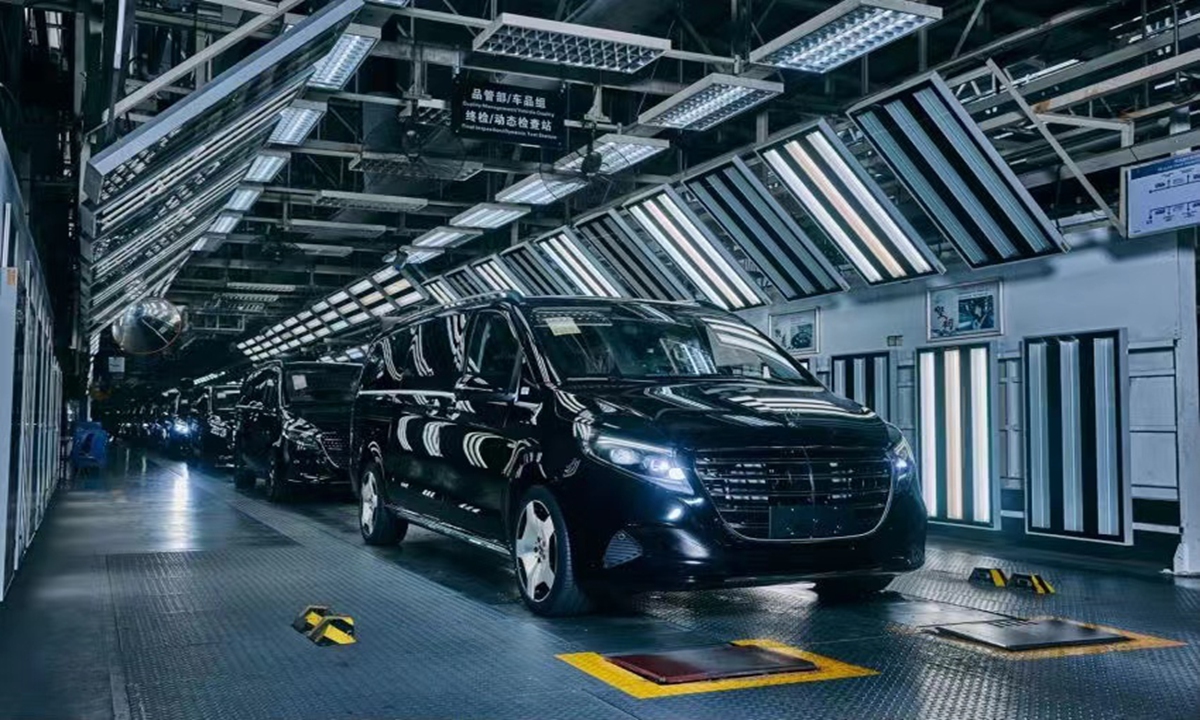
A view of a Mercedes-Benz factory in East China's Fujian Province. Photo: Courtesy of Mercedes-Benz
Germany is preparing a far-reaching package of economic-security measures to shield strategic industries from China that may include new tariffs on hybrid electric vehicles (EVs), Bloomberg reported. A Chinese expert said that the planned measures risk externalizing Germany's own competitiveness problems rather than addressing the structural challenges facing its industrial sector.
More tariffs and restrictions against China would do little to address Germany's underlying economic problems and could instead raise costs, disrupt China-Germany supply chains and weaken the competitiveness of German industry, the expert said.
German ministries are mapping vulnerabilities to China and assessing countermeasures, with potential proposals including new tariffs, mandatory joint ventures, strengthened inbound and outbound investment screening and a bolstered export control regime, according to people familiar with the plans, Bloomberg reported.
Chancellor Friedrich Merz's government is targeting cabinet approval on October 14 before seeking broader support from the EU, according to the report.
Berlin is working with Paris to build support among other EU members at a summit in Brussels in October and ahead of talks with Beijing later that month, Bloomberg reported.
The reported push represents a further toughening of Germany's China policy at a time when the country's industrial sector, particularly its auto industry, is under growing pressure, said the report.
Treating competition from China as a major cause of Germany's industrial difficulties risks externalizing Germany's own problems, which are largely structural and have accumulated over many years, Hu Qimu, a professor at the Maritime Silk Road Institute of Huaqiao University, told the Global Times on Tuesday.
Hu noted that Germany's industrial challenges stem from a combination of factors, including high energy and labor costs, weak investment and mounting pressure for technological transformation.
Meanwhile, Chinese vehicle producers have strengthened their competitiveness through technological innovation, integrated supply chains and intense competition in the domestic market, the expert said.
Chinese carmakers grew market share in Europe with a hybrid surge, according to media reports. According to Singaporean media outlet the Business Times, Chinese automakers' share of new car sales in Europe topped 11 percent in July, as consumers continued to snap up more affordable plug-in hybrids. A record one-third of plug-in hybrids registered in July were made by brands such as Chery Automobile's Jaecoo, the report said, citing data from Dataforce.
Their growing presence in Europe reflects global demand for cost-effective EVs as well as the needs of the green transition in the region, Hu said.
Evidence from Germany's own business community suggests that domestic and European structural factors are contributing to the competitive pressures facing German companies.
A recent survey released by the German Chamber of Commerce and Industry (DIHK) claimed that corresponding feedback indicates that the competition risks are not solely due to China but also European structural disadvantages, giving examples such as "higher energy or labor costs" and "excessive bureaucratic regulations in Europe."
"Not every Chinese competitive advantage is a distortion of competition, and not every German competitive disadvantage originates in China," DIHK's head of foreign trade Volker Treier acknowledged, according to Reuters.
At the same time, German companies' investment decisions point to the continued importance they attach to the Chinese market despite the increasingly restrictive policy debate in Berlin.
German companies increased investment in China by one-third in the first half of 2026 while sharply reducing investment in the US, according to a study by the German Economic Institute seen by Reuters on Sunday.
The latest findings highlight a potential gap between the increasingly restrictive policy debate in Berlin and the practical needs of German businesses operating in China, Hu said.
"Rather than resorting to tariffs, which would raise costs, disrupt China-Germany supply chains and weaken the competitiveness of German industry, a more sustainable approach for Germany and the bloc would be to strengthen innovation, improve the investment environment and accelerate industrial transformation while maintaining open markets and cooperation with China," Hu said.
Global Times
RELATED ARTICLES