BUSINESS / CHINA NEOMAKE
China’s industrial output growth accelerates in August; high-tech manufacturing, robot production see sharp gains
New growth drivers contribute over 60% of industrial expansion
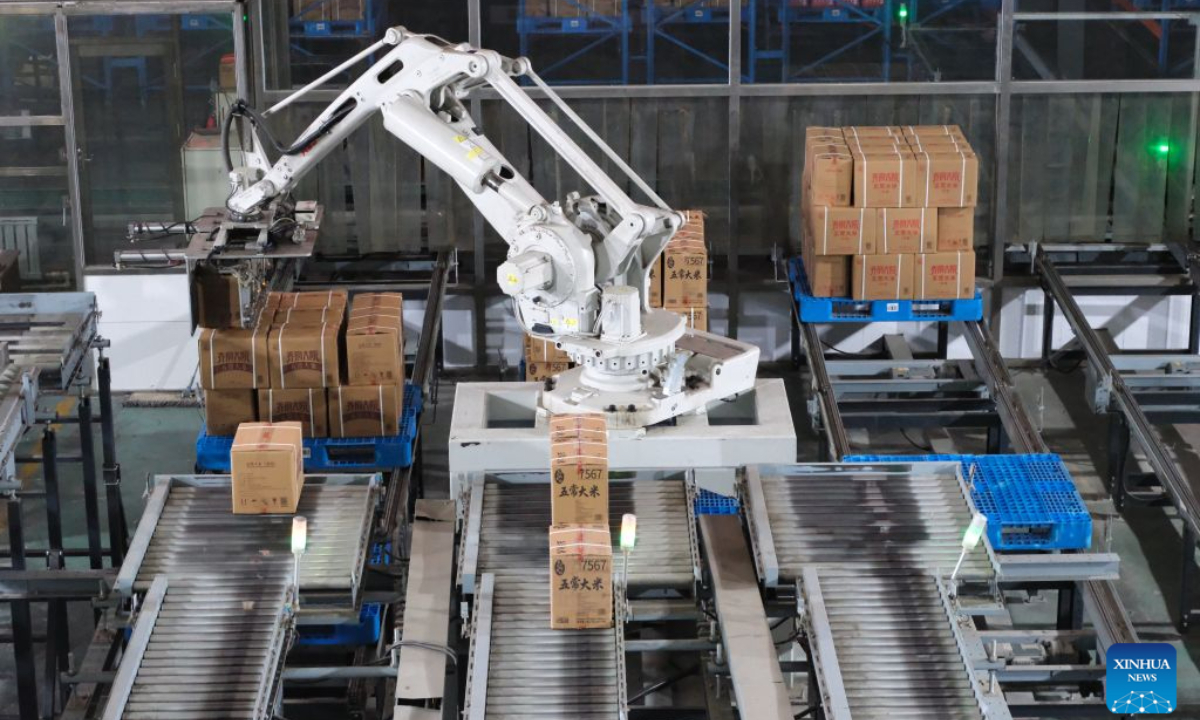
A robot stacks packaged rice for shipment at a workshop of Qiaofu Dayuan Agricultural Co., Ltd., in Wuchang City, northeast China's Heilongjiang Province, Aug. 31, 2026. (Xinhua/Ji Hang)
China's economy maintained generally stable growth in August, continuing to show stronger new growth drivers and an improving economic structure, while industrial production picked up pace, with high-tech manufacturing, equipment manufacturing and rapidly expanding sectors such as industrial robots and lithium-ion batteries providing stronger support for growth, official data showed on Tuesday.
Data showed that while some indicators still have room for improvement, the economy continued to see positive structural changes, although a more balanced recovery between supply and demand has yet to be further consolidated. Chinese experts said that China's economy should be viewed in the context of both global conditions and its development stage.
They noted a continued shift in China's growth structure, with high-tech and advanced manufacturing playing a larger role. Consumption and investment, meanwhile, still have room to improve, making stronger domestic demand an important part of sustaining the transition toward more innovation-driven growth.
China's value-added industrial output rose 5.2 percent year-on-year in August, accelerating by 0.7 percentage points from July, according to data released by the National Bureau of Statistics (NBS).
Within the headline figure, equipment manufacturing expanded 12.1 percent and high-tech manufacturing surged 16.7 percent, respectively 6.9 and 11.5 percentage points faster than overall industrial output growth.
Fu Linghui, a spokesperson for the NBS, said at a State Council Information Office press conference on Tuesday that emerging industries continued to grow rapidly in August. Value-added output of high-tech manufacturing and digital product manufacturing rose 16.7 percent and 15.7 percent year-on-year, respectively, while new growth drivers contributed more than 60 percent of the growth in industrial output above designated size.
Foreign trade also maintained rapid growth. China's total goods imports and exports increased 19.8 percent year-on-year in August, while exports and imports rose 18.6 percent and 21.7 percent, respectively, according to Fu.
At the same time, retail sales rose 0.4 percent year-on-year in August, while fixed-asset investment fell 7.2 percent in the first eight months. The NBS noted that the imbalance between strong supply and relatively weak demand remained prominent and said the foundation for sustained economic improvement still needed consolidation.
Advanced manufacturing gains weight
A closer look at August production data shows that the acceleration was concentrated increasingly in technologically intensive manufacturing rather than being evenly distributed across traditional industries.
Output of lithium-ion batteries surged 57.2 percent year-on-year in August, industrial robot production rose 34.6 percent and 3D-printing equipment output increased 29.9 percent, according to the NBS,
As a key component of the industrial economy, value-added output of equipment manufacturing rose 12.1 percent year-on-year, with all eight major equipment sectors posting relatively rapid growth. The electronics sector grew 17.2 percent, marking the largest contribution among all industrial sectors.
The data suggest that sectors once seen primarily as emerging industries are becoming an increasingly important part of China's broader industrial growth engine.
Fu said information transmission, software and information technology services also grew rapidly, with their production index rising 9.6 percent in August and contributing more than 20 percent of overall service-sector index growth.
Investment patterns provided another indication of the shift. While overall fixed-asset investment declined in the first eight months, investment in high-tech industries increased 5.2 percent. Investment in information services jumped 22.7 percent, aerospace vehicle and equipment manufacturing rose 14.9 percent, and electronic and communication equipment manufacturing increased 6.9 percent.
Investment plays a forward-looking role in economic growth, Zhou Mi, a researcher at the Chinese Academy of International Trade and Economic Cooperation, told the Global Times on Tuesday. Zhou noted that China's rapid advances in high-tech and advanced manufacturing largely reflect sustained investment made in earlier stages. As those investments deliver results, they can attract more capital into high-tech sectors, creating a positive cycle of investment, industrial upgrading and renewed investment, while also drawing greater interest from global partners and investors, Zhou said.
Structural upgrading remains key
The strength of advanced manufacturing nevertheless contrasts with continued adjustment in some areas of domestic demand, while underscoring how the focus of policy support is shifting in step with broader structural changes in the economy, Chinese experts noted.
Retail sales of consumer goods totaled 3.98 trillion yuan ($590 billion) in August, up 0.4 percent year-on-year. Yet the broader consumption structure showed notable growth in services, with retail sales of services increasing 4.9 percent in the first eight months, compared with a 1 percent rise in goods retail sales, NBS data showed.
Investment in some areas remained under greater pressure. Fixed-asset investment fell 7.2 percent in the first eight months, compared with a 6.7 percent decline in the first seven months.
But no single set of data can fully capture the broader picture of China's economy, Chinese experts noted.
"China is at a critical stage in the transition between old and new growth drivers, and the economy should be assessed in the context of both the global environment and its own stage of development, as external uncertainties rise and some domestic demand remains cautious," Tian Yun, a Beijing-based economist, stressed.
Against this backdrop, expanding new growth drivers to a larger scale is also an important development priority for China.
Hu Qimu, a professor at the Maritime Silk Road Institute of Huaqiao University, told the Global Times on Tuesday that a key policy task is to not only strengthen new growth drivers, but also scale them up so they account for a larger share of the economy and become a more solid pillar of growth. Only with greater industrial scale and market presence can their rapid expansion translate more broadly into jobs, business activity and tangible economic gains, according to Hu.
Such industrial transformation helps explain why more investment is flowing into sectors that are critical to the country's development priorities, Hu said.
He noted that external uncertainties tend to affect China more through the industrial sector. Against this backdrop, accelerating the transition between old and new growth drivers will require continued expansion of high-tech and advanced manufacturing, while also stabilizing consumption, investment and traditional industries so that new growth drivers can translate into broader support for the economy, Hu said.
At the same time, China has repeatedly stressed this year that it will strengthen macroeconomic policy adjustment, expand domestic demand, and advance industrial upgrading.
The August figures suggest that the central question for the economy is increasingly not whether new growth drivers are emerging, but how effectively their expanding contribution can combine with the nation's balanced growth, Chinese experts noted.
RELATED ARTICLES