India, Pakistan trade blame over naval collision; incident to add fuel to tension but unlikely to cause major confrontation: expert
By Published: Sep 17, 2026 12:47 PM

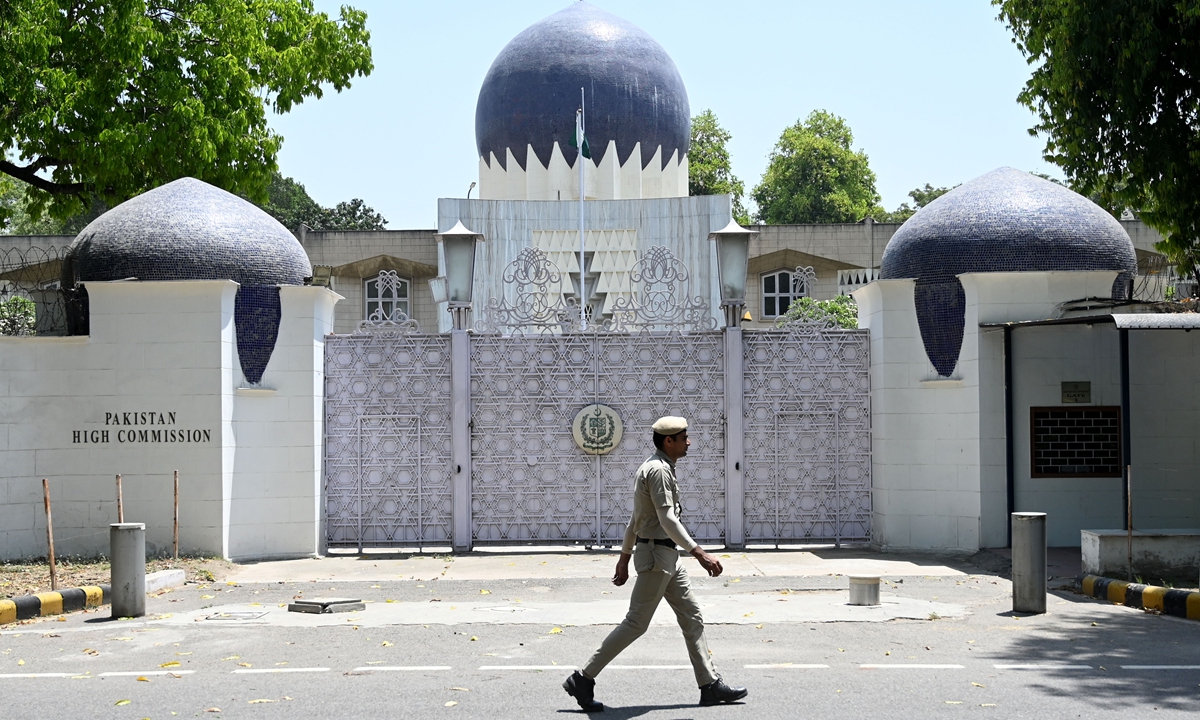
A general view of the Pakistan High Commission in New Delhi, India. Photo: VCG
India and Pakistan traded blame on Wednesday for a collision at sea between two vessels operated by their navies, summoning each other's top diplomats to lodge "strong" protests. A Chinese expert said that the maritime collision is likely to further strain already tense relations between the two countries, though it is unlikely to escalate into a major confrontation.
"While the Pakistan Navy was undertaking its biennial exercise SEASPARK-26, the Indian vessel carried out aggressive maneuvers in dangerously close proximity of Pakistani naval ship, resulting in contact between the two vessels," according to a statement published by Pakistan's foreign ministry on X on Wednesday.
The statement said that Pakistan's foreign ministry summoned the Charge d'Affaires of the Indian High Commission in Islamabad and lodged a strong protest over what it described as a highly "provocative and unacceptable" action by a vessel of the Indian Navy in Pakistan's Exclusive Economic Zone (EEZ) on September 15, 2026.
Following the incident, India's Ministry of External Affairs on Wednesday also summoned the Charge d'Affaires of the Pakistan High Commission, Saad Warraich, and lodged a strong protest over the "unacceptable and unprofessional conduct" of the Pakistani naval unit, according to the New Indian Express.
Contradicting Pakistan's account, Reuters quoted Indian sources as saying that the collision occurred when a Pakistani naval ship moved closer to a frontline Indian warship on a "routine surveillance mission" in the north Arabian Sea at high speed.
Both sides accused each other of violating rules.
Pakistan said that "the incident constituted a serious violation of international law and the bilateral agreement on Advance Notice on Military Exercises, Manoeuvres and Troop Movements, 1991, and risked escalating tensions in the region."
India's Ministry of External Affairs also accused the conduct of the Pakistani vessel of contravention of the Agreement.
The incident, which took place in international waters, did not cause any major damage, according to India's Ministry of External Affairs.
Reuters said this was the first overt military tension between the nuclear-armed neighbors since they engaged in a fierce military conflict last year that raised fears of a wider war before a ceasefire was reached.
The current incident is likely to add another layer to tensions that were already heightened by the military conflict last year, Qian Feng, director of the Research Department at Tsinghua University's National Strategy Institute, told the Global Times. With the dispute now spilling into the diplomatic arena, the risk of further friction has increased, he said. Neither side is likely to want to appear as though it is backing down, meaning the exchange of accusations could continue for some time.
Still, Qian said the episode was unlikely to escalate into a major confrontation. The collision caused no casualties or serious damage to either vessel, and similar encounters at sea have occurred before.
India-Pakistan relations are themselves a major factor shaping the security environment in South Asia, Qian said. A further deterioration in ties could add to regional tensions, but under the current circumstances, the likelihood that the incident would lead to a substantive military confrontation remained relatively low.
RELATED ARTICLES