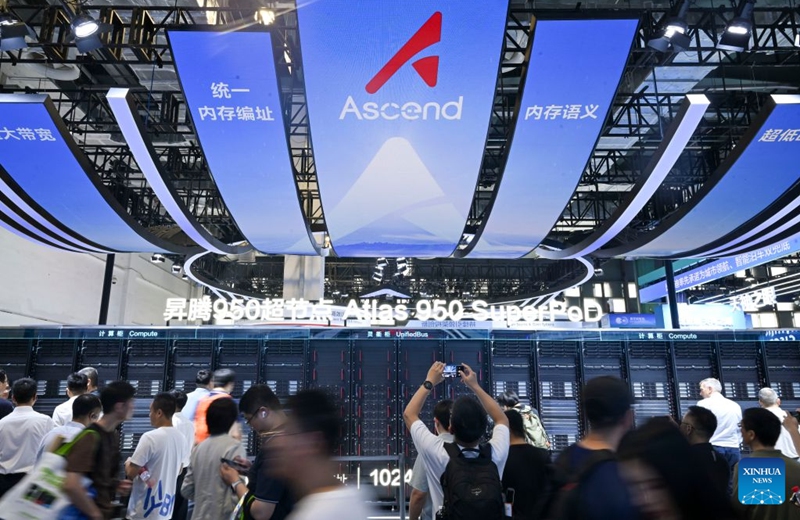
People view the Atlas 950 SuperPoD of Huawei displayed during the 2026 World AI Conference and High-Level Meeting on Global AI Governance in Shanghai, east China, July 19, 2026. (Xinhua/Chen Haoming)
Huawei on Thursday unveiled its Ascend 960 SuperPoD, which is the world's first AI supernode to adopt near-packaged optics (NPO) technology, as larger and more complex AI models drive demand for greater computing scale and lower latency.
The system can support large-scale training and inference for AI models with up to 10 trillion parameters, Huawei rotating chairman David Wang said at Huawei Connect 2026.
A SuperPoD, or supernode, connects multiple physical computing nodes through high-bandwidth, low-latency interconnects, allowing them to operate as a single logical computer.
The company also brought forward the rollout of its next-generation Ascend 960 AI chips after development progressed faster than expected, according to media reports.
Huawei said the Ascend 960 series will deliver roughly double the computing performance of the previous generation.
The Ascend 960DT is expected to be ready in the first quarter of 2027, three quarters earlier than originally planned, while the Ascend 960PR is scheduled for the third quarter of 2027, one quarter ahead of previous schedule.
As AI models grow larger, efficiently linking large numbers of processors is becoming increasingly important ̶ a key challenge SuperPoDs are designed to address, analysts said.
More than 1,000 Ascend supernodes have already been deployed, while the Ascend 950 SuperPoD has entered large-scale commercial use, according to the company.
Huawei plans to continue launching a new generation of Ascend chips each year, with the Ascend 970 scheduled for 2028 and the Ascend 980 for 2029. Wang said the company would follow the Tau (τ) Scaling Law to continue doubling computing capacity while substantially increasing memory bandwidth, memory capacity and interconnect bandwidth.
In recent years, competition in the AI chip industry has increasingly moved beyond the performance of individual processors toward system-level computing. JD Cloud and Chinese GPU maker Moore Threads recently announced plans to build a 100,000-GPU computing cluster, underscoring a broader push to deploy domestically developed AI chips at much greater scale.
Global Times
RELATED ARTICLES