ARTS / TV
China’s micro-drama users surpass 800 million as market tops 100 billion yuan: NRTA officials
By Published: Sep 17, 2026 06:02 PM

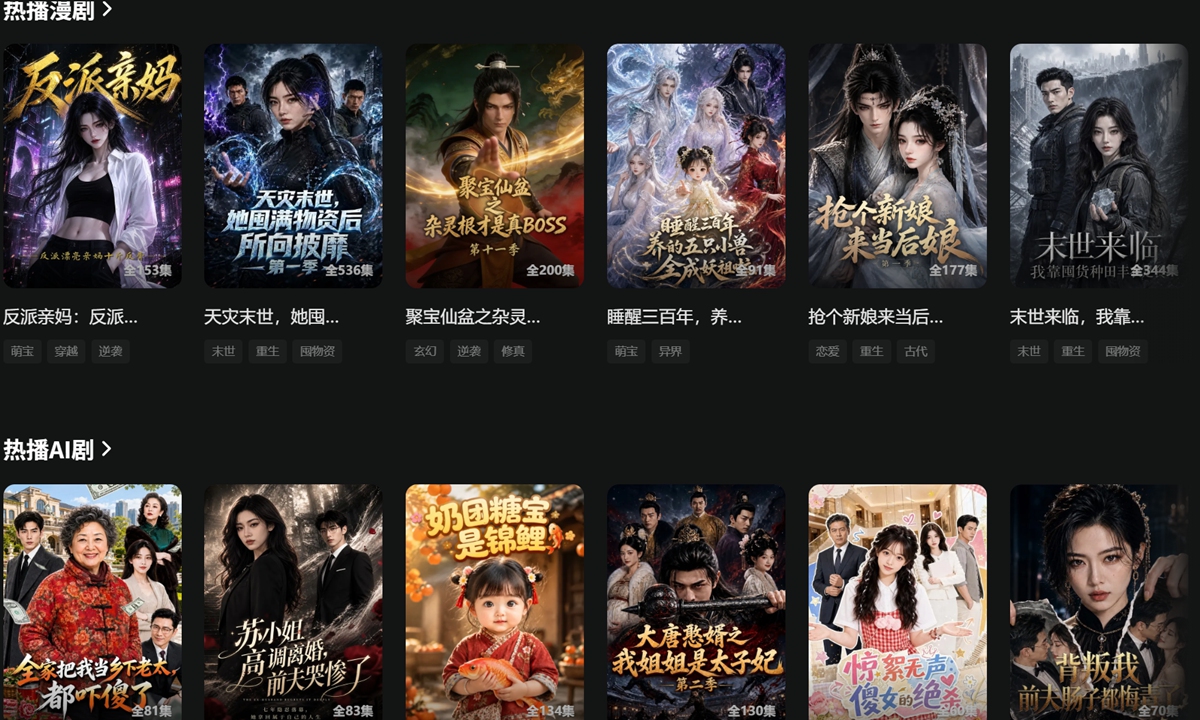
Snapshot of Hongguo Short Drama Photo: Hongguo app
China's micro-drama users have surpassed 800 million, and the market exceeded 100 billion yuan ($14.91 billion) in 2025, a senior broadcasting official said on Thursday, as the country released 430,000 micro-dramas in the first eight months of 2026, 13 times the total for all of last year, with AI-generated titles accounting for more than 90 percent. The figures underscore a boom that is reshaping content creation and prompting tighter scrutiny.Wang Xiaoliang, director of the National Radio and Television Administration's (NRTA) online audiovisual program management department, told a State Council Information Office briefing that artificial intelligence has opened new space for cutting costs, improving efficiency and innovating expression in micro-dramas. But he said it has also brought new challenges in rights protection and content quality, Xinhua News Agency reported on Thursday.
"AI is a tool; people remain the main body of creation," Wang said, adding that the faster AI dramas develop, the more important it is to ensure content quality.
He said live-action dramas remain the main force of premium creation and would receive strong support. The NRTA will implement a premium micro-drama creation and broadcast plan, guide platforms to open live-action sections, and provide financial support so that good works can find a market and generate returns.
For AI-generated dramas, Wang said regulators would encourage innovation while maintaining regulatory bottom lines. "AI dramas must be labelled, and platforms must strictly respect portrait and voice authorization and conduct full-process vetting," he said.
The regulator has also stepped up its crackdown on harmful, vulgar, child-unfriendly and pirated content. Wang said 68,000 micro-dramas violating rules had been taken down across the internet this year. Platforms bear primary responsibility for content and must keep tightening controls to clean up the industry, he added.
Industry practitioners told the Global Times that the shift is already well underway, driven by the dominance of Chinese video-generation models.
"Even the best overseas video platforms are now using Chinese-made large models," Feng Anrong, a 33-year-old former screenwriter and director who runs an AI production studio, told the Global Times.
Feng said China's video AI has moved decisively ahead of foreign rivals, giving studios a powerful cost-cutting engine. Productions that once required expensive location shoots and months of post-production can now be created entirely on a computer, from scene design to camera previews.
Fu Weiwei, another director who shifted from traditional filmmaking to AI-generated "simulated human" dramas, was equally blunt. "The transition from traditional films to AI ones is irreversible. It's like films once threatening stage dramas, or the internet crushing TV stations," he told the Global Times.
Wang's balancing act between promoting AI innovation and tightening content controls comes as the NRTA also looks abroad. He Biao, vice minister and spokesman for the NRTA, told the same briefing that audiovisual works are bridges for people-to-people bonds.
Chinese micro-dramas have become a popular art form among international audiences, He said, adding that during the 15th Five-Year Plan period from 2026 to 2030, the NRTA will systematically plan its international communication efforts, support content and platforms going overseas, and help more high-quality audiovisual content and services "go global."
He said the NRTA issued measures for managing micro-drama development in August and is accelerating legislation for a radio and television law. It is also improving emergency broadcasting and expanding the China-Africa radio and television innovation cooperation program, he said.
While He focused on the international dimension, Feng Shengyong, director of the NRTA's television drama department, turned to the domestic supply of longer-form content. He described TV dramas as a "ballast stone" for premium creation and a "main course" for people's cultural needs.
"During the 15th Five-Year Plan, the NRTA plans to roll out about 100 outstanding TV and online dramas, focusing on five priorities," said Feng.
Those include overall planning under the "Drama Beautifies China" initiative, major anniversaries, script quality, a better creative environment and industrial empowerment. Feng said the industry should reduce reliance on traffic stars and return to telling good stories with good scripts. In the first eight months, 801 TV and online dramas were filed for public notice, up 33.3 percent year on year, he said.
He also noted that a good drama can be a "super traffic gateway" for industries, citing examples of dramas boosting tourism in filming locations. "Following TV dramas to travel" has become fashionable, he said.
China's micro-drama sector has grown rapidly in recent years, becoming a key export of Chinese audiovisual content. But regulators are balancing that growth with content safety, data security and copyright protection as AI tools make production faster and cheaper.
The remarks come as China seeks to expand the international reach of its cultural products while tightening oversight of online content at home. Officials say the goal is not to slow the industry, but to steer it toward higher-quality production and sustainable growth.
RELATED ARTICLES