Photo: VCG
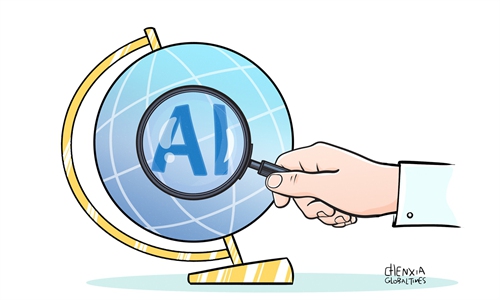
Debates over artificial intelligence (AI)-driven risks have been heating up in the US. In a flash poll of attendees at a Yale School of Management event this week, 93 percent cited AI safety threats as real, The Wall Street Journal reported on Wednesday.
The participants were not casual observers but chief executives from various industries. Their broad recognition that AI risks are no hoax shows the issue is no longer confined to technology circles.
Yet, acknowledging risks is not the same as solving them. AI carries risks that are inherently shared by all humanity, and no single country can resolve them on its own. From the spread of technology and computing power flows to open-source ecosystems and cross-border applications, the entire AI industrial chain has long transcended national boundaries. Unilateral controls cannot block the natural flow of technology, and confrontation will only leave blind spots on the global AI governance map. The very nature of the problem dictates that global coordination and multilateral governance provide the most viable path forward.
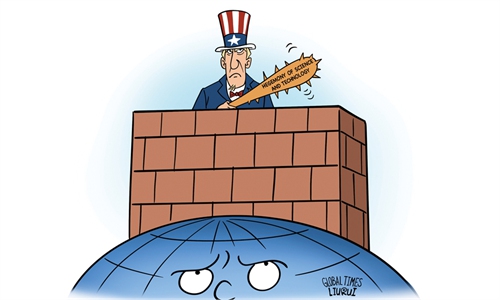
What deserves high vigilance, however, is that this heated debate over AI in the US is showing a clear tendency to become politicized. Some leading US technology firms have seized on narratives about AI risks to raise entry barriers to the industry, while certain forces in Washington have tied AI risks to geopolitical games, hyping the so-called "China AI threat" as a pretext to escalate chip export controls and expand technological blockades.
But such a politicized narrative cannot resolve any genuine AI risks; instead, it will seriously disrupt the already fragile global AI governance order. AI risks will not disappear just because they are linked to any geopolitical topic, nor will they become easier to address under the hype of the so-called "China AI threat."
In response to recent remarks by certain leaders of the biggest AI companies, Chinese Foreign Ministry spokesperson Guo Jiakun said on Monday that AI is a consequential technology for the wellbeing of all humanity. All parties should jointly promote the open and inclusive development of AI for good and for all. Fear-mongering, confrontation and vicious competition will only hamper efforts toward sound global AI governance, which serves no one's interest.
China and the US are the two core players with the fastest AI development, the most active technological innovation, and the richest application scenarios. Their technological trajectories, governance philosophies, and cooperative postures directly determine the overall landscape of global AI development and governance. Precisely for this reason, China-US collaboration in AI is never a choice, but an imperative - one tied to global technological security and the shared interests of humanity. Cooperation is no panacea, but its absence will only compound risks and multiply strategic miscalculations.
As a responsible AI player, China has upheld the principle of balancing development and governance from the very beginning. For instance, in September 2025, China released the AI Safety Governance Framework version 2.0. With reference to AI technological development and application practices, the framework continuously tracks changes in risks, refines and optimizes risk classification, explores risk grading, and dynamically adjusts and updates prevention and governance measures.
At this year's World Artificial Intelligence Conference, China further proposed "improving global governance" with the establishment of the World Artificial Intelligence Cooperation Organization. It's the world's first intergovernmental international organization to cope with the opportunities and challenges posed by AI.
Amid the surging technological wave, what is needed is consensus among countries to jointly respond to the risks ahead. Bringing the two largest AI powers under one common safety framework answers public anxieties far better than fragmentation.
Global AI governance is now at a critical juncture, with technological iteration outpacing the formulation of rules. It is time for those still clinging to hegemonic thinking and zero-sum confrontation to change course. Only by building consensus, pursuing pragmatic cooperation, and constructing a fair, open and inclusive global AI governance system can humanity keep the final say in human hands and ensure that cutting-edge technologies benefit all people. Whether AI proves a blessing or a curse for humanity still depends on the choices we make.
RELATED ARTICLES