BUSINESS / PRESS RELEASE
Artistic expressions of heart-mind: How Confucius Academy inspires civilizational empathy
Language has national borders, yet aesthetics transcend them. In 2026, the Confucius Academy in Guiyang has transformed core philosophical tenets — "innate knowledge of the good," "the oneness of all things" and "the unity of knowledge and action" — into calligraphy and painting, guqin melodies, dance and handicrafts.
Art as a bond of hearts: A brush-and-ink dialogue between cross-Straits calligraphers and painters
On August 5, the cross-Straits cultural exchange event "Rooted in the Same Heritage, United in Heart: A Journey to Guizhou" kicked off at the Confucius Academy, with the "Harmony under Heaven • People's Hearts Expressed in Art" Chinese Calligraphy and Painting Exhibition opening concurrently. Over 100 works by calligraphers and painters from both sides of the Taiwan Straits were on display, alongside the Confucius Academy's collection of calligraphic works of Confucian classics and stone rubbings of ancient sages, as well as new creations by Taiwanese artists.
Ran Maoliu, a vice chairman of the Guizhou Provincial Artists Association, commented that the exhibition integrates ideas, art and sentiment. "It represents both an innovative practice for the dynamic inheritance and dissemination of Yangming culture and a key platform for cross-Straits connection, with art as a bond of hearts."
Guqin as a medium of fellowship: Cross-cultural resonance in millennia-old elegant music
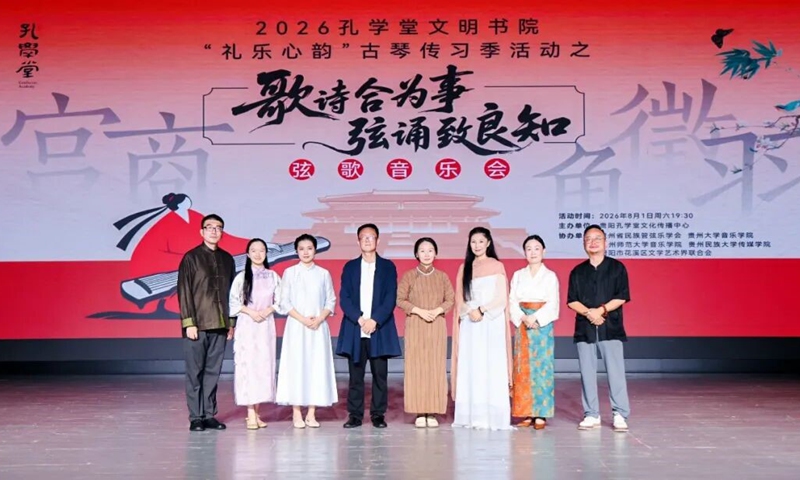
From late July to early August, the Confucius Academy held the "Rites-Music and Rhythm of Mind" Guqin Study and Practice Season. Across five concerts, celebrated masters of the Zhejiang Yao School, Guangling School and Shu School of guqin performed in succession. The string-song concert "Songs of Poesy for Times – Chanting for Innate Knowledge" stood out in particular. Presented with guqin and xiao ensemble and classical chanting of Wang Yangming's poems, it infused the wisdom of the Learning of the Heart-Mind into the refined grace of string-song art. Yao Gongbai, a national-level representative inheritor of guqin art on China's intangible cultural heritage list, described the profile of this season as "diverse schools, varied forms, equal weight given to scholarship and art, and emphasis on locally based exchanges."
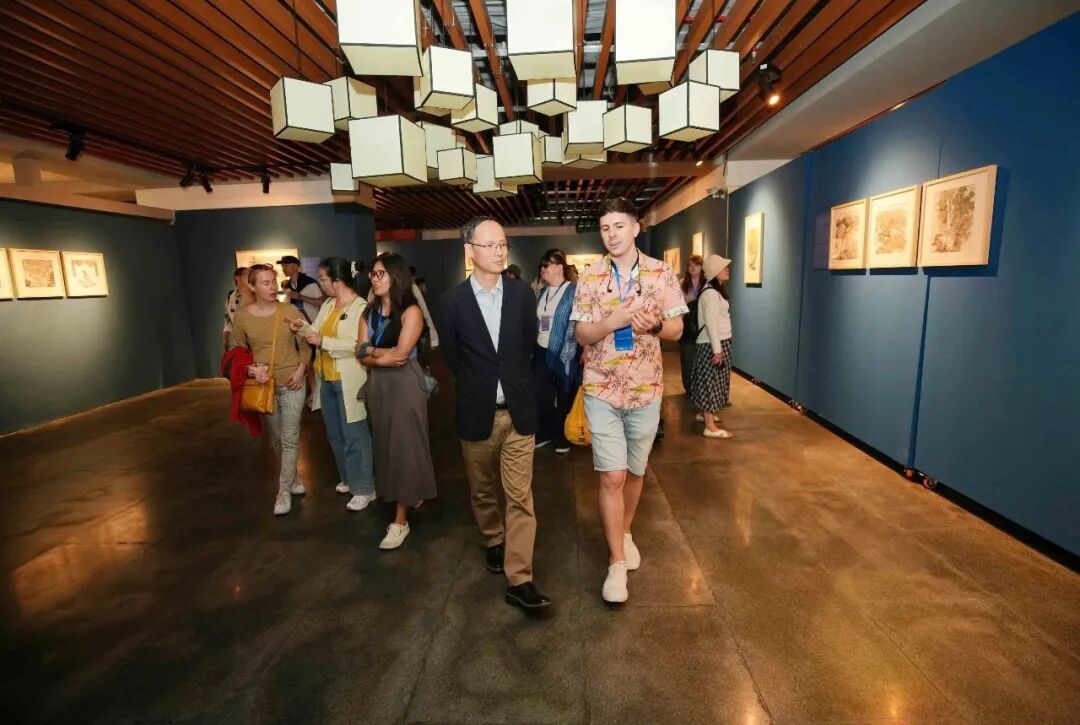
The charm of artistic trans-creation resides not only in evoking cultural memories, but also in bridging civilizational divides and resonating with human hearts. Back in May, the study camp Foreign Educators See China: A Journey in Guizhou for the Learning of the Heart-Mind was held at the Confucius Academy. More than 30 foreign educators from 15 countries toured the thematic exhibition on the "Four Major Cultural Projects" and experienced traditional arts including tea meditation, lacquer fan painting and painted clay whistles. British teacher Andrew commented during the tea-meditation session that he once understood the "tea ceremony" merely as brewing tea, yet on this occasion he came to grasp the essence of "tranquility" — "as if holding a dialogue with one's inner self." Upon the conclusion of the study camp, Pakistani scholar Ullah Zia stated that the experience had "contributed greatly to his mental conditioning and spiritual growth." Anton Panchev from Bulgaria said, "In just two days, I have grown deeply attached to Guizhou."
Objects as a vehicle of teachings: Daily transformation of Yangming's philosophical imagery
If the calligraphy and painting exhibition and the Guqin Study and Practice Season the Learning of the Heart-Mind "visible" and "audible," the opening of the "Twelve Realms of Seeking Truth" cultural and creative space makes it "portable" and "usable."
In June, this cultural and creative IP was officially launched at the Confucius Academy, tracing the complete trajectory of Wang Yangming's arrival in Guizhou, his path to spiritual enlightenment and his teaching activities. Over 20 products were developed, including tea gift boxes, Zhenyuan paper-carving lanterns, and brass paperweights.
Statistics shows that in the first half of 2026, the Confucius Academy held more than 500 cultural events, receiving 274,000 residents and visitors.
Academic conferences fuel intellectual exchanges, while art nurtures spiritual rapport. When Wang Yangming's Learning of the Heart-Mind touches people of diverse civilizations via works of calligraphy and painting, guqin melodies, dance and cultural artifacts, "the oneness of all things" evolves from a classical tenet into a tangible lived experience.
Art as a bond of hearts: A brush-and-ink dialogue between cross-Straits calligraphers and painters
On August 5, the cross-Straits cultural exchange event "Rooted in the Same Heritage, United in Heart: A Journey to Guizhou" kicked off at the Confucius Academy, with the "Harmony under Heaven • People's Hearts Expressed in Art" Chinese Calligraphy and Painting Exhibition opening concurrently. Over 100 works by calligraphers and painters from both sides of the Taiwan Straits were on display, alongside the Confucius Academy's collection of calligraphic works of Confucian classics and stone rubbings of ancient sages, as well as new creations by Taiwanese artists.
Ran Maoliu, a vice chairman of the Guizhou Provincial Artists Association, commented that the exhibition integrates ideas, art and sentiment. "It represents both an innovative practice for the dynamic inheritance and dissemination of Yangming culture and a key platform for cross-Straits connection, with art as a bond of hearts."
Guqin as a medium of fellowship: Cross-cultural resonance in millennia-old elegant music
From late July to early August, the Confucius Academy held the "Rites-Music and Rhythm of Mind" Guqin Study and Practice Season. Across five concerts, celebrated masters of the Zhejiang Yao School, Guangling School and Shu School of guqin performed in succession. The string-song concert "Songs of Poesy for Times – Chanting for Innate Knowledge" stood out in particular. Presented with guqin and xiao ensemble and classical chanting of Wang Yangming's poems, it infused the wisdom of the Learning of the Heart-Mind into the refined grace of string-song art. Yao Gongbai, a national-level representative inheritor of guqin art on China's intangible cultural heritage list, described the profile of this season as "diverse schools, varied forms, equal weight given to scholarship and art, and emphasis on locally based exchanges."
The charm of artistic trans-creation resides not only in evoking cultural memories, but also in bridging civilizational divides and resonating with human hearts. Back in May, the study camp Foreign Educators See China: A Journey in Guizhou for the Learning of the Heart-Mind was held at the Confucius Academy. More than 30 foreign educators from 15 countries toured the thematic exhibition on the "Four Major Cultural Projects" and experienced traditional arts including tea meditation, lacquer fan painting and painted clay whistles. British teacher Andrew commented during the tea-meditation session that he once understood the "tea ceremony" merely as brewing tea, yet on this occasion he came to grasp the essence of "tranquility" — "as if holding a dialogue with one's inner self." Upon the conclusion of the study camp, Pakistani scholar Ullah Zia stated that the experience had "contributed greatly to his mental conditioning and spiritual growth." Anton Panchev from Bulgaria said, "In just two days, I have grown deeply attached to Guizhou."
Objects as a vehicle of teachings: Daily transformation of Yangming's philosophical imagery
If the calligraphy and painting exhibition and the Guqin Study and Practice Season the Learning of the Heart-Mind "visible" and "audible," the opening of the "Twelve Realms of Seeking Truth" cultural and creative space makes it "portable" and "usable."
In June, this cultural and creative IP was officially launched at the Confucius Academy, tracing the complete trajectory of Wang Yangming's arrival in Guizhou, his path to spiritual enlightenment and his teaching activities. Over 20 products were developed, including tea gift boxes, Zhenyuan paper-carving lanterns, and brass paperweights.
Statistics shows that in the first half of 2026, the Confucius Academy held more than 500 cultural events, receiving 274,000 residents and visitors.
Academic conferences fuel intellectual exchanges, while art nurtures spiritual rapport. When Wang Yangming's Learning of the Heart-Mind touches people of diverse civilizations via works of calligraphy and painting, guqin melodies, dance and cultural artifacts, "the oneness of all things" evolves from a classical tenet into a tangible lived experience.
