BUSINESS / PRESS RELEASE
2026 Engineering Capacity Building Program (Green Building) held in Beijing
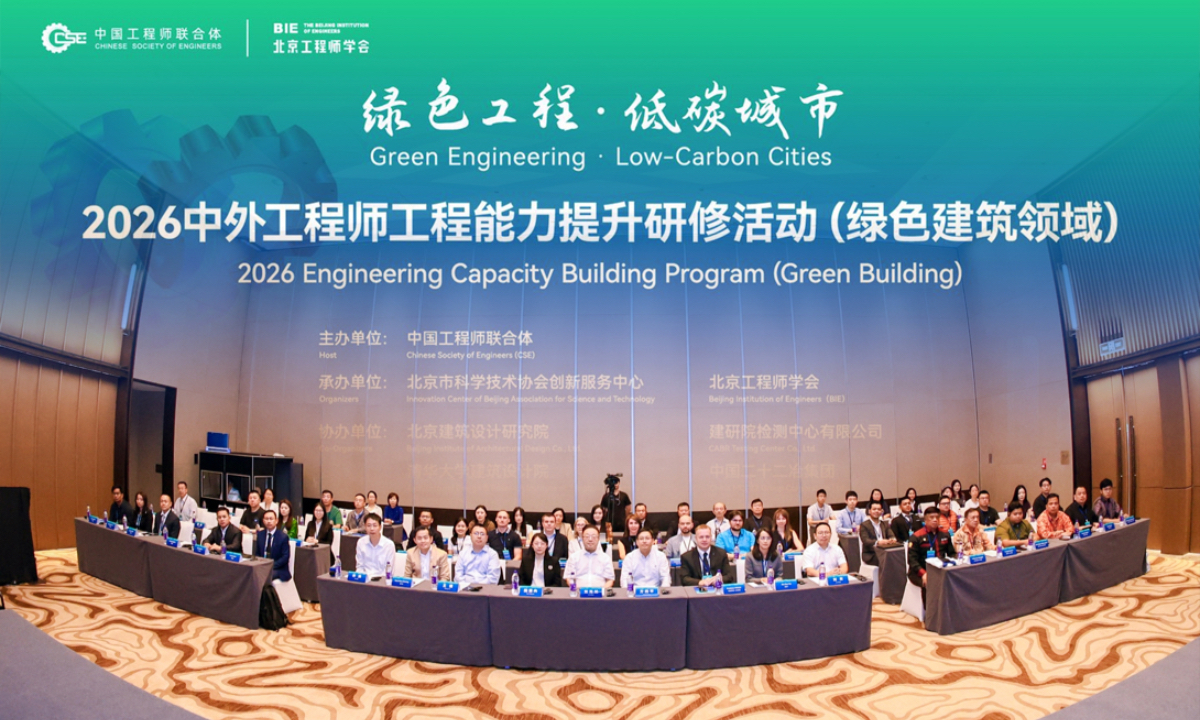
Engineers attend a workshop of The 2026 Engineering Capacity Building Program (Green Building) held on September 17, 2026. Photo: Courtesy of Chinese Society of Engineers
The 2026 Engineering Capacity Building Program (Green Building) officially launched in Beijing from September 13 to 18. During six days, 60 professional construction engineers from China, Russia, Indonesia, Malaysia, Thailand, Myanmar, Cambodia, and Vietnam gathered and exchanged opinions on frontier industry fields, including the low-carbon transition of the construction sector, nearly zero-energy buildings, and the renovation of existing buildings.
The program is hosted by the Chinese Society of Engineers (CSE). With the theme of “Green Engineering, Low-Carbon Cities,” it is grounded in China-ASEAN, China-Russia multilateral and bilateral cooperation mechanisms, focusing on cutting-edge directions including green buildings, low-carbon construction, nearly zero-energy buildings, and intelligent industrialized construction. This training program constructs a “Cognition-Institution-Real-world Practice-Collaboration-Recognition” five-in-one curriculum system, integrating thematic reports, benchmark enterprise field visits, case workshops, and cultural characteristic activities, building an international platform for Chinese and international engineers for institutional mutual learning, technical exchange, and collaborative co-creation.
Fang Siping, Director of the General Office, CSE, delivered a speech at the opening ceremony of the program held on September 14. Xu Wei, Director of the Science and Technology Innovation Department of the Beijing Association for Science and Technology, the program’s co-organizer, also presented opening remarks. During the session, representatives from ASEAN engineering institutions introduced their national engineering competency evaluation systems. Participants compared the similarities and differences between Chinese and foreign engineering governance frameworks, explored feasible pathways for the international mutual recognition of engineering qualifications, and bridged information gaps across professional practice systems. The in-depth exchanges strengthened bilateral mutual trust and laid a solid institutional foundation for the global promotion of Chinese engineering standards and the establishment of long-term cooperative mechanisms among international engineers.
During technical presentations later that day, He Kebin, Academician of the Chinese Academy of Engineering, Dean of the Institute for Carbon Neutrality, Tsinghua University, delivered a keynote speech on pathways for low-carbon transition in the building sector under the “Dual Carbon” goals while some ASEAN experts shared local green building case studies. Balancing top-level strategic research with frontline engineering practices and incorporating overseas local experience, the curriculum avoids one-way knowledge transfer. It helps Chinese and foreign engineers keep abreast of cutting-edge green building technologies, interpret relevant domestic codes and standards, inspire cross-disciplinary innovation, and facilitate two-way exchange of green building expertise.
“I believe this program will strengthen professional bonds among engineers from China, Russia and other participating countries, and promote the application of shared professional expertise in practical engineering projects,” Kostared Maksim, President of the CCI Union of the Tomsk Region, told the Global Times.
”Discussing unified approaches to the design, construction and operation of architectural facilities, exchanging targeted technical solutions, and building sustainable professional communication channels are of great significance. Moving forward, I look forward to closer mutual recognition of engineering standards, more consistent professional qualification requirements, and standardized and transparent professional experience verification procedures. These improvements will lower the threshold for engineers to participate in international projects and comprehensively elevate the quality of cross-border engineering cooperation,” he added.
“This program serves as a vital platform for China and Russia’s joint efforts in green building development. It will effectively support engineers’ professional growth, broaden their access to cutting-edge engineering solutions, and expand international professional networks – all of which can be fully translated into practical outcomes in real-world engineering projects,” he emphasized.
For Alan Poon, an Associate Director from Laurelcap, Malaysia, this program reshaped his understanding of green buildings. He pointed out that modern green building development goes far beyond simply installing rooftop solar panels or obtaining green building certifications. “My focus is on the entire industrial system: passive architectural design, energy efficiency optimization, renewable energy application, building electrification, embodied carbon control, digital twins, AI and IoT technology – and crucially, how individual green buildings can be integrated into low-carbon communities and smart cities,” Poon said.
Poon shared that, during the program, he and fellow international engineers had in-depth discussions covering intelligent construction, prefabricated architecture, high-performance building systems, renewable energy utilization and digital construction technologies. What intrigued him most was the transformation of these standalone technologies into a unified, integrated engineering system.
Yuliarman Saragih, a Technical Director of PT Bacarthas in Jakarta, Indonesia, said that he would bring the advanced technologies and practical experience he gained from the program back to his home country and university, and promote substantive technological cooperation with Chinese institutions in the field of green buildings.
“Indonesia’s green building technology application is still in its initial stage, lagging far behind China’s mature development. China has mastered a full range of high-end green building technologies, so I am here to learn from Chinese experts and upgrade my professional expertise,” Saragih told the Global Times.
