Political symbols at Games could put delegations at risk, OCA chief responds to possible display of militarist ‘rising sun flag’
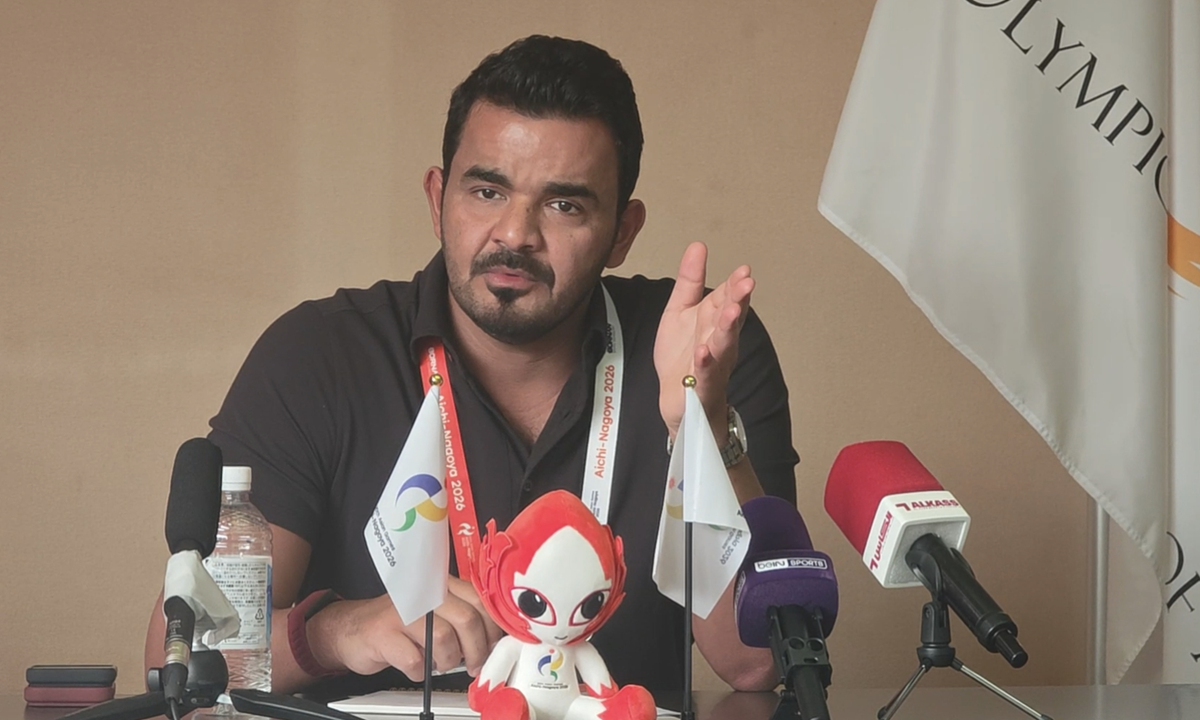
Olympic Council of Asia (OCA) President Sheikh Joaan bin Hamad Al Thani speaks to the Global Times on September 19, 2026 in Nagoya, Japan. Photo: Lu Wenao/GT
Bringing political symbols into competition venues at the Aichi-Nagoya Asian Games could put athletes and their delegations at risk, Olympic Council of Asia (OCA) President Sheikh Joaan bin Hamad Al Thani told the Global Times on Saturday.As the games opened, calls emerged to prevent Japanese fans from displaying the notorious "rising sun flag," which is strongly connected to Japan's wartime past, at the event, according to media reports.
Japanese fans' historical past of showing the militarism-related "rising sun flag" at sports events has triggered concerns they would repeat such actions at the Asian Games.
Speaking at a media discussion in Nagoya on the morning of the Games' opening ceremony, Sheikh Joaan told the Global Times that anyone bringing political flags or symbols into stadiums will face consequences.
"We don't mix sports with politics," he told the Global Times. "If something like this will happen, we have our way of taking care of it. All the delegations know what the protocol is and what should be done and what shouldn't be done, and whoever violates that protocol is going to put himself and his delegation at risk."
Under the OCA rules, violations of applicable regulations at the Asian Games can result in temporary or permanent ineligibility, exclusion from the Games, disqualification or withdrawal of accreditation.
Asked whether he was concerned that politics could get in the way of fair treatment between delegations, Sheikh Joaan said the OCA's focus was on athletes and their rights to compete.
"Our focus here is on the athletes and on making sure that everyone, all the athletes, have equal rights in competing," he said. "I don't think politicians or politics should be involved in sports."
The Games has faced a series of organizational challenges ahead of the opening ceremony, including athletes being trapped at Nagoya airport. The OCA president acknowledged that such difficulties existed but said the way they were addressed was more important.
"As with other major Games, there have been challenges for sure," he said. "But what is most important is the way in which the challenges are addressed."
The Aichi-Nagoya Asian Games has taken an unconventional approach to accommodation, with no traditional athletes' village. A Cruise ship has been used to house a large number of athletes, alongside other accommodation facilities including logistic containers.
RELATED ARTICLES