More US protectionism against Chinese carmakers to backfire; there is huge room for cooperation: experts
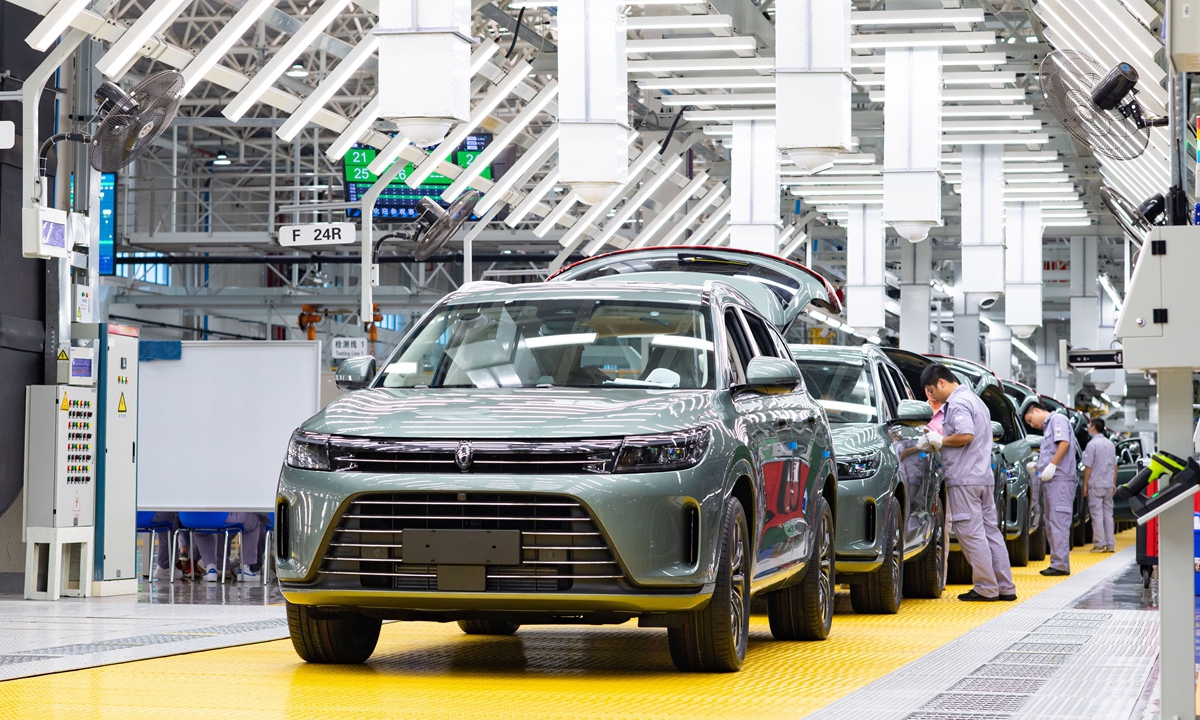
An NEV manufacturing line in Southwest China's Chongqing Municipality Photo: VCG
More US protectionist actions against Chinese automakers will not help the US auto industry improve its competitiveness in the era of new-energy vehicles (NEVs) and will hurt US consumers, Chinese industry experts said on Sunday, after some major US automakers, suppliers and dealers have reportedly written to the White House urging the US administration to shut Chinese automakers out of the American market.
Rather than clinging to closed and exclusionary competition, the US auto industry should view China-US automotive competition and cooperation objectively and pursue win-win collaborative innovation amid global industrial upgrading, the experts noted.
A letter from six groups representing General Motors, Toyota, Volkswagen, Ford, Hyundai, Stellantis, Tesla and others urged the White House to maintain policies that keep the door firmly shut to Chinese automakers seeking to sell vehicles in, import vehicles into or manufacture vehicles in the US, Reuters reported.
The letter, signed by the Alliance for Automotive Innovation, American Automotive Policy Council, Autos Drive America, and others, claimed that allowing Chinese automakers to open manufacturing facilities in the US would provide them with a foothold in the US market at the expense of manufacturers operating there.
Meanwhile, some US politicians have also joined the smear campaign against Chinese auto enterprises, falsely claiming that Chinese brands including BYD could bankrupt Western automakers and dismantle the manufacturing foundation of Western economies, according to Reuters.
Behind this protectionist push lies a deeper problem: traditional automakers and dealers do not want to abandon their long-standing profitable model built around conventional fuel vehicles despite the accelerating green transition in the global auto industry, Zhang Xiang, secretary-general of the International Intelligent Vehicle Engineering Association, told the Global Times on Sunday.
“Such short-sighted protectionist moves will only trap the US automotive sector in self-isolation, hinder domestic industrial upgrading and harm consumer interests,” Zhang said, adding that as global resources and supply chains shift toward NEVs, more US perfectionist actions will gradually isolate itself, which will lead to surging production costs and vehicle prices.
The US is already falling behind China in the transition toward NEVs. More than 13 million electric vehicles (EVs) were sold in China in 2025, maintaining the country’s position as the world’s largest EV market and accounting for six out of ten EVs sold globally. By comparison, only 1.5 million EVs were sold in the US in 2025, according to the IEA’s Global EV Outlook 2026.
Notably, even as Washington doubles down on protectionism, American consumers are moving in the opposite direction, seeking more cost-effective and technologically advanced options. An online survey of 802 US consumers by Cox Automotive, published in February, found that 40 percent supported Chinese automotive brands entering the US market.
Consumer perceptions of Chinese automotive brands were most positive on value, with 49 percent of consumers rating them as excellent or very good for value for money. Performance also rated relatively well, giving Chinese brands strong marks from 35 percent of consumers, according to the survey.
Amid such market trends, Chinese experts said that the US should abandon biased trade barriers, view China-US automotive competition objectively, and embrace global industrial cooperation to achieve healthier and more sustainable development of its auto industry.
Zhou Mi, a senior research fellow at the Chinese Academy of International Trade and Economic Cooperation, told the Global Times that the US auto supply chain has long been deeply integrated into global networks, and that closing the market to Chinese competitors would disrupt this ecosystem, raise production costs and weaken US manufacturers’ competitiveness.
“The EV transition will only get faster,” Zhou said. “Without market competition and technological progress, EV development in the US will face further obstacles — and with inflation, prices are likely to rise. Protectionism raises costs for everyone.”
Zhou pointed out that China and the US have huge room for automotive cooperation, spanning supply-chain coordination, joint technological innovation, intelligent-driving research and supporting infrastructure.
“Rather than decoupling and confrontation, open competition and win-win cooperation can foster technological progress on both sides. I believe enterprises on both sides can become more profitable, while auto companies will also gain greater room for development,” Zhou said.
RELATED ARTICLES