More than 300 robots showcase real-world skills at Hangzhou event
Scenario-driven innovation, practical testing accelerate industry development: expert
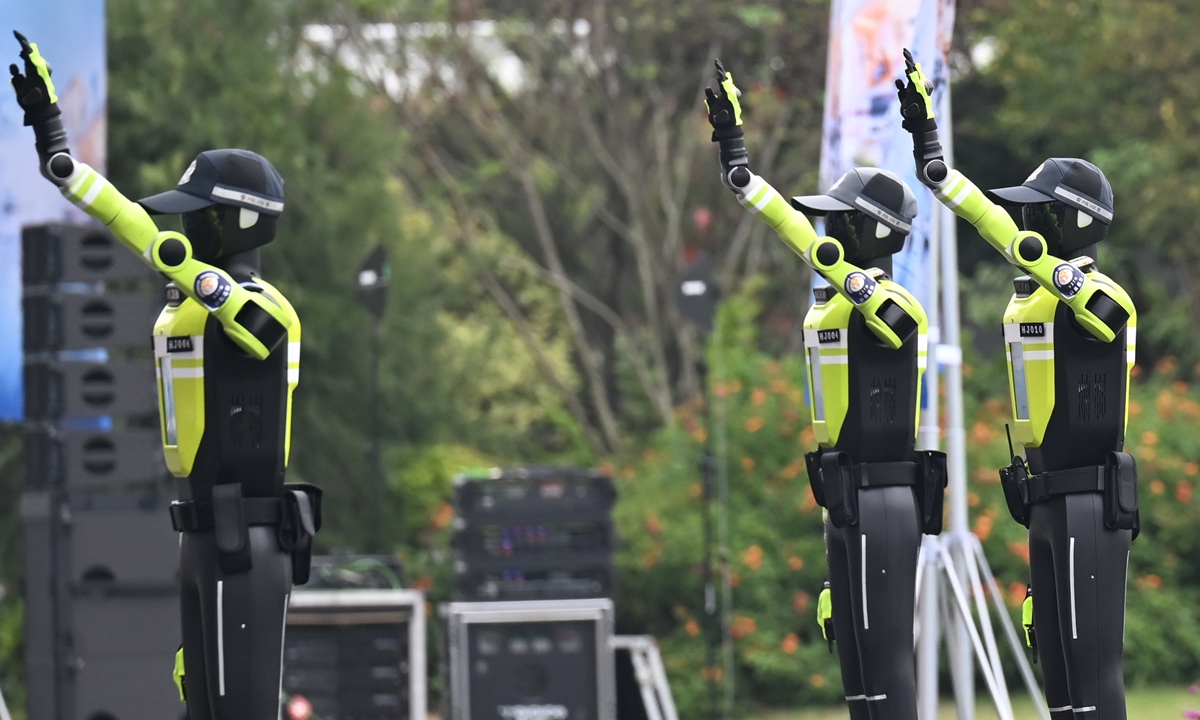
Robots assemble at an intelligent robot application skills exhibition in Hangzhou, East China's Zhejiang Province on September 20, 2026. Photo: VCG
From laboratory showpieces to hands-on tools, a growing wave of high-tech products is moving into real-world applications. A Chinese-made robotic "wolf" that can withstand temperatures of 500 C plunges deep into burning buildings to scout ahead and send back live images. During Category 14 typhoon winds strong enough to send bicycles flying, a Chinese-made robotic dog struggles to adjust its posture, holding steady as it pushes forward against the gale.
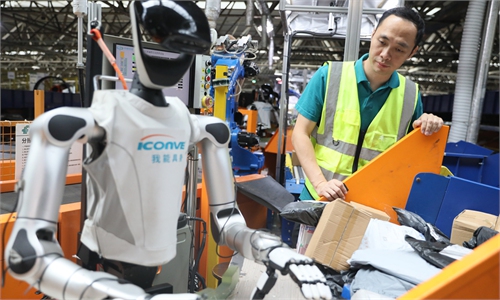
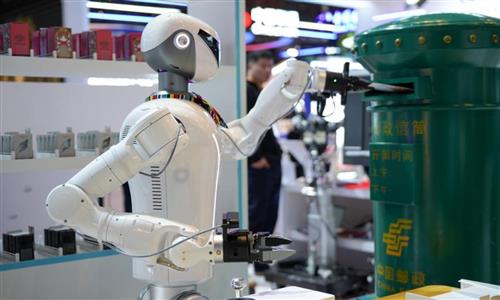
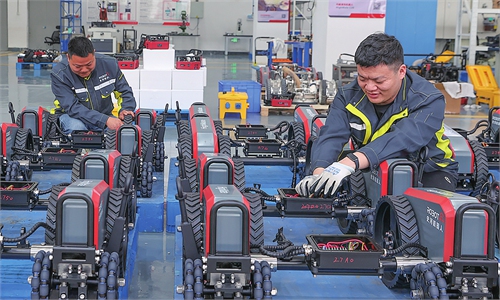
More than 300 robots assembled at an intelligent robot application skills exhibition on Sunday in Hangzhou, East China's Zhejiang Province, ready to be put to the test and sharpen their skills across key scenarios — manufacturing, maintenance and repair, food and retail, medical care and elder services, and emergency rescue — as they demonstrate their real ability to "take up the job" in dangerous and high-stakes situations.
According to CCTV News, the Hangzhou Public Security Bureau brought 60 sets of smart police equipment to the event. These traffic-control robots officially hit the street and reported for duty on May 1 this year. On smooth, even roads, wheeled robots are the stars of the show — efficient, energy-saving, and fast.
In addition to humanoid robots, there are also non-humanoid robots that leverage their unique characteristics to complete tasks in specific scenarios.
Lynx, a wheel-legged hybrid from Hangzhou-based Deep Robotics, is set to demonstrate climbing directly onto the deck of a tractor and then jumping off while the vehicle is still moving at the exhibition, according to the report.
On flat ground, it deploys its wheels for high-speed rolling with low energy consumption, and when it encounters steps or steep slopes, it retracts its wheels and switches to walking on four legs. The product has already patrolled the Jingjiang Embankment and conducted scientific research in Hoh Xil at an altitude of 4,600 meters, the report said.
Spherical robots have no limbs and move by rolling. They are fast and highly impact-resistant, able to squeeze into narrow, confined spaces. They can also be equipped with modules for audio, tools and more, expanding their ability to handle high-risk situations. At the event, police spherical robots will give a live demonstration of their net-gun capture and control skills, said CCTV News.
There are also magnetic wall-climbing robots that cling to the vertical surfaces of box girders, which are dedicated to grinding and cleaning. They are actively deployed on both the newly opened century project of the Pinglu Canal and the Xiamen-Kinmen Bridge currently under construction, according to CCTV News.
"The significance of the exhibition lies in moving robots from flashy demonstration stages back to real-world testing grounds for practical, on-the-job deployment," Chen Jing, vice president and research fellow at the Society for the Study of Technological and Strategic Trends, told the Global Times on Sunday.
Chen said that by using competitions to drive applications and exhibitions to boost production, companies can expose problems and refine reliability in authentic scenarios, noting that this process allows end-users to clearly see the robots' practical value in specific roles and bridges the critical gap from laboratory to production line.
"Chinese robots are distinctly scenario-driven, with deep integration between demand-side users and R&D teams, where real-world tasks drive technological iteration," the expert said, noting that humanoid and specialized robots are transitioning from demonstrations to pilot deployments in inspection, rescue, logistics and other fields, with their ability to deliver in real-world scenarios rapidly strengthening.
In August, China's output of industrial robots jumped 34.6 percent year-on-year. Data released in July by the China Machinery Industry Federation showed that homegrown industrial robots are being used in 253 industry groups, covering more than half of all such groups nationwide.
Chen noted that China's robot applications already rank among the world's leaders, yet measured by the standard of "actually getting the job done," the high-quality training data robots need remains severely insufficient, and embodied intelligence is still in its early stages.
Compared with other countries, China enjoys clear advantages with large-scale and multi-layered application scenarios, a complete range of manufacturing sectors, and a breadth of demand that is hard for others to replicate.
"Overall, China's robot R&D is advancing at a rapid pace, yet to use these robots effectively and sustainably, several tough challenges still need to be overcome," Chen said.
RELATED ARTICLES