Latest China-US observations reveal supernova origin of galactic turbulence in Andromeda: expert
Phooto: Xinhua
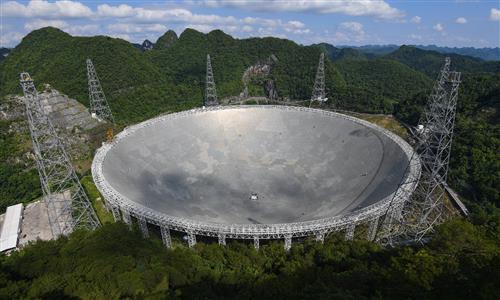
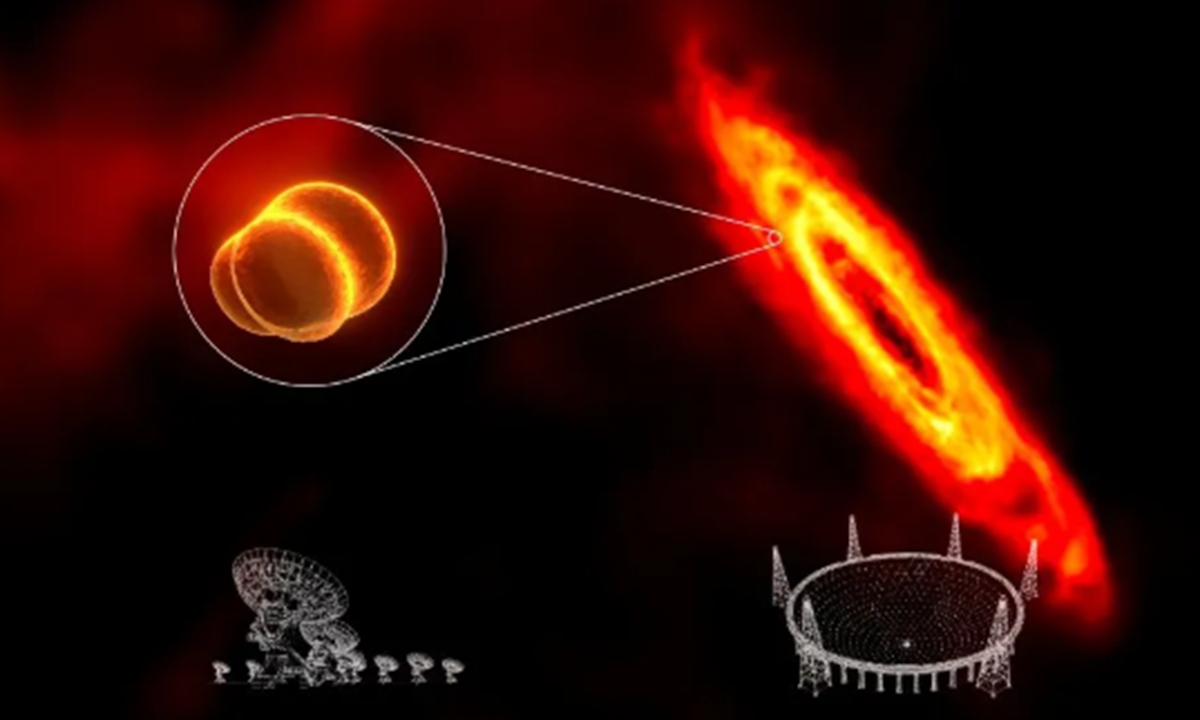
A team of Chinese and US scientists has recently obtained the most detailed gas images yet of the Andromeda Galaxy through joint observations using China's Five-hundred-meter Aperture Spherical Radio Telescope (FAST) and the US Karl G. Jansky Very Large Array (JVLA), identifying 118 superbubbles and providing observational evidence that repeated supernova explosions can drive and sustain galactic turbulence, the motion of gas and dust between stars.The findings were published in Nature Astronomy under the title "Supernova origin of galactic turbulence revealed by superbubbles." Li Di, corresponding author of the article and former chief scientist of FAST, told the Global Times on Saturday that the findings offer a quantitative observational explanation for the long-standing question of where turbulence in galaxies comes from.
"The findings could help scientists better understand how galaxies evolve and take shape," said Li, also head of the Department of Astronomy at Tsinghua University. "The Andromeda Galaxy is about 2.5 million light-years from Earth and is one of the Milky Way's closest galactic neighbors."
"Although we cannot see the Milky Way in its entirety from within it, we can study our neighboring galaxy in detail to better understand our own galactic home and the evolution of Earth," Li said.
According to Li, when a supernova explodes, it releases enormous amounts of energy, pushing gas and dust in the interstellar medium outward and creating expanding superbubbles.
"The 118 superbubbles identified in Andromeda correspond to thousands of supernova explosions over the past 40 million years."
The team then examined the relationship between these superbubbles and galactic turbulence. They found that the average rate at which superbubbles inject kinetic energy is comparable to the rate at which turbulence dissipates energy, with the two also showing consistent trends. This suggests that successive supernova explosions within star clusters are sufficient to sustain galactic turbulence.
"Turbulence is an extremely complex but ubiquitous physical phenomenon," Li said, noting that it affects everything from rivers, lakes and oceans to cars, aircraft and even everyday activities such as walking and running. "On the scale of galaxies, turbulence represents an important component of their energy, but its origins have remained unclear."
According to Li, this study provides a quantitative, observational answer to that question.
"Superbubbles themselves are a prominent signature of stellar feedback. Previous studies have focused more on how such bubbles form, while the new research looks more closely at how they may affect galaxies as a whole," Li said. "In this sense, the bubbles can serve as a tool for studying the evolution of galaxies."
Galaxy evolution is closely linked to the properties of the gas within galaxies, and turbulence is an important part of those properties. The study not only provides evidence for the source of turbulent energy, but also offers a new approach for making more detailed comparisons between the gas properties of galaxies and other measurements of stellar feedback, according to the research team.
Looking ahead, Li said his team plans to expand the work to nearby galaxies and systematically build a broader picture of how superbubbles and supernova explosions influence galaxy evolution.
"FAST, currently one of the world's most sensitive radio telescopes, offers particular advantages for studying hydrogen gas and other important components of cosmic matter," Li said. "The team is also working to combine FAST observations more deeply with artificial intelligence to further explore those capabilities."
The telescope's highly sensitive measurements of diffuse gas on large scales are crucial for reconstructing the dynamical effects of explosions, according to Li.
"The richness and diversity of the universe have never disappointed us as observers. If we simply look deeper, we can see things that humanity has never imagined," Li said.
RELATED ARTICLES