China's grain industry eyes 4.5 trillion yuan output value by 2030, as food security holds firm: official
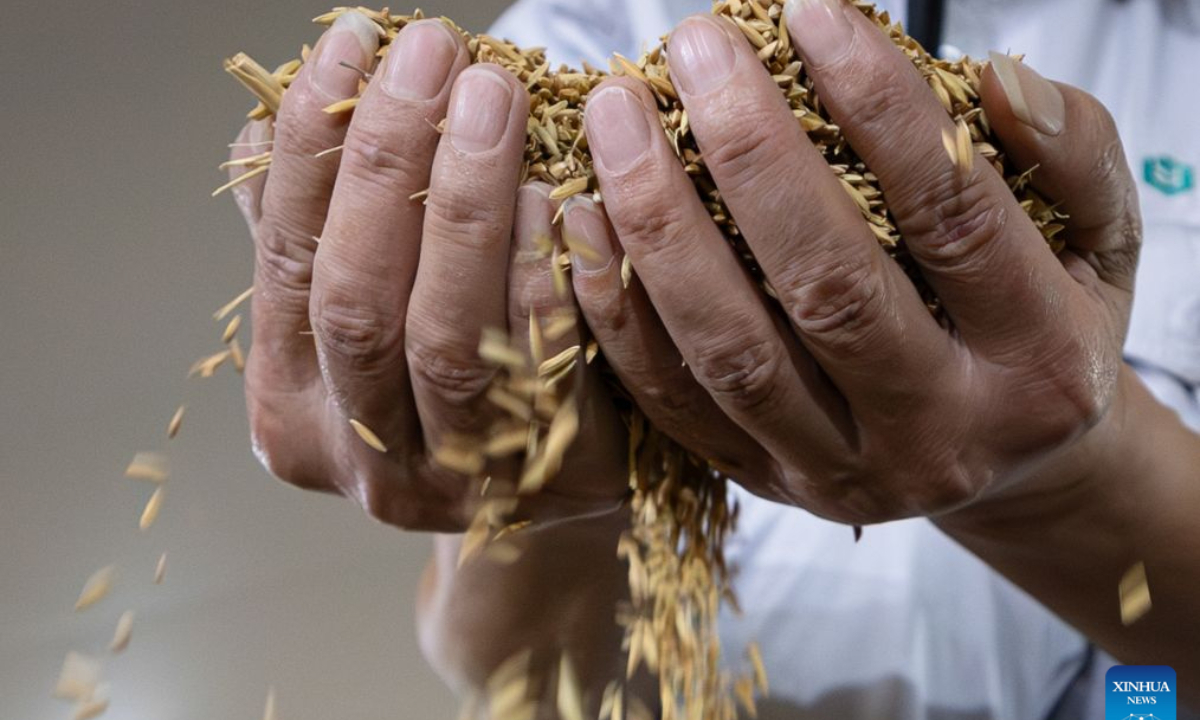
A staff member works at a grain storage facility under Sinograin in Xiantao City, central China's Hubei Province, Sept. 10, 2026. As early autumn sets in, farmers are busy with farm work in Hubei, one of China's leading provinces in terms of agricultural output. (Xinhua/Xiao Yijiu)
China aims to achieve its grain industry's annual output value above 4.5 trillion yuan ($666.8 billion) by 2030 through making use of latest technologies, government officials said on Monday, stressing that the country's food security remains guaranteed despite global market volatility.
The annual industrial output value of China's grain industry is expected to exceed 4.5 trillion yuan during the 15th Five-Year Plan period (2026-2030), an official said.
The grain sector will better meet people's demand for higher-quality, more nutritious and healthier food, said Liu Huanxin, head of the National Food and Strategic Reserves Administration, at a press conference in Beijing.
Support will go to major grain-producing counties to boost their processing capacity and strengthen county-level grain economies, lifting value-added returns for the sector. Efforts will target savings and loss reduction across the entire post-harvest chain, including accelerated adoption of green grain storage technologies. Authorities will also nurture leading enterprises, guide smaller firms toward specialized, high-end development, and build grain brands to steer the industry toward newer, higher-quality growth, Liu said.
Technology is set to play a central role. Efforts will be made to boost sci-tech support, step up breakthroughs in core grain technologies, popularize advanced technical equipment, and nurture grain-sector talent, Liu said.
New equipment such as flexible rice milling machines and AI color sorters has already lifted processing efficiency, while technologies like low-temperature extraction and biomass conversion have turned by-products into valuable resources, pushing the industry toward smart, green development.
During the 15th Five-Year Plan period, China will focus innovation on green grain storage, quality and safety, nutrition and health, processing and modern logistics, building an innovation chain from research to industrial application, officials said.
Responding to a question about rising international grain prices driven by El Niño and global geopolitical conflicts, officials acknowledged that the current international grain market has indeed seen fluctuations of varying degrees, but they stressed that China's grain market has remained generally stable, and China's food security is reliably guaranteed.
Liu listed three factors. On production, China's annual grain output has stayed above 650 million tons since 2015, topped 700 million tons for the first time in 2024, and reached 715 million tons in 2025, with per capita grain availability exceeding 500 kilograms—above the global average.
On reserves, China has built a system combining government and enterprise stockpiles, with the ratio of grain stock to consumption far exceeding the 17-18 percent international warning line, allowing the authorities to release or absorb reserves to stabilize the market, Liu said.
On food processing, 24,000 grain enterprises with an annual output value of over 4 trillion yuan ensure ample supply of flour, rice and edible oil, Liu said.
Global Times
RELATED ARTICLES