China-Laos digital payment connect highlights digital yuan’s rise
Deeper connection
By Published: Sep 21, 2026 08:21 PM

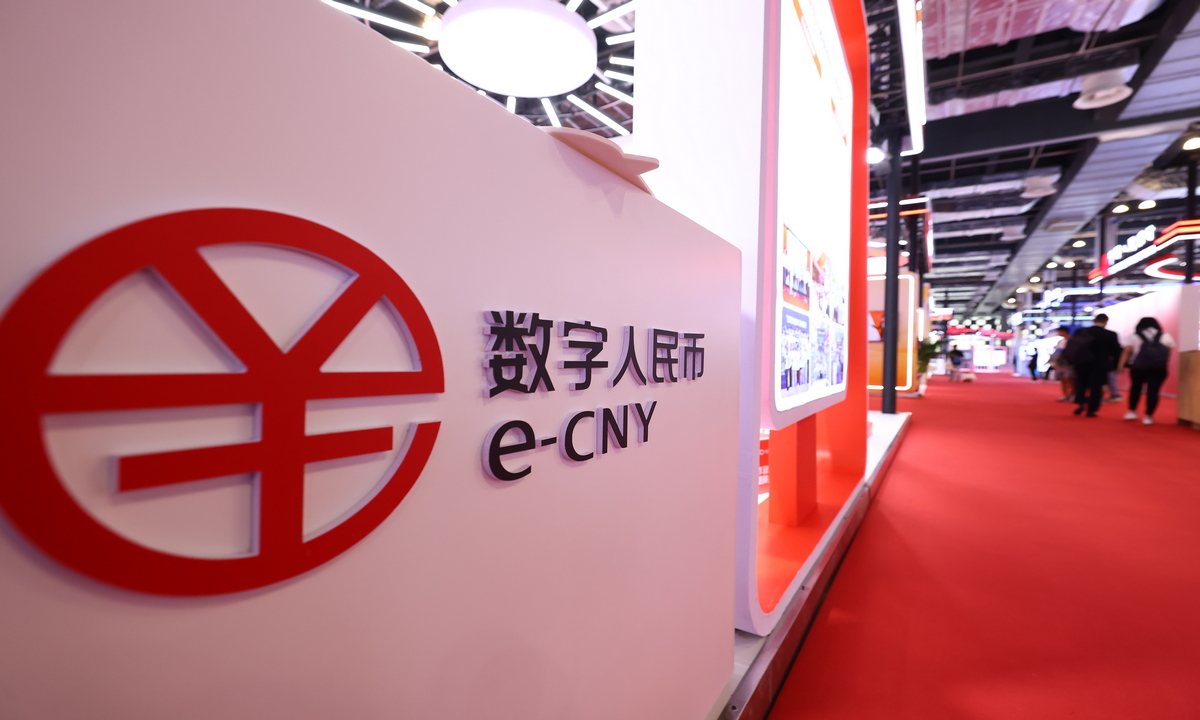
An exhibition area of digital yuan at the 2026 China International Financial Exhibition in Shanghai, on June 18, 2026 Photo: VCG
When it comes to ties between China and Laos, the China-Laos Railway has been the highlight - running since 2021 and carrying 245,000 cross-border trips in the first eight months of 2026 alone. But a deeper, if less visible, connection between the two countries is taking shape.
On Friday, the People's Bank of China (PBC) and the Bank of the Lao PDR jointly launched the China-Laos Cross-Border Digital Payment Connect in Nanning, South China's Guangxi, according to a statement on the PBC's website.
Beyond its significance in ever growing bilateral cooperation, the move also underscored the rapidly expanding and innovative use of the digital yuan, or e-CNY, a legal tender digital currency issued by the PBC, industry experts noted.
Boosting bilateral ties
Under the bilateral program, some Lao banks have already connected to CBETS and activated its new trade-settlement and investment and financing service, which supports round-the-clock digital, smart and convenient closed-loop cross-border payments as well as investment and financing, according to Financial News.
The connection is expected to facilitate two-way trade and economic exchanges.
In terms of payments, the connection allows the digital yuan and local Lao QR payments to enables interoperability, meaning that Chinese residents can pay by scanning QR codes at Lao merchants served by local Lao commercial banks using e-CNY wallets opened with digital-yuan operators. The two countries are also upgrading functions and expanding use cases to make travel and tourism spending between the two countries easier, according to the report.
Such cooperation also injects momentum to a shift already under way: the digital yuan's cross-border use is moving from large-value wholesale settlement toward smaller retail payments, experts noted.
"In the past, most digital yuan transfers through mBridge were used mainly by state-owned and large enterprises. Now they have expanded into specialized and innovative areas such as overseas education payments and logistics payments in free trade zones. This in fact is worth watching as digital yuan moves from something that 'can be used' in cross-border business to something 'that is used' in routine practice," Wang Peng, an associate research fellow at the Beijing Academy of Social Sciences, told the Global Times on Monday.
Cross-border transfers of the digital yuan are currently handled mainly through the multi-CBDC bridge (mBridge), a cross-border platform for experimenting with central bank digital currencies for international trade, and Cross-border e-CNY Transfer Services (CBETS), a cross-border and blockchain infrastructure service platform for e-CNY.
China's central bank began research on digital currency in 2014, and pilot programs were first launched in late 2019. Over the years, the digital yuan has been constantly upgraded with faster cross-border transfers.
In the past, the cross-border payments could take several working days or longer, however now in China, settlement times have been drastically reduced to near-instant - thanks to the wider application of the digital yuan.
Recently, the Shanghai branch of the Industrial and Commercial Bank of China (ICBC) transferred several hundred million yuan in digital yuan on behalf of Ant International to ICBC Asia, based in the Hong Kong Special Administrative Region (HKSAR). The funds arrived within seconds, "far faster than the multi-day clearing cycle of a traditional cross-border payments," according to a statement Ant International sent to the Global Times on Monday.
Ant International told the Global Times that as yuan's internationalization gains momentum, the company hopes to explore more diversified use scenarios, including treasury operations, and work with other financial institutions to accelerate the market-oriented and large-scale development of digital-yuan cross-border payments.
The funds transferred will ultimately be used to support Ant International's settlement services for micro and small merchants in cross-border scenarios.
Constant upgrade
Experts noted that the transfer marks another key step in deepening the cross-border use of China's digital yuan in what some have called its "2.0 version," as the currency evolves from a payment tool used in retail transactions, dining, tourism, education, healthcare, public services into becoming an innovative platform for financial cooperation and cross-border settlement.
Wang said that the shorter transfer time is not merely a matter of speed; it also raises the ceiling on how fast funds can turn over and transaction frequency, therefore opening far greater room for cross-border commerce.
Figures show that by the end of November 2025, mBridge had handled 4,047 cross-border payments totaling 387.2 billion yuan ($55.5 billion), with the digital yuan accounting for about 95.3 percent of the total transaction value across all currencies. Meanwhile, the digital yuan had handled a cumulative 3.48 billion transactions as of November 2025, totaling 16.7 trillion yuan.
This comes amid constant upgrade of the digital yuan. On January 1, the PBC put into effect an action plan, laying out a new framework for the measurement, management, operation and ecosystem development of the digital yuan. The move, some analysts said, marked the digital yuan's official entry into the 2.0 era.
An important feature of the 2.0 version is the accrual of interest based on demand deposit rates. The upgrade makes the digital yuan the world's first interest-bearing central bank digital currency and signals that e-CNY is moving from "digital cash" to "digital deposits" — a generational shift in the form of money, according to media reports.
Dong Ximiao, chief researcher at Merchants Union Consumer Finance Company, drew a clear distinction between the digital yuan, and cryptocurrencies and non-bank payment instruments. Unlike the latter two, the digital yuan has three distinct features: it is legal tender, must be accepted where applicable, and is generally usable, Dong told the Global Times on Monday.
Dong pointed out that the expanding global use of the digital yuan could also help elevate the international standing of the Chinese yuan. There are great prospects for China's central bank to work with peers in ASEAN and Africa, as well as other neighboring countries and regions to increase the use and share of the digital yuan in cross-border payments.
In August, China's central bank announced that it had added eight banks to its list of authorized institutions for digital yuan operations, in a step to promote the steady development of the digital currency. This expansion has brought the number of digital-yuan operating institutions to 30, signaling faster expansion of the digital yuan's application.
RELATED ARTICLES