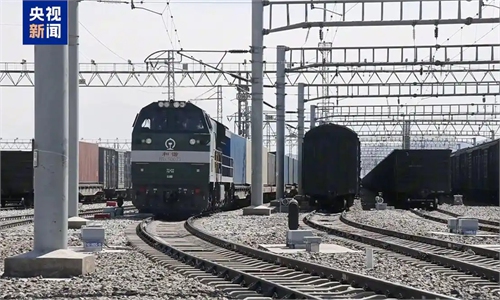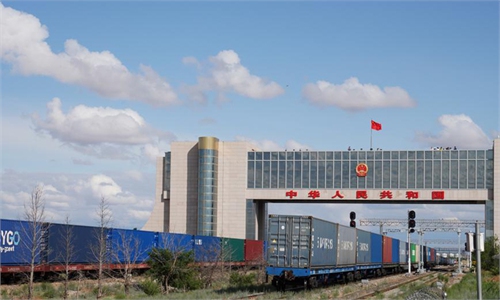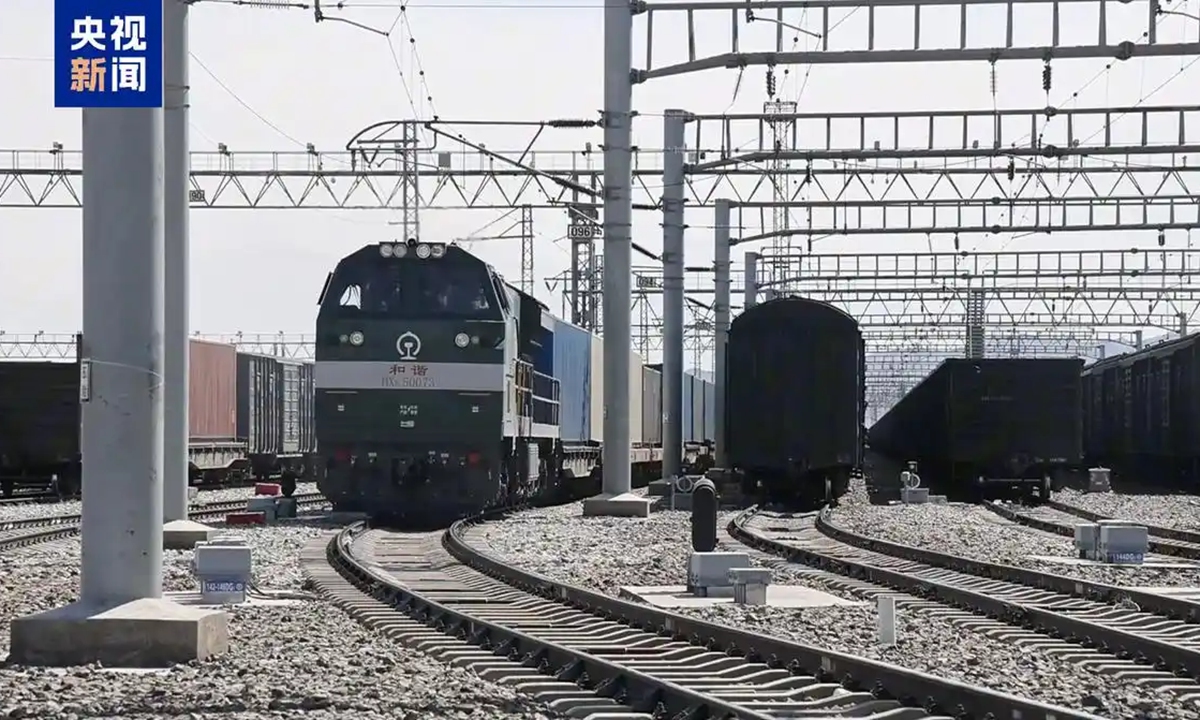
A China-Europe and China-Central Asia freight train Photo: CCTV News
The China-Europe freight train No.1293, fully loaded with auto parts and other goods, departed from the Erenhot railway port bound for Europe on Monday, marking the moment the central corridor of the China-Europe freight trains surpassed 3,500 trips this year.The Erenhot railway port is a major border crossing between China and Mongolia in North China's Inner Mongolia Autonomous Region, and it is also the sole entry and exit point for the central corridor of China-Europe freight trains. As of Sunday, the port had handled 3.32 million tons of import and export cargo via China-Europe trains this year, up 25.11 percent year-on-year and setting a record for the same period, the Xinhua News Agency reported.
As of August 24, the cumulative number of China-Europe freight trains passing through the Erenhot port had exceeded 26,000. The first train ran in 2013, with the cumulative total reaching 1,000 trains in 2018.
The time needed to add another 1,000 trains has shortened dramatically, from five years for the first 1,000 to less than three months at this time, CCTV News reported.
Currently, 76 routes of China-Europe freight trains operate via the Erenhot port, connecting more than 70 hub stations in more than 10 countries, including Germany and Poland. Cargo has shifted from primarily metals, chemicals, and apparel/footwear in the early days to high-value "Made-in-China" products such as new-energy vehicles, electronics, and household appliances. The share of these high-value-added goods has risen from under 10 percent initially to more than 40 percent, according to CCTV News.
Progress at the central corridor is just one example of the rapid development of the China-Europe freight trains, which have become an increasingly important force in stabilizing global trade.
As of June, the loaded-container rate of China-Europe freight trains had remained at 100 percent for 46 consecutive months. The ratio of return to outbound trips stood at nearly 1:1, reflecting an increasingly balanced structure of services, an official of the National Development and Reform Commission (NDRC) said in July.
In addition, cumulative trips of China-Europe freight trains have surpassed 130,000, carrying goods valued at more than $520 billion and serving as an unceasing "steel camel caravan" along the Silk Road Economic Belt, according to the official.
The NDRC official noted that amid a complex and volatile international environment, the China-Europe freight train service has fully leveraged its unique advantages of all-weather operation, large capacity, high efficiency, and low-carbon performance. It has maintained safe and stable operations, providing crucial support for keeping Asia-Europe logistics corridors open and safeguarding the stability of international industrial and supply chains.
Whenever maritime routes between Asia and Europe are disrupted or global supply chains face shocks, the China-Europe freight trains become a key alternative for domestic and foreign enterprises.
The service has also opened new routes, including the Trans-Caspian International Transport Route, pathways into Europe via Turkey, and connections through Russia's Port of St. Petersburg to Germany, offering businesses more diversified and resilient transport options, the NDRC noted.
Global Times
RELATED ARTICLES