ARTS / CULTURE & LEISURE
Chinese equestrian Hua Tian looks beyond the Asian Games
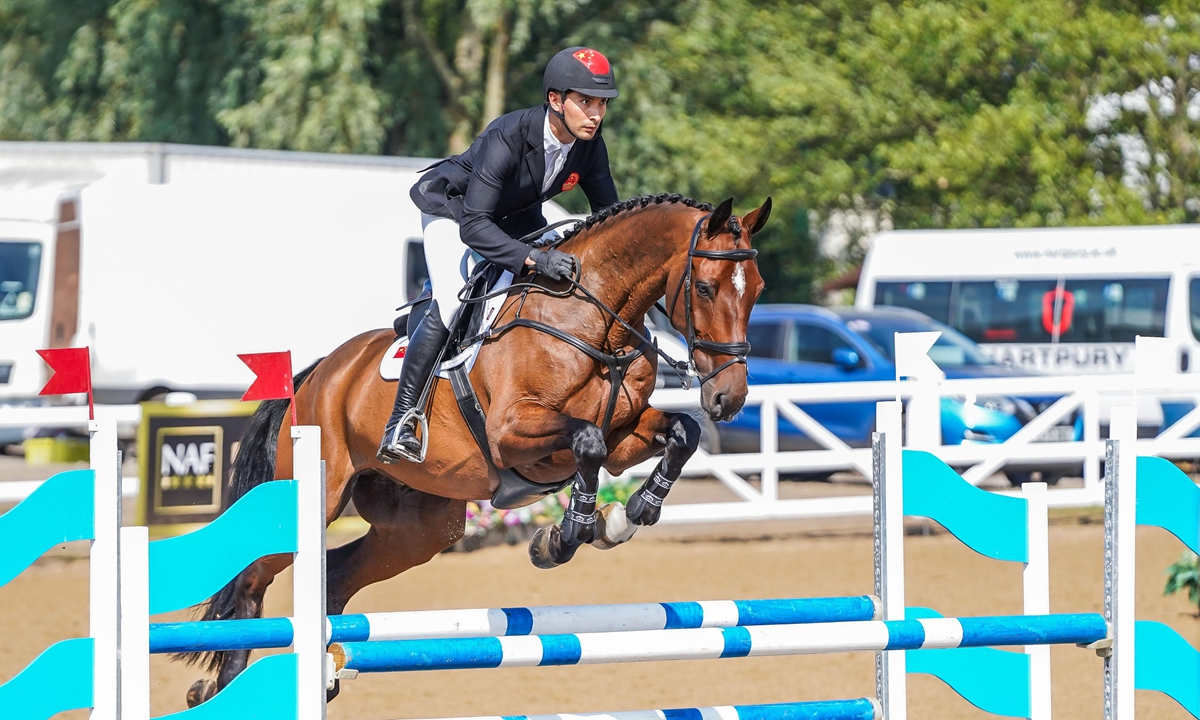
Chinese equestrian Hua Tian competes at the 2026 FEI World Championships in Aachen, Germany. Photo: Courtesy of FEI
Twelve years after making his Asian Games debut, Chinese equestrian Hua Tian is preparing for his fourth appearance at the continental multi-sport event, with more experience and a deeper pool of horses at his disposal.
But despite the changes, Hua does not see himself as fundamentally different from the rider who won an individual bronze medal at the 2014 Asian Games.
"To be honest, there hasn't been a huge amount of fundamental change between me then and me now," Hua told the Global Times in an interview ahead of the eventing competition at the 20th Asian Games Aichi-Nagoya 2026 in Anjo city of Aichi Prefecture, Japan.
What has changed, he said, is everything that has been built around him. Experience with horses remains central to his career, but Hua noted that the people and horses around him are just as important.
"Experience with your horses is really important. But your horse power and your network and the experience and expertise within your team is also really important," he told the Global Times. "All of those things have developed year over year, Olympic cycle over Olympic cycle."
The 36-year-old heads into the Asian Games competition with perhaps the strongest horse pool of his career. The depth has become particularly important as he looks beyond a single competition and toward the four-year Olympic cycle that has long structured his career.
New heights
Hua's recent results suggest that the changes he has made are beginning to pay off.
At the FEI Eventing World Championships in Aachen, Germany, in August, Hua and his horse Chicko finished 12th, marking the best-ever result by a Chinese rider in eventing at the World Championship.
Hua is now ranked 17th in the FEI world eventing rankings. Yet his recent success has not changed his attitude toward the sport.
"Like any sport, confidence is so important," Hua said. "But with horses, you have to have humility. That's the first thing that every writer learns when they fall off as a child. Humility is most important, and humility is always around corner."
Hua will compete with Bodhi at the Asian Games, while Gracie will be his reserve horse.
The Asian Games also present a different challenge from the World Championships. Hua pointed out that the World Championships represent a much higher level of competition, while the Asian Games feature a smaller field but still include strong riders from countries such as Japan, Thailand and India.
"I feel like I've come a long way and gained a lot of confidence, as long as we don't become complacent," he told the Global Times. "As we can hold up composure and do a good job, I am very much hopefully for a medal. exactly which level whose ends up depends on how it ends up on the day."
Deeper horse pool
For Hua, the importance of having a deep horse pool extends well beyond this Asian Games. He said the depth gives him the flexibility to select horses based on the demands of different championships.
"Each competition, each championships has different rain and different horses, suit different types of horses," he said. "So it's really important in all horse sports to have strengthened depth in eventing even more."
Now at 36, Hua's ambition is therefore not simply to find one horse capable of delivering a major result. It is to continue developing a sustainable team around him.
"At the moment, that really has a big influence on my rankings and my results," he said. "I hope it's an ongoing life mission. Every four years around each Olympic cycle, the goal is to continue to develop and produce the strength of horse power to ensure that I have the right horses for the right championships."
He emphasized that, as a horseman, his responsibility is to prepare both himself and the horse as well as possible and then bring their best on competition day. That mindset, he said, also helps protect the partnership between rider and horse from excessive pressure.
"If you're trying to compare yourself too much to everybody else, rather than looking to develop and produce and progress your own riding in your horse's development in your partnership," he said, "the only outcome from that is over pressurizing the horse, over pressurizing yourself and over pressurizing the partnership."
Fast-developing equestrian sports
Hua's perspective extends beyond his own career to the development of equestrian sports in China.
He noted that China's equestrian scene has developed rapidly, particularly in show jumping, with a growing domestic competition circuit and an increasing number of talented young riders.
But he also sees a gap in equestrian culture. Many young Chinese riders come from families without a traditional horse background, creating challenges in developing the knowledge and skills needed for long-term careers.
"If we want to be producing long-term competitive championships riders, we need to be developing our young riders in a slightly different way to the way we are now," Hua said.
He said greater emphasis should be placed on horsemanship, care of the horse and the fundamental qualities needed over a long career.
For Hua, those skills are not limited to technical riding. He warned that the rush to produce the next top Chinese rider could come at the expense of a young athlete's long-term development. "My fear is in the rush to be the next best rider in China, we are actually not serving our young riders well," he said.
Hua said young riders and their families need strong role models and mentors to help them navigate decisions at the early stage of their careers.
For Hua, the road ahead is clear: another Asian Games, followed by another Olympic cycle.
"Last year was the beginning of that, and I'm really happy with the decisions I've made," Hua said.
"I'm really looking forward to not only these Asian games, but the next Olympic cycle. And hopefully the one after that, I've got some great horses at the moment."
RELATED ARTICLES