China Southern Airlines resumes Guangzhou-New Delhi direct route
Frequent flights help lift bilateral economic ties: expert
By and Published: Sep 21, 2026 10:12 PM


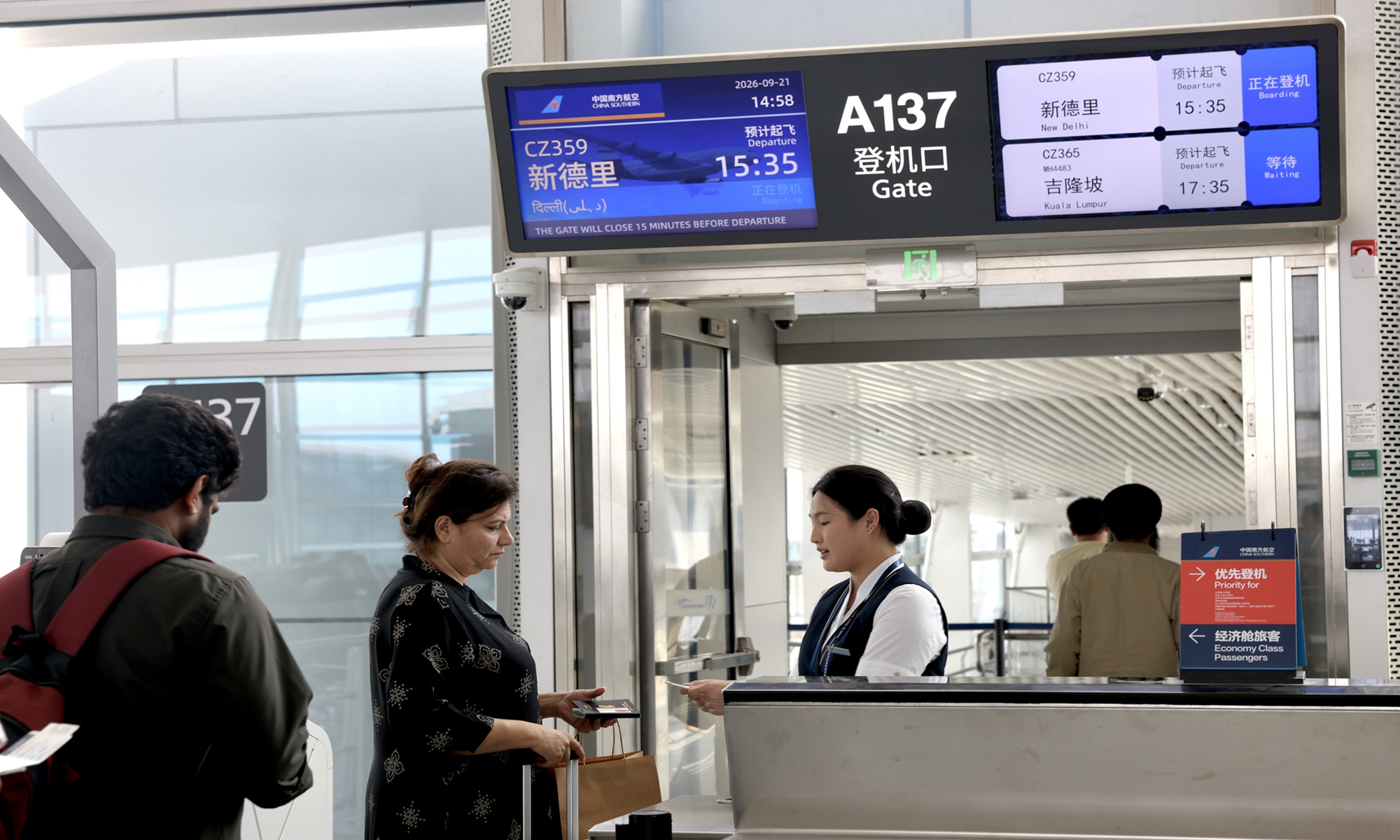
China Southern Airlines flight CZ359 departs Guangzhou Baiyun International Airport for New Delhi on September 21, 2026, marking the carrier's return to India after a six-year suspension. Photo: Courtesy of China Southern Airlines
At 3:46 pm on Monday, China Southern Airlines flight CZ359 departed from Guangzhou Baiyun International Airport bound for Indira Gandhi International Airport in New Delhi, marking the relaunch of China Southern's India service after a six-year suspension.
Following China Eastern Airlines and Air China, it is the third major Chinese airline to have restored flights between the two countries, marking a further expansion of trade and economic ties.
China Southern told the Global Times that the plane carried 133 passengers, with a load factor of nearly 80 percent.
To ensure smooth support for the resumed flights, China Southern, together with its Delhi office, has taken concrete measures to ensure smooth operations across the entire process. This includes agency agreements, operating systems, load planning, transfer services, and special passenger support, the carrier said.
Direct air route resumptions have accompanied the warming of bilateral ties, such as Air China resuming its Beijing-Delhi route on April 21, China Eastern reopening the Kunming-Kolkata link on April 18 and IndiGo launching services connecting Kolkata and Shanghai in March.
Amid improving bilateral relations, business and people-to-people exchanges have also been picking up.
"Business delegations to India have increased noticeably recently," Dong Ruixia, head of World Vision Travels Private Ltd, told the Global Times on Monday.
Dong said that she had just finished leading a delegation of more than 200 people from China to Delhi, Bangalore, and Mumbai in India to attend exhibitions. The group included both large enterprises and many small and medium-sized ones. Most of these delegations were organized by non-governmental bodies, with a focus on business visits and exhibitions.
The increase in business flight routes will also benefit bilateral economic and trade exchanges, Dong added.
Mansoor Nadeem Lari, CEO of the India-based Silk Route Trade and Industry Development Corp, told the Global Times that direct flights to China have made travel comparatively cheaper and more convenient for multi-city connections both in India and China.
We have been engaged with China for the past 15 years. During the suspension of India-China flights, we continued our general business and engagements with China via Hong Kong and ASEAN routes, which also offer good connections between Indian and Chinese cities, Lari said.
The strengthening of people-to-people and cultural exchanges is one of the important signs of the ongoing improvement in China-India relations, Qian Feng, director of the Research Department at Tsinghua University's National Strategy Institute, told the Global Times.
He added that the resumption of China-India routes by major airlines also reflects the gradual recovery of bilateral relations and will further strengthen the foundation of bilateral ties.
The improvement in bilateral relations is not only reflected in cultural and people-to-people exchanges, but also in the growing economic interdependence between the two countries.
China and India are embedded in each other's supply chains and complement each other rather than compete with each other. We will see more supply chain integration between India and China in all manufacturing and services sectors in the years ahead for the benefit of China and India, said Lari.
China has made a lot of technology advancement in all types of manufacturing industries and India can benefit from China's expertise in developing its manufacturing sector. Similarly, India has a relatively large pool of services-oriented human resources and the combination of both can be a win-win for both India and China, said Lari.
On September 12, China's Minister of Commerce Wang Wentao met with Indian Minister of Commerce and Industry Piyush Goyal in New Delhi.
India is an important neighbor of China. China stands ready to work with India to implement the important consensus reached by the leaders of the two countries, expand mutually beneficial cooperation in the economic and trade fields, properly address each other's economic and trade concerns in a balanced manner, and better benefit enterprises and people of both countries, said Wang.
RELATED ARTICLES