China's chip push gains momentum as breakthroughs spread from manufacturing to AI processors
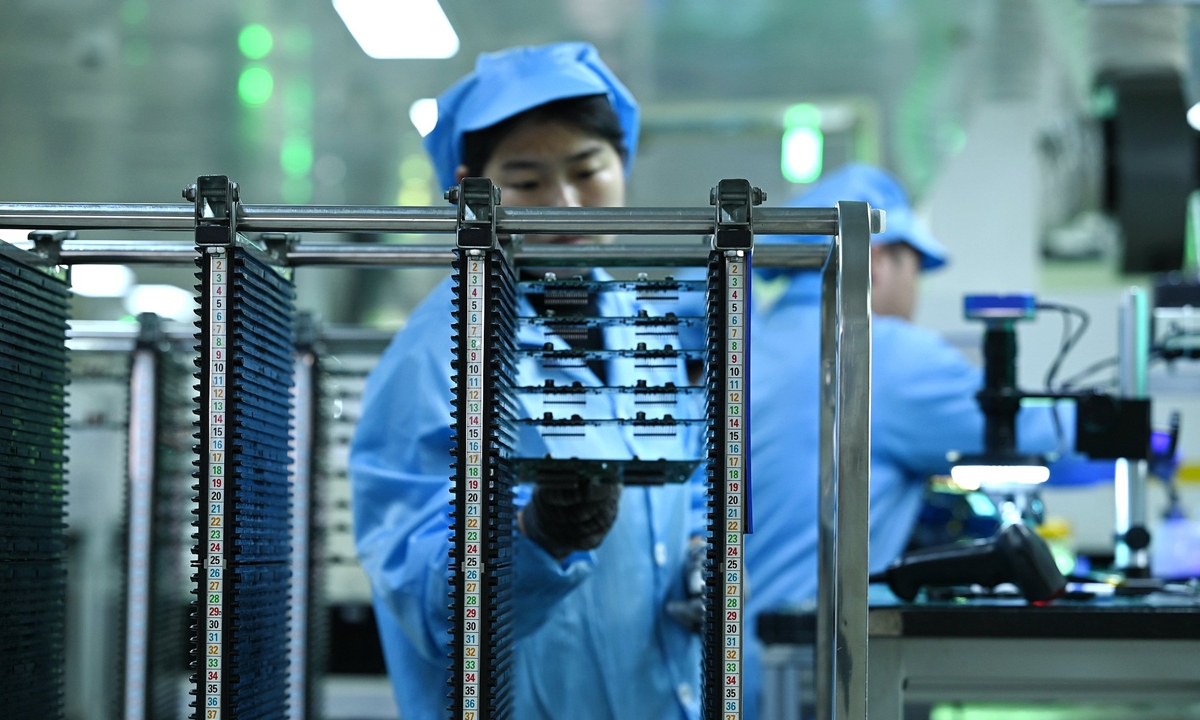
A technician conducts chip quality inspections in a factory in Yiwu, East China's Zhejiang Province, in March 2026. Photo: VCG
From advanced manufacturing to high-performance processors, China's chip industry is breaking new ground on multiple fronts. The advances point to something bigger than a string of individual breakthroughs: a growing capacity to innovate across the semiconductor supply chain.What is driving this shift, and how far can it take China's chip industry amid persistent external restrictions?
The industry momentum was evident at the 7th AI Computing Conference in Beijing on Monday, where next-generation chip architectures, computing-in-memory and 3D chip integration took center stage. The focus reflected a broader push across China's chip industry to unlock greater computing power and efficiency as artificial intelligence (AI) demand surges, analysts said.
The conference came amid advances by Chinese chipmakers across design, manufacturing, equipment and computing architectures, even as US semiconductor restrictions continue to tighten.
On Sunday, Chinese memory-chip maker CXMT announced mass production of its fifth-generation DRAM platform and unveiled two 24-gigabit LPDDR5X chips with higher capacities than their predecessors, another advance in a sector dominated by a handful of global players.
Days earlier, Huawei unveiled an accelerated road map for its Ascend AI processors, with the next-generation Ascend 960DT expected to be ready in the first quarter of 2027, three quarters ahead of its original target. The company also outlined plans for annual chip upgrades through 2029, alongside advances in processor interconnection and computing architecture.
Elsewhere, Chinese GPU developer MetaX said that its C600, built using an entirely domestic manufacturing process, entered mass production in May, while its next-generation C700 series, developed using advanced domestic process technology, remains in the design and development stage.
Semiconductor equipment producer Naura has developed a two-step cyclic etching process to address manufacturing challenges in next-generation 3D DRAM chips. Meanwhile, Huawei's Kirin 9050 Pro and Xiaomi's self-developed XRing O3 processor have brought domestic chip innovation to high-end consumer devices, including foldable smartphones and tablets.
Xiang Ligang, a veteran telecommunications industry expert, told the Global Times on Monday that "China's semiconductor development is not about a breakthrough in one particular field or technology. It is about comprehensive development across the entire industrial chain."
He pointed to progress in equipment, chip design, fabrication, packaging and materials, saying that sustained investment since 2021 had helped China establish capabilities in areas where domestic alternatives were previously limited.
"China's homegrown semiconductor technologies have begun catching up with world-class standards in most areas, and the momentum is unstoppable," Xiang said.
China has made significant progress in high-end chip design, but advanced manufacturing remains a key area where it lags behind global leaders, Liu Gang, chief economist at the Chinese Institute of New Generation AI Development Strategies, told the Global Times.
"Improvements in domestic fabrication over the past two years have also helped companies such as Huawei advance their high-end processors and AI chips, providing stronger manufacturing support for China's chip design capabilities," Liu said.
Since 2018, the US has progressively tightened restrictions on China's semiconductor industry, and expanded its semiconductor controls on China from advanced chips to manufacturing equipment and critical technologies, adding urgency to China's drive to build a more self-reliant chip supply chain.
Liu attributed the industry's progress to a combination of long-term technological accumulation, sustained research investment and policy support, including national research programs, industrial investment funds and local government initiatives.
He cited Huawei's "Tao's Law," which emphasizes innovation in chip architecture as a path to greater computing power, as an example of how years of research and technological accumulation are beginning to yield breakthroughs across multiple areas.
Xiang highlighted China's vast domestic market, infrastructure, talent pool and financial resources as key advantages. "Few countries can match China's combination of strengths, which provides a solid foundation for advances across the semiconductor industry," he said.
China's expanding semiconductor industry is also reflected in trade. Integrated circuit exports reached $216 billion in the first seven months of 2026, up 99.5 percent year-on-year and surpassing the full-year 2025 total of $201.9 billion, according to customs data.
Market research firm Omdia recently sharply raised its 2026 growth forecast for China's semiconductor market, projecting that it will reach $812.08 billion this year, with year-on-year growth of 92.9 percent, according to the Xinhua News Agency.
Domestic chipmakers are also deepening their integration with China's AI industry. GPU developer Moore Threads, for example, has announced adaptations of its computing platform to models developed by DeepSeek, Alibaba's Qwen and Zhipu AI. Such efforts are broadening the applications of homegrown computing hardware as China's AI industry expands.
Despite recent progress, sustaining the momentum will require further advances in both chip architecture and manufacturing technology. Liu identified computing-in-memory and specialized architectures tailored to AI applications as important directions, particularly as demand grows for more efficient computing in areas such as autonomous driving.
"Having an innovative chip architecture alone is not enough if manufacturing capacity cannot keep up," he said, stressing the need for innovation across the industrial chain.
Li Chao, deputy director of the Policy Research Office of the National Development and Reform Commission, said in August that China would step up efforts to achieve decisive breakthroughs in key semiconductor technologies across the supply chain and promote the industry's high-quality development.
RELATED ARTICLES