Chinese team achieves world's first practical underwater solar power generation at 10-meter depth
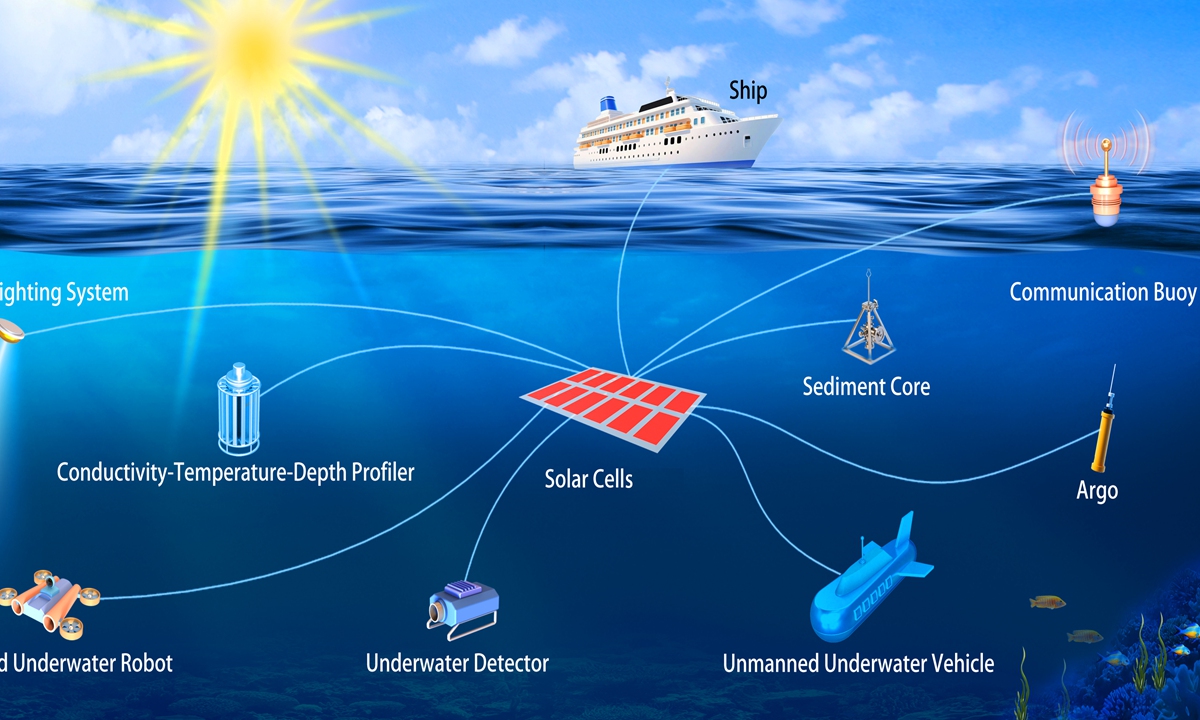
Schematic illustration showing how underwater solar cells could supply clean energy to marine monitoring, communication and exploration equipment. Graphic: Courtesy of Yunnan University
Chinese scientists have achieved the world's first practical demonstration of underwater solar power generation at a depth of 10 meters, successfully testing perovskite photovoltaic (PV) modules in the South China Sea in a breakthrough that could help keep underwater equipment powered for extended periods, the Global Times learned from the research team at Yunnan University on Tuesday.
The breakthrough offers a new source of clean energy for underwater equipment, with potential applications in intelligent marine systems and the development of China's marine economy, according to the research team.
Using wide-bandgap perovskite solar cells designed to harvest sunlight that penetrates seawater, the team successfully tested large-area PV modules in the South China Sea. The modules generated 324 milliwatt-hours of electricity over two hours, demonstrating their ability to charge lithium-ion batteries and power light-emitting diodes, according to research materials provided by the university's College of Materials and Energy.
The achievement, published recently in the international journal Joule, comes as China expands marine exploration, underwater monitoring and marine ranching, driving growing demand for power across underwater monitoring, communication, aquaculture and operational equipment.
Ensuring a reliable, continuous power supply for such equipment remains a major challenge worldwide, particularly in remote waters where replacing batteries or connecting to external power sources is difficult and costly. The successful sea trial offers a potential solution to this longstanding constraint.
The breakthrough addresses a fundamental limitation of conventional solar technology, which is that seawater absorbs sunlight rapidly, particularly red and ultraviolet wavelengths, leaving only a fraction of the original light available at greater depths. Conventional silicon solar cells are poorly suited to the narrower spectrum that remains.
To overcome this challenge, the team, led by Zhang Wenhua, dean of Yunnan University's College of Materials and Energy and a corresponding author of the study, developed wide-bandgap perovskite cells tailored to the underwater light spectrum. Their tunable bandgap allows the cells to capture wavelengths that penetrate seawater, the research team told the Global Times.
In laboratory tests simulating sunlight at a depth of 10 meters, a small-area cell achieved a power conversion efficiency of 34.71 percent. The researchers then tested larger PV modules in actual seawater near Weizhou Island in the South China Sea, demonstrating their ability to generate electricity and charge batteries under real marine conditions.
The results exceeded the team's initial expectations. Zhang said that researchers had anticipated an output of just 50 to 100 milliwatt-hours at 10 meters, rather than the more than 300 milliwatt-hours ultimately recorded.
The successful trial opens up the possibility of extending PV technology beyond satellites in space and power plants on land to the ocean, where it could provide a sustainable source of clean energy for underwater equipment.
Durability is another critical consideration for equipment operating underwater for extended periods. Laboratory tests showed no significant performance degradation after 1,160 hours of continuous operation under simulated underwater illumination at a depth of 10 meters. Accelerated aging tests further predicted approximately 5.49 years, at 25 C under simulated submerged conditions.
The underwater environment itself could help extend the cells' lifespan, as cooler temperatures and reduced ultraviolet exposure may limit some of the degradation experienced by perovskite cells on land, Zhang said.
However, the projected lifespan has yet to be verified through long-term operation in the ocean. Further improvements in encapsulation are needed to ensure reliability in seawater, while the lead contained in the cells raises environmental safety concerns, the research team told the Global Times.
The team is now assessing the cells' power generation capabilities at depths of 20 to 30 meters, where they believe the technology could also perform well, according to Zhang.
The research also reflects China's push to advance next-generation PV technologies as its solar industry expands. As of the end of July, the country's installed solar power capacity had reached 1.286 billion kilowatts, surpassing coal power for the first time, according to the National Energy Administration. Research into emerging technologies, including perovskite solar cells, is also accelerating as China expands its solar manufacturing and deployment.
RELATED ARTICLES