SPORT / MISCELLANY
China sweeps Japan to retain Asian Games women's volleyball title
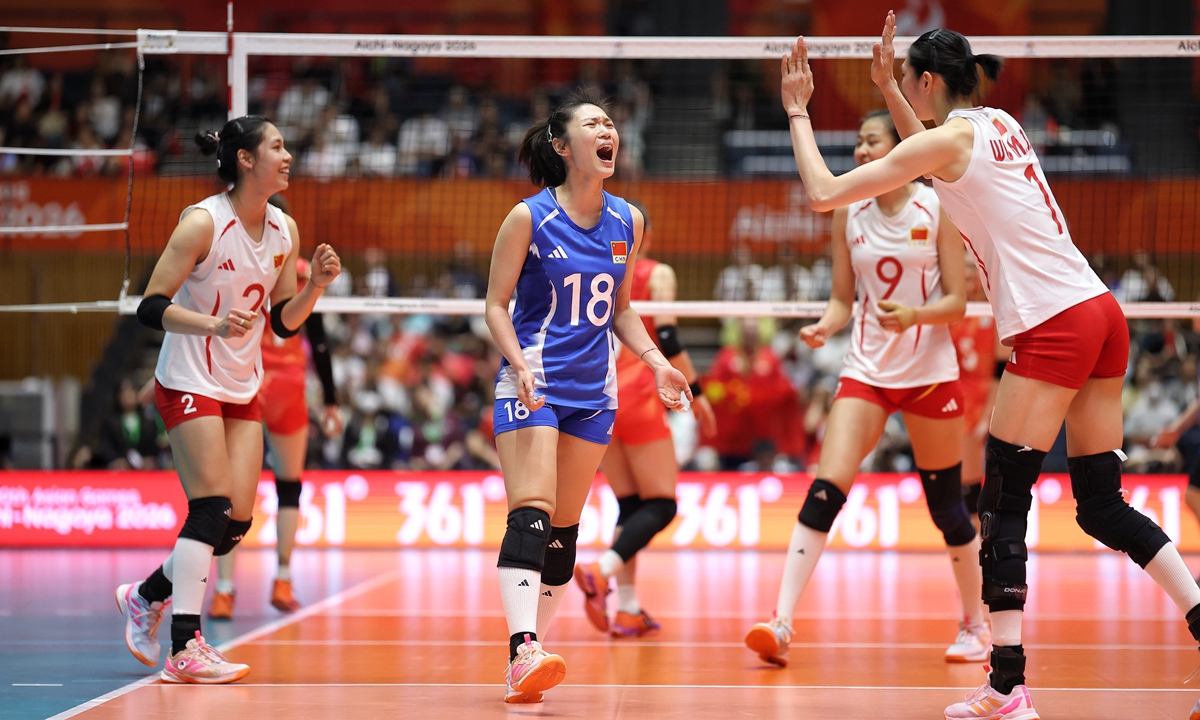
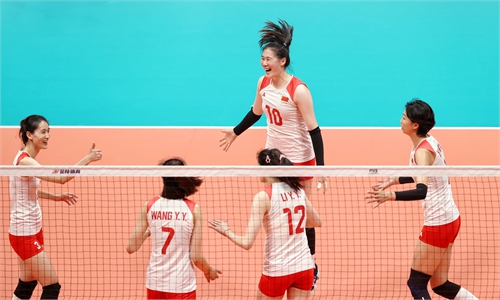
Chinese players celebrate victory after defeating Japan at the final women's volleyball match at the 20th Asian Games in Komaki, Japan, on September 22, 2026. The Chinese team claimed its 10th Asian Games women's volleyball gold medal and its third in a row with a 3-0 victory. Photo: VCG
China swept host Japan 3-0 in the women's volleyball final at the 20th Asian Games on Tuesday, collecting a third consecutive Asian Games title and extending its record to 10 women's volleyball gold medals at the continental multi-sport event.Playing in front of a home crowd at the Park Arena Komaki in Japan, China held its nerve through a closely contested third set to secure the title and cap a tournament in which it had been tested by Thailand in the semifinals.
The victory also gave the Chinese team an important boost after it lost to Thailand in the final of the Asian Women's Volleyball Championship in August, a result that saw China missing out on an early qualification for the Los Angeles 2028 Olympics.
China, who bounced back to defeat the Thai team 3-2 in the Asian Games semifinals, took control against Japan early in the final and maintained its advantage through the opening two sets. Japan fought back in the third, however, putting China under pressure before the defending champions regained their composure and closed out the match.
China's head coach Zhao Yong said the team's desire to win was decisive in the final.
"I think the players' desire to win was stronger throughout the match," Zhao said after the final.
Speaking to media after the match, the Chinese players emphasized the importance of putting the Asian Championship disappointment behind them during the Asian Games. Outside hitter Zhuang Yushan said the team was determined not to allow that defeat to define its campaign.
"We did turn things around," Zhuang said. "The Chinese women's volleyball team's reputation cannot be ruined in our generation. We have to take on that responsibility."
Zhuang also highlighted the team's response when Japan threatened to take control in the third set.
"Being behind had already become a fact, so we could only focus on what was happening at that moment," she said. "When they were serving, I just tried to receive the ball well and create better conditions for my teammates. When we had a chance to counterattack, I just went for it."
The Chinese team had faced another difficult test only a day earlier, when it overcame Thailand in five sets after surrendering a match point in the fourth set. Zhao said the lesson was to remain patient rather than allow fluctuations in a match to affect the team's belief in itself.
"We kept emphasizing to the players that fluctuations during a match are normal," Zhao said. "Japan has its ability and strengths. Being a few points behind is normal. We shouldn't give up easily. So long as we fight for every point, there is still a chance."
Middle blocker Wang Aoqian, who played a prominent role in the starting lineup during the tournament, said the gold medal was particularly important for the relatively young Chinese team.
"This championship win is very important for the current team," Wang said. "It boosts our confidence to aim for a higher level."
Wang said the biggest change she had noticed in herself during the tournament was psychological. Previously, she said, she would sometimes put additional pressure on herself before important matches.
"But starting from this Asian Games, I don't know exactly at which point, I began to feel from my heart that as long as we play our own game, there will be no problems," she said.
The final came after Japan had also entered the match with momentum, having beaten South Korea in straight sets in the semifinals. Japan was seeking its first women's volleyball gold at the Asian Games since 1978, while China was defending the title it won at the Hangzhou Asian Games.
Outside hitter Dong Yuhan said the team had also made a conscious effort to play without excessive pressure.
"From a psychological perspective, we wanted to put down the burden and play boldly," Dong said. "We wanted to take the initiative and challenge them."
That approach ultimately carried China through its toughest moments in Komaki. When Japan mounted its strongest challenge in the third set of the final, China refused to let the match slip away.
Zhuang summed up the mentality that carried the team through the tournament in simple terms.
"The spirit of Chinese women's volleyball is never giving up," she said. "Just like in the third set, as long as we didn't give up, we had a chance."
RELATED ARTICLES